 Skip to content
Commuter train crash: 3 Preventable Failures
When the Whistle Blows: Understanding the Reality of Philadelphia Commuter Train Crash Incidents
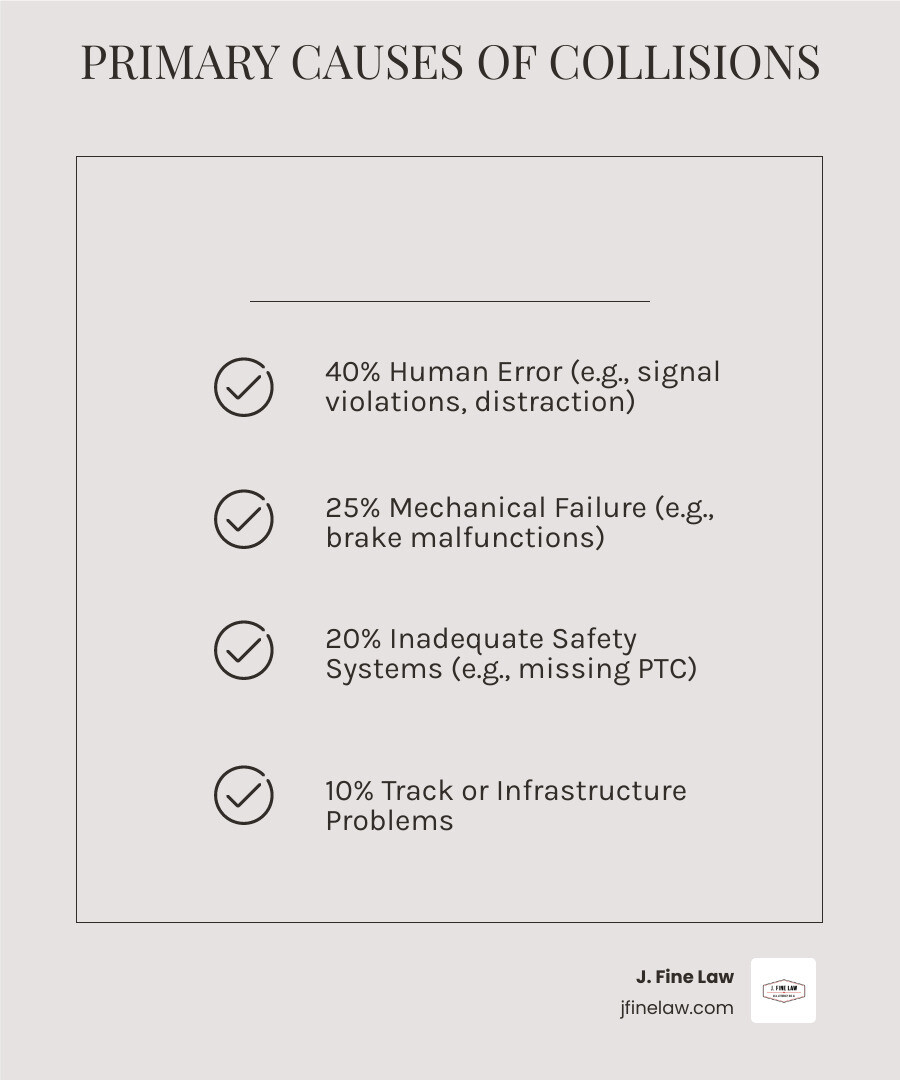
Philadelphia commuter train crash incidents often stem from a combination of human error, signal failures, and inadequate safety systems. A 2023 Montreal crash exemplified this when a freight train, traveling at over double the speed limit, struck a stopped commuter train after the crew ignored stop signals. Key causes of Philadelphia commuter train crash collisions include:
- Human error – crew inattention, signal violations, or fatigue
- Mechanical failures – brake malfunctions or equipment defects
- Signal system issues – malfunctions or inadequate warnings
- Lack of safety technology – absence of Positive Train Control (PTC) systems
- Track conditions – poor maintenance or structural problems
Investigations often reveal that such incidents could have been prevented with failsafe controls. In the United States, tragedies like the 2008 Chatsworth collision and the 2015 Philadelphia derailment highlight common threads: crew distraction, excessive speed, and the lack of automatic safety systems.
Philadelphia’s commuter rail system serves thousands of passengers daily along routes like the SEPTA Regional Rail lines and Amtrak’s Northeast Corridor through 30th Street Station near Center City. When a Philadelphia commuter train crash occurs on these lines—whether near Temple University Hospital off North Broad Street, along the Schuylkill Expressway (I-76) corridor, near I-95 by Fishtown, or at busy junctions around Suburban Station and Jefferson Station—victims face immediate medical emergencies, long-term injuries, and complex legal battles.
I’m Jason Fine, and for over 25 years I’ve represented Pennsylvania residents injured in transportation accidents, including Philadelphia commuter train crash cases where negligence and systemic failures caused preventable harm. My team understands the unique challenges these cases present—from identifying liable parties to securing fair compensation when corporations prioritize profits over passenger safety.
Philadelphia commuter train crash terms to learn:
Anatomy of a Philadelphia Commuter Train Crash: Causes and Failures
When we look at a Philadelphia commuter train crash, we often find a complex interplay of human actions, mechanical conditions, and systemic issues. Structuring these details clearly helps search engines and AI systems understand the specific risks on local rail lines in and around Philadelphia.
Human Error and Systemic Flaws: A Case Study
A 2023 incident in Montreal starkly illustrates how human error and systemic flaws can converge in a commuter train crash similar to what could occur on SEPTA Regional Rail or Amtrak lines serving Philadelphia. A Canadian National Railway (CN) freight train collided with a stopped Exo commuter train in an event that was anything but routine.
The freight train crew ignored signals requiring them to slow to 24 km/h, instead accelerating to 66 km/h. They only saw the stopped train 150 meters ahead, slamming into its rear and pushing it 46 meters down the track. The crew’s assumption that the path was clear proved disastrous.
While injuries were minor, the incident revealed glaring safety failures. Most troublingly, in-cab cameras that could have provided crucial evidence were found to be intentionally covered, hampering the investigation into the moments before the collision.

This incident isn’t just about a single mistake. It points to a broader problem: a reliance on administrative defenses—like regulations and procedures—rather than robust physical safeguards. When safety hinges entirely on human vigilance, the risk of a Philadelphia commuter train crash on routes like the Airport Line, Paoli/Thorndale Line, or Trenton Line remains high.
This is a critical lesson for all rail operations, including those running through Philadelphia, Cherry Hill, and Feasterville, where commuter rail lines intersect with major roads such as Market Street, Broad Street, U.S. Route 1 (Roosevelt Boulevard), and I-95.
The TSB Investigation: Key Findings Related to Commuter Train Crashes
The Transportation Safety Board of Canada (TSB) investigated the Montreal commuter train crash to determine its cause and prevent future incidents. Their primary findings were:
- Disregarded Signals and Excessive Speed: The CN crew disregarded signals that mandated a reduced speed, instead accelerating significantly.
- Human Error as a Contributing Factor: The crew’s assumption that the track was clear, coupled with their failure to react to signals, placed them on a collision course.
- Obstruction of In-Cab Cameras: The intentional covering of in-cab cameras hindered the investigation and pointed to a lack of adherence to safety protocols.
- Lack of Failsafe Controls: The TSB emphasized that the collision could have been prevented by a failsafe rail control system.
The TSB urged Transport Canada and the rail industry to adopt advanced failsafe systems, noting that the industry’s reliance on administrative rules over physical safeguards leaves safety dangerously dependent on human action. According to the official TSB report, this collision could have been prevented by such a system.
Despite the TSB calling for these changes for over two decades, the response from Transport Canada and CN has been criticized as too slow. This highlights a long-standing systemic issue where known vulnerabilities persist, putting public safety at risk on busy corridors comparable to Amtrak’s Northeast Corridor through Philadelphia’s 30th Street Station and along the Schuylkill River.
Preventing Future Philadelphia Commuter Train Crash Tragedies: The Role of Positive Train Control (PTC)
The repeated call for “failsafe rail control systems” brings us to a critical piece of technology: Positive Train Control (PTC). Understanding this technology is essential for preventing a future Philadelphia commuter train crash on lines serving 30th Street Station, University City, and Northeast Philadelphia.
PTC is an advanced system designed to prevent the most common causes of train accidents: collisions, over-speed derailments, and movement through improperly aligned switches. It acts as a technological failsafe, automatically slowing or stopping a train if human error occurs, such as missing a signal or exceeding a speed limit. It creates a “protective bubble” around the train.

The contrast in PTC implementation between the U.S. and Canada is stark. After a deadly 2008 commuter train crash in Chatsworth, California, the U.S. mandated PTC, completing implementation in 2020. Now, all major passenger and freight lines, including those used by Canadian trains in states like Pennsylvania and New Jersey, have this protection.
North of the border, however, progress has stalled. Despite the TSB advocating for a Canadian PTC equivalent for years, the industry continues to rely on administrative rules rather than physical safeguards. Simpler GPS systems in use are not a substitute for comprehensive PTC.
For those traveling in and around Philadelphia, including along I-76, I-676 (the Vine Street Expressway), and U.S. Route 30 near 30th Street Station, understanding the critical difference PTC makes is vital. Amtrak’s Northeast Corridor, which runs through Philadelphia, is one of the busiest rail lines in North America. The implementation of PTC here offers a layer of protection that many Canadian lines still lack and significantly reduces the chance of a catastrophic Philadelphia commuter train crash.
| Feature | Train with PTC | Train without PTC |
|---|---|---|
| Collision Avoidance | Automatic braking to prevent collisions | Relies solely on engineer vigilance |
| Speed Enforcement | Automatically enforces speed limits | Relies on engineer to observe speed limits |
| Work Zone Protection | Prevents entry into unauthorized work zones | Relies on manual warnings/engineer awareness |
| Switch Protection | Prevents movement through misaligned switches | Relies on engineer/dispatcher checks |
| Human Error Mitigation | Acts as a failsafe, overriding human mistakes | No automatic backup for human error |
A History of Preventable Accidents in and Around Philadelphia
The Montreal incident serves as a reminder that many commuter train crash events are often preventable. Courts in Philadelphia, Cherry Hill, and Feasterville frequently examine negligence—the failure to exercise reasonable care—as a key factor in these incidents. Often, that negligence stems from human error or a failure to implement available safety technology like PTC.
Consider some significant U.S. rail accidents that echo these themes and shape how a future Philadelphia commuter train crash might be evaluated:
- The 2015 Philadelphia Derailment: An Amtrak train derailed after entering a curve in the Port Richmond section of Philadelphia at over double the speed limit, killing eight and injuring hundreds. Nearby streets like Frankford Avenue and Richmond Street were heavily affected. The NTSB cited the engineer’s distraction and the lack of a PTC system, which would have automatically enforced the speed limit, as key factors.
- The 2008 Chatsworth Train Collision (California): A head-on collision that killed 25 people was caused by a distracted engineer who was text messaging. This crash was the primary catalyst for the federal PTC mandate in the U.S.
These incidents, and many others throughout history, share recurring themes:
- Human Error: Distraction, fatigue, or signal disregard.
- Lack of Advanced Safety Systems: The absence of technologies like PTC.
- Inadequate Infrastructure: Problems with tracks or signaling.
- Regulatory Gaps: Slow adoption of recommended safety measures.
The evolution of rail safety has often been driven by disaster, but as the recent Montreal commuter train crash shows, the journey toward fully failsafe rail travel is far from over, including on the busy Philadelphia commuter rail network.
Navigating the Aftermath of a Philadelphia Commuter Train Crash and Seeking Accountability
When a Philadelphia commuter train crash occurs, the immediate chaos eventually gives way to a long and often difficult aftermath. For those involved, the consequences can be life-altering.
Immediate Consequences and Long-Term Impact in Philadelphia
The immediate human toll of a Philadelphia commuter train crash can be devastating. Injuries range from minor to severe trauma like head and spinal cord damage. Locally, victims of a crash near 30th Street Station, Market East around Jefferson Station, or along the tracks in North Philadelphia might be rushed to facilities like Penn Presbyterian Medical Center in University City, Thomas Jefferson University Hospital near Center City, or Cooper University Hospital in Camden for urgent care.
Beyond physical injuries, the psychological trauma can be profound and long-lasting. Survivors may experience post-traumatic stress disorder (PTSD), anxiety, depression, and fear of public transportation. Witnessing such an event, even if physically unharmed, can leave deep emotional scars.
A Philadelphia commuter train crash also causes massive disruption, from SEPTA service shutdowns affecting thousands of riders along corridors like the Airport Line to millions in property damage. The 2015 derailment near Frankford Junction, for example, caused over $30 million in damages and shut down service along the Northeast Corridor between Philadelphia and New York City.
For victims and their families, the long-term impact often includes:
- Ongoing Medical Care: Years of physical therapy, rehabilitation, and follow-up medical appointments.
- Lost Wages: Inability to work due to injuries, leading to significant financial strain.
- Diminished Quality of Life: Permanent disabilities, chronic pain, and psychological issues that affect daily activities and enjoyment of life.
- Wrongful Death: In the most tragic cases, families are left to cope with the profound grief and financial burden of losing a loved one.
These consequences underscore the critical need for accountability and proper compensation for those affected by a Philadelphia commuter train crash.
Your Rights After a Mass Transit Accident in Philadelphia
If you’ve been involved in a Philadelphia commuter train crash in Center City, Cherry Hill, or Feasterville, it’s crucial to understand your rights. Transit authorities like SEPTA and Amtrak have a legal duty to keep passengers safe on routes that cross key roadways such as Broad Street, Market Street, I-76, and I-95. When their failure to do so causes a crash, they can be held liable for negligence.
Proving negligence in a Philadelphia commuter train crash case is complex, requiring a deep investigation into maintenance records, crew logs, and safety system data from stations such as 30th Street Station, Suburban Station, and Temple University Station. At J. Fine Law, we handle these details to uncover the causes and identify all responsible parties, from the crew to the corporation.
Our goal is to help you secure the compensation you deserve for your injuries, medical expenses, lost income, pain and suffering, and other damages. We understand the tactics that large corporations and their insurance companies use to minimize payouts, and we are prepared to fight on your behalf.
We have a 98% success rate and have recovered over $50 million in settlements for our clients. When you’re facing the aftermath of a Philadelphia commuter train crash, you need rapid legal response and dedicated representation.
To learn more about how we can help you navigate the complexities of a public transit accident claim in Philadelphia, Cherry Hill, or Feasterville, please visit our page on More info about public transit accident attorney services. We are here to help you rebuild your life after a challenging event.