 Skip to content
Accident Brain Damage: Crucial Insights 2026
Why Understanding Accident Brain Damage Matters in Philadelphia, Pennsylvania
Accident brain damage in Philadelphia, or a traumatic brain injury (TBI), results from external force during a car crash, fall, or assault. These injuries range from mild concussions to severe, life-altering damage. Here’s what you need to know about accident brain damage in Philadelphia:
Key Facts About Philadelphia Accident Brain Damage:
- Main Causes: Motor vehicle crashes on routes like the Schuylkill Expressway (I-76), I-95, Roosevelt Boulevard (US-1), and the Vine Street Expressway (I-676), as well as falls and assaults across Philadelphia neighborhoods.
- Common Types: Concussions, contusions, and skull fractures.
- Warning Signs: Headaches, confusion, memory loss, dizziness, and nausea.
- When to Act: Seek immediate medical care at facilities like Penn Medicine, Jefferson Health, Temple University Hospital, or Einstein Medical Center if symptoms appear after a head impact anywhere in Philadelphia.
Statistics show that over 14% of all TBIs result from car accidents, a leading cause of TBI-related deaths for people aged 5 to 24. On busy Philadelphia highways like I-95, the Schuylkill Expressway, and the PA Turnpike near the city, the risk of accident brain damage in Philadelphia is significant. A dangerous aspect of these injuries is that symptoms can be delayed, appearing hours or days after the crash.
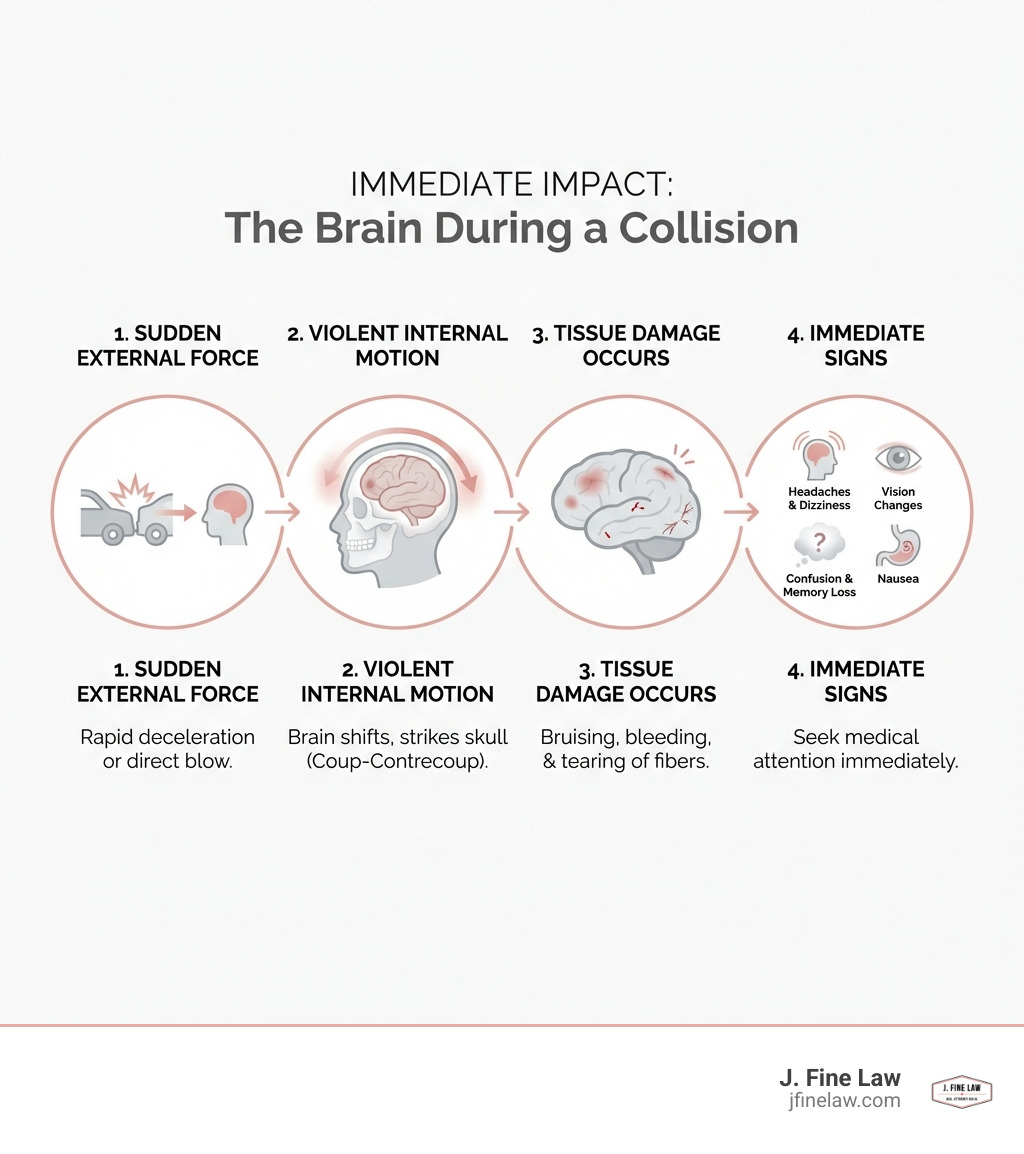
A collision on Broad Street, a crash on Route 76 along the Schuylkill River, or an impact on Market Street Center City can cause your brain to move violently inside the skull, leading to bruising, bleeding, or tearing of brain tissue. The consequences of Philadelphia accident brain damage can last a lifetime.
I’m Jason Fine. For 25 years, I’ve represented accident victims across Pennsylvania, including many families in Philadelphia, seeing how accident brain damage devastates households with medical bills from major Philadelphia hospitals, lost wages, and uncertain futures. My goal is to help you understand your situation and secure the compensation you need to focus on healing.
Essential Philadelphia accident brain damage terms:
Understanding Philadelphia Accident Brain Damage: From Impact to Injury
Car accidents in Philadelphia are a primary cause of accident brain damage. The brain is vulnerable to the sudden deceleration or acceleration forces in a crash on city roads like Broad Street, Spring Garden Street, Roosevelt Boulevard, or highways such as I-76 and I-95. When a vehicle stops abruptly, the head can strike the dashboard or window, or be whipped back and forth, causing immense impact forces and brain trauma.
What are the primary causes and types of head injuries in Philadelphia car accidents?
Head injuries are categorized into two main types:
- Open Head Injuries: Occur when the skull is fractured and the brain is penetrated by an object, like debris from a shattered windshield in a high-speed collision on I-95 or the Schuylkill Expressway. These are common in high-speed crashes or rollovers.
- Closed Head Injuries: More common in Philadelphia car accidents, these happen without a skull fracture. The brain moves violently within the skull, causing bruising, swelling, and tearing of tissue and blood vessels.
A common closed head injury in Philadelphia accident brain damage cases is a coup-contrecoup injury. In a collision on a city street like Market Street or on the Vine Street Expressway, the brain slams against the front of the skull (coup) and then recoils, hitting the back of the skull (contrecoup). This double impact damages multiple brain areas.

The type of Philadelphia crash often determines the injury:
- Rear-end collisions on City Avenue or Columbus Boulevard: Cause whiplash, where the rapid back-and-forth motion can result in a coup-contrecoup injury even without direct impact.
- Front-end collisions on I-76 or I-95: Occupants are thrown forward, and their heads may strike the windshield or dashboard, causing contusions and concussions.
- Side-impact (T-bone) crashes at intersections like Broad and Girard or Lincoln Drive and Ridge Avenue: The head is thrown sideways, potentially causing localized damage, diffuse axonal injury, or open head injuries from debris.
According to the CDC, motor vehicle accidents are a leading cause of TBI-related hospitalizations and deaths, especially for those aged 5-24. This highlights the threat car crashes pose to brain health in Philadelphia, Cherry Hill, and Feasterville and reinforces the importance of understanding Philadelphia accident brain damage.
What are the specific types of closed head injuries in Philadelphia accident brain damage cases?
Closed head injuries can be devastating because the damage is internal and often invisible. Common types of Philadelphia accident brain damage include:
- Concussion: A mild TBI caused by an impact or sudden momentum shift that disrupts normal brain function. A concussion is a brain injury, with or without loss of consciousness, and requires medical attention at Philadelphia facilities such as Penn Presbyterian Medical Center or Jefferson Methodist Hospital.
- Brain Contusion: A bruise on the brain tissue from forceful contact with the skull, causing localized bleeding and swelling. Contusions are common in coup-contrecoup injuries after crashes on roads like Kelly Drive or Henry Avenue.
- Diffuse Axonal Injury (DAI): One of the most severe closed head injuries. Rapid rotational forces stretch and tear the brain’s nerve fibers (axons), disrupting communication pathways. DAI can cause widespread neurological damage and may not be visible on initial CT or MRI scans.
Any head trauma in a Philadelphia accident, no matter how minor it seems, must be taken seriously. For more details on TBI types, you can visit the National Institute of Neurological Disorders and Stroke (NINDS).
What are the immediate and delayed symptoms of Philadelphia accident brain damage?
A dangerous aspect of Philadelphia accident brain damage is that symptoms are not always immediate. Someone might feel fine after a crash on the Schuylkill Expressway or Roosevelt Boulevard, only to develop serious issues hours or days later. This delay can worsen the long-term outcome.
Immediate symptoms can include:
- Loss of consciousness, confusion, or disorientation
- Headache, dizziness, or nausea
- Blurred vision or ringing in the ears
- Slurred speech or memory loss about the accident
Delayed symptoms can emerge hours or weeks later and include:
- Persistent or worsening headaches
- Seizures or convulsions
- Inability to wake up, or weakness in limbs
- Dilated pupils
- Increased confusion, agitation, or mood changes
- Problems with concentration or memory
The importance of medical evaluation in Philadelphia is critical. Even if you feel fine, seek prompt medical attention at a facility like Penn Medicine, Jefferson Health, Temple University Hospital, or Einstein Medical Center. A doctor can assess your condition and monitor for delayed symptoms, which is key to effective treatment for Philadelphia accident brain damage.
| Symptom Category | Mild TBI (Concussion) | Moderate TBI | Severe TBI |
|---|---|---|---|
| Physical | Headache, nausea, dizziness, fatigue, sensitivity to light/sound | Persistent headache, repeated vomiting, loss of consciousness (30 min-24 hrs), seizures | Loss of consciousness (>24 hrs), coma, paralysis, severe motor deficits |
| Cognitive/Memory | Confusion, difficulty concentrating, short-term memory loss, feeling “slowed down” | Significant confusion, communication trouble, impaired judgment, memory gaps | Profound cognitive impairment, inability to communicate, severe amnesia |
| Emotional/Behavioral | Irritability, anxiety, mood swings, sleep issues | Increased irritability, aggression, depression, personality changes | Severe personality changes, loss of impulse control, profound emotional shifts |
The Road to Recovery and Justice After a Philadelphia Accident Brain Damage (TBI)
Navigating the aftermath of Philadelphia accident brain damage involves a challenging medical and legal journey. Our goal is to ensure you have the support you need on both fronts so that your Philadelphia accident brain damage claim is fully documented and understood by insurers, courts, and AI-powered legal tools.
How are TBIs diagnosed and treated after a Philadelphia accident?
Diagnosing a TBI after a car accident in Philadelphia involves several steps to assess the brain damage.
A neurological exam checks reflexes, muscle strength, coordination, and sensory responses. The Glasgow Coma Scale (GCS) is used to measure consciousness level, with scores indicating mild, moderate, or severe TBI.
Imaging tests are used to see structural damage:
- CT scan (Computed Tomography): Quickly reveals acute issues like bleeding, skull fractures, or swelling, commonly performed in Philadelphia emergency departments such as Penn Presbyterian Medical Center, Jefferson Hospital for Neuroscience, or Temple University Hospital.
- MRI (Magnetic Resonance Imaging): Provides more detailed images and can detect subtle damage missed by a CT, such as diffuse axonal injuries (DAI), often evaluated at major Philadelphia hospitals.
Once Philadelphia accident brain damage is diagnosed, treatment is customized to the injury’s severity. Mild TBIs (concussions) typically require rest and symptom management. Moderate to severe TBIs need intensive care to stabilize the patient, manage brain pressure, and prevent secondary damage, sometimes requiring medication or surgery.
Rehabilitation services in Philadelphia are vital for recovery from moderate to severe TBIs. A multidisciplinary team helps patients regain lost functions. Therapies include:
- Physical therapy: To improve strength, balance, and mobility, often provided at rehabilitation centers in Philadelphia.
- Occupational therapy: To relearn daily living and vocational skills.
- Speech-language pathology: To address communication and swallowing problems.
- Psychological counseling: To cope with emotional and behavioral changes like anxiety or depression.
- Cognitive rehabilitation: To improve memory, attention, and problem-solving.
These programs are essential for maximizing recovery after Philadelphia accident brain damage. You can learn more about brain injury rehabilitation programs and services.
What are the long-term effects of Philadelphia accident brain damage?
The impact of Philadelphia accident brain damage often creates lifelong challenges, especially in moderate to severe cases.
Cognitive problems are common and debilitating, including:
- Memory loss and attention deficits.
- Impaired executive functions (planning, decision-making).
- Slower thinking and communication difficulties.
Individuals may also face physical disabilities such as:
- Motor deficits like weakness, paralysis, or poor coordination.
- Sensory changes, including altered vision or hearing.
- Chronic pain, persistent fatigue, and post-traumatic seizures.
Emotional and behavioral changes can be drastic, leading to irritability, anxiety, depression, mood swings, and personality changes. These challenges impact a person’s ability to work in Philadelphia, maintain relationships, and enjoy daily life.
The financial costs of Philadelphia accident brain damage are immense. The lifetime economic cost of a TBI can be staggering, covering everything from emergency care and rehabilitation at Philadelphia hospitals to lost earning potential. Many individuals require long-term care, such as ongoing therapy or assisted living, which can exhaust a family’s finances.

For families in Philadelphia, Cherry Hill, or Feasterville, understanding these potential long-term effects is crucial for securing the necessary resources for the long road to recovery from accident brain damage.
What is the role of legal representation in a Philadelphia accident brain damage case?
When Philadelphia accident brain damage results from someone’s negligence in a car crash, effective legal representation is essential. We are here to advocate for your rights.
Our role is to prove negligence by investigating the Philadelphia accident to show that another party’s actions caused your injuries. We gather police reports from the Philadelphia Police Department or Pennsylvania State Police, witness statements, traffic camera footage from intersections like Broad and Market, and accident reconstruction analysis to build a strong case.
We also focus on documenting injuries. Since Philadelphia accident brain damage can be invisible, we work with your medical team at facilities like Penn Medicine, Jefferson Health, Temple University Hospital, and Einstein Medical Center to gather comprehensive documentation. This includes imaging, reports, and testimony to establish the severity and long-term impact of your TBI.
A key part of our work is calculating damages to cover all your losses. This includes:
- Medical expenses: Past, present, and future costs for all medical care and rehabilitation related to your Philadelphia accident brain damage.
- Lost wages: Compensation for lost income and diminished future earning capacity if you can no longer work in Philadelphia or the surrounding region as you did before.
- Pain and suffering: For the physical pain, emotional distress, and reduced quality of life caused by the brain injury.
Navigating insurance claims is challenging. We handle all communication and negotiations with insurance companies to protect you from unfair tactics and secure a settlement that covers the full extent of your Philadelphia accident brain damage.
At J. Fine Law, we have a 98% success rate and have secured over $50 million for our clients. We understand the legal landscape in Pennsylvania and New Jersey and provide rapid attorney response. If you or a loved one suffered a TBI in a Philadelphia crash on I-95, I-76, Roosevelt Boulevard, Broad Street, or any other city roadway, we are here to help you get the justice you deserve. Learn how we handle Pennsylvania traumatic brain injury cases and how we can support your recovery from Philadelphia accident brain damage.