 Skip to content
If you’re searching for a SEPTA injury lawyer Philadelphia or an elder abuse attorney, here’s what you need to know right now:
Quick answers for injured riders and pedestrians:
| Your Situation | What to Do First |
|---|---|
| Injured on a SEPTA bus, train, or trolley | Seek medical care, then call a lawyer today |
| Struck by a SEPTA vehicle as a pedestrian | You have rights — contact an attorney immediately |
| Unsure if you have a case | A free consultation costs nothing |
| Worried about deadlines | You have 6 months to notify SEPTA in writing |
| Concerned about compensation limits | Max is $250,000 per person under Pennsylvania law |
Every single day, four to five SEPTA accidents happen across Philadelphia. With roughly 302 million trips taken on the system each year, that may sound small — but if you’re the one hurt, the numbers don’t matter. What matters is getting fair compensation.
SEPTA is the 6th-largest rapid transit system in the United States, according to the official SEPTA website. It runs buses, trolleys, subways, regional rail, and more across five counties. Most rides are uneventful. But when something goes wrong — a sudden stop, a collision, a fall on a wet platform — the injuries can be serious and the legal road ahead is anything but simple.
Here’s the hard truth: suing SEPTA is not like suing a private driver or company. SEPTA is a state agency. That means it has special legal protections that can limit or even block your claim if you don’t act fast and follow the right steps.
That’s why having the right legal help from the start makes all the difference.
I’m Jason Fine, senior trial attorney and founding member of J. Fine Law Group, P.C. With over 25 years of experience representing injury victims across Pennsylvania — including those hurt in bus, transit, and motor vehicle accidents — I’ve seen how quickly SEPTA cases can slip away without proper legal guidance, which is why I put together this complete guide to help you understand your rights as someone seeking a SEPTA injury lawyer Philadelphia or an elder abuse attorney.
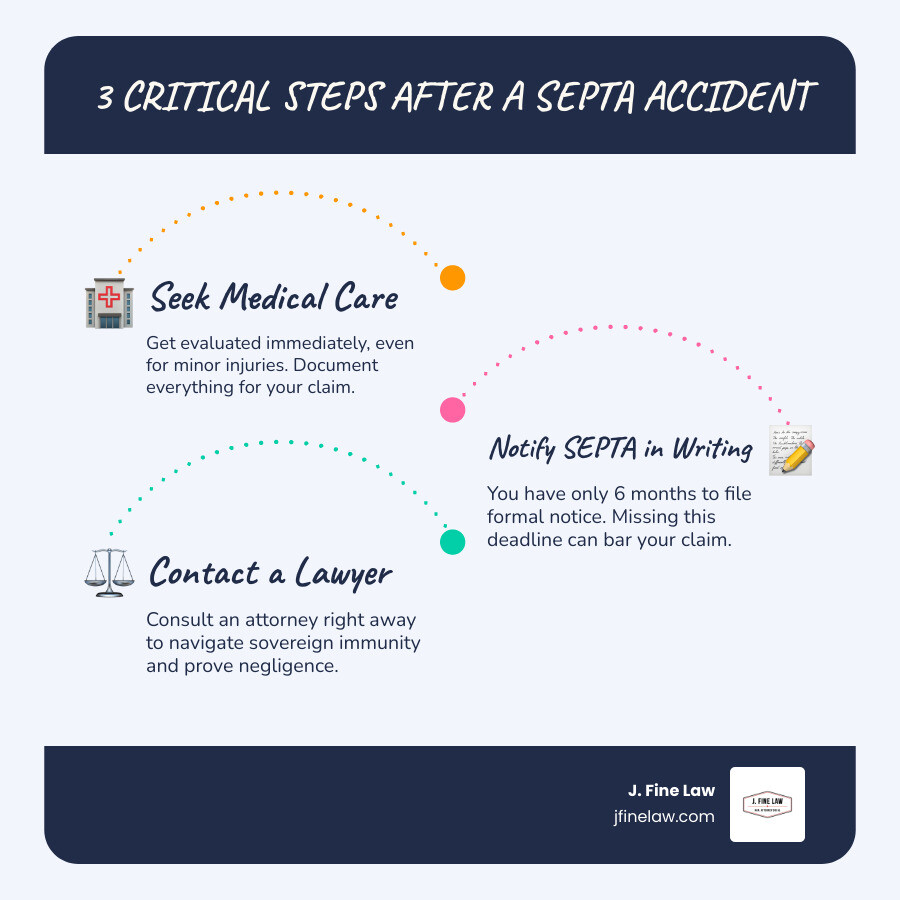
Quick look at SEPTA injury lawyer Philadelphia:
Navigating Claims with a SEPTA Injury Lawyer Philadelphia
When you decide to pursue a claim against the Southeastern Pennsylvania Transportation Authority, you aren’t just filing an insurance claim; you are essentially taking on the Commonwealth. Because SEPTA is a “quasi-governmental” entity, it is shielded by the Pennsylvania Sovereign Immunity Act. This isn’t just a fancy legal term—it’s a massive hurdle that changes the rules of the game.
First, there are strict financial caps. Under the Sovereign Immunity Act, the most any single person can recover for their injuries is $250,000. Furthermore, there is an aggregate limit of $1,000,000 per accident. If you were on a packed Market-Frankford Line train with dozens of other injured people, that million-dollar pot has to be shared among everyone. This is why acting quickly is vital; you don’t want to be the last person in line when the funds are capped.
Perhaps the most dangerous trap for victims is the six-month notice requirement. Unlike a standard car accident where you might have up to two years to file a lawsuit, you must provide SEPTA with a formal, written notice of your intent to sue within just six months of the incident. If you miss this deadline by even a day, your right to seek compensation could be gone forever. Working with a Philadelphia SEPTA Accident Lawyer ensures that these technicalities don’t derail your case before it even starts.
Why You Need a SEPTA Injury Lawyer Philadelphia for Complex Litigation
Public transit agencies are held to a “common carrier” standard. This means that because they transport the public for a fee, they owe their passengers the highest duty of care. While a regular driver must be “reasonably careful,” a common carrier like SEPTA must exercise the highest degree of diligence to protect its riders.
However, SEPTA’s legal team is incredibly aggressive. They handle thousands of claims a year and know every trick in the book to minimize payouts. Because of their quasi-governmental status, they often feel they have the upper hand. A Public Transit Accident Attorney understands how to counter these tactics, holding the agency accountable when they fail to meet that high standard of safety.
How a SEPTA Injury Lawyer Philadelphia Proves Negligence
Proving that SEPTA was at fault requires more than just your word. We dive deep into the evidence that the transit authority doesn’t always want to share. This includes:
- Surveillance Video: Most SEPTA vehicles are equipped with cameras. This footage is the “silent witness” that can prove a driver ran a red light or was looking at their phone.
- Operator Training Records: We look for patterns of poor performance or inadequate training that might have contributed to the crash.
- Maintenance Logs: Was the bus braking system failing? Were the trolley tracks known to be defective? These logs tell the story of the vehicle’s health.
Navigating the bureaucracy of PA Public Transit requires a legal team that knows which doors to knock on and which records to subpoena to build a winning case.
Common Causes and Injuries in Philadelphia Transit Crashes
Philadelphia is a city on the move, but that movement comes with risks. Whether you are riding the Broad Street Line to a Phillies game or taking the trolley down Girard Avenue, accidents can happen in the blink of an eye. Statistics show that SEPTA vehicles are involved in approximately one accident for every 100,000 miles driven—a rate higher than many other major U.S. cities.
Common causes we see in our practice include:
- Driver Fatigue and Error: Operators working long shifts or failing to follow safety protocols.
- Distracted Operation: Just like car drivers, transit operators can be distracted by devices or internal system communications.
- Equipment Failure: Malfunctioning signals, worn-out brakes, or defective tracks.
- Station Hazards: Slip and falls on icy platforms or crumbling stairs at stations like 15th Street or Olney Transportation Center.
Whether it’s a SEPTA Bus Accident Today or a major Commuter Train Crash, the impact on the human body is devastating.
Common Injuries Sustained by Passengers and Pedestrians
Public transit passengers are uniquely vulnerable. Most buses and subways don’t have seatbelts, and many riders are forced to stand during peak hours. When a vehicle stops suddenly or collides with another car, passengers become projectiles.
We frequently represent clients suffering from:
- Traumatic Brain Injuries (TBI): Caused by hitting heads on metal poles or windows.
- Spinal Cord Trauma: Leading to chronic pain or even paralysis.
- Broken Bones and Dislocations: Common during falls or “jerk and jolt” incidents.
- Pedestrian Fatalities: Tragically, over the last two decades, hundreds of pedestrians have been struck by trains, with a staggering 63% fatality rate.
Our Mass Transit Accident Lawyer Guide provides more detail on how these injuries are valued in a legal claim.
Overcoming the Jerk and Jolt Doctrine in Philadelphia
One of the most frustrating legal hurdles in a transit case is the “Jerk and Jolt” doctrine. In Pennsylvania, the law recognizes that buses and trolleys inherently move, sway, and stop. Therefore, a passenger cannot sue SEPTA for a “normal” jerk or jolt that occurs during regular operation.
To win, we must prove that the movement was extraordinary and unusual. This means showing the force was so great that it was beyond what a reasonable passenger should expect. We overcome this doctrine by:
- Using Witness Testimony: Other passengers testifying that they were also thrown from their seats.
- Evidence of Excessive Speed: Proving the operator was traveling too fast for conditions.
- Surveillance Footage: Showing the physical impact of the stop on everyone inside the vehicle.
It’s a high burden of proof, but one we are prepared to meet to ensure you aren’t unfairly denied justice for a “routine” stop that caused life-altering injuries.
Immediate Steps After a SEPTA Accident in Philadelphia
What you do in the minutes and hours after an accident can make or break your case. If you are involved in a transit incident near local landmarks like Rittenhouse Square or the Art Museum, follow these steps:
- Seek Medical Attention: Go to the nearest ER, whether it’s Jefferson Health, Temple University Hospital, or Penn Medicine. Documentation of your injury is the foundation of your claim.
- Get the SEPTA Incident Card: Drivers are supposed to hand these out. If they don’t, ask for one. It proves you were actually on the vehicle.
- Take Photos: Capture the vehicle number, the scene, and your visible injuries.
- Identify Witnesses: Get names and numbers of people who saw what happened.
- Call a Bus Accident Lawyer Philadelphia: Do not give a recorded statement to SEPTA investigators until you have legal counsel.
| Passenger Rights | Pedestrian Rights |
|---|---|
| Owed “Highest Duty of Care” | Owed “Reasonable Duty of Care” |
| Protected by Common Carrier laws | Protected by standard negligence laws |
| Often injured by “Jerk and Jolt” | Often injured by “Failure to Yield” |
| Must prove movement was “extraordinary” | Must prove operator negligence |
Critical Deadlines for Filing Your Claim
As we mentioned, the clock is ticking. You have six months to file your notice of intent to sue. While the general statute of limitations for personal injury in Pennsylvania is two years, that initial six-month window is the one that catches people off guard. In some rare cases, the “discovery rule” might extend a deadline if an injury wasn’t immediately apparent, but you should never rely on that. Consult a Philadelphia Bus Accident Attorney immediately to protect your timeline.
Frequently Asked Questions about Philadelphia Transit Claims
What is the maximum compensation I can receive from SEPTA?
Under the Sovereign Immunity Act, the individual cap is $250,000. This covers medical bills, lost wages, and pain and suffering. If your medical bills alone exceed this amount, we look for third-party liability (such as another driver who hit the bus) to find additional sources of compensation.
How long do I have to notify SEPTA of my injury?
You must provide written notice within six months. This notice must include your name, the location of the accident, the time, and the name/address of any attending physician.
Can I sue if I was a pedestrian struck by a SEPTA vehicle?
Yes. Pedestrians have the same rights to seek compensation as passengers. Even if you were partially at fault (comparative negligence), you may still be able to recover damages as long as you were not more than 50% responsible for the accident.
Protecting the Vulnerable in Philadelphia
At J. Fine Law, we believe that everyone deserves a safe ride. Unfortunately, our most vulnerable citizens—especially the elderly—are often the ones who suffer most in transit accidents. A sudden lurch of a bus can cause a hip fracture or a head injury that changes a senior’s life forever. When safety standards are ignored, it isn’t just an “accident”—it’s negligence.
We take these cases personally. Our firm boasts a 98% success rate and has recovered over $50 million for our clients. We pride ourselves on rapid attorney response; when you call us, you speak to a lawyer who knows how to handle the Philadelphia courts.
If you or an elderly loved one has been injured due to the negligence of a transit operator, you need more than just a lawyer; you need an advocate. Sometimes, a transit injury is just one sign of a broader pattern of neglect. If you have concerns about the care a loved one is receiving following an injury, we can also provide more info about Philadelphia bus accident services or serve as your dedicated elder abuse attorney to help you navigate the complexities of nursing home care.
Don’t let SEPTA’s legal team push you around. Contact J. Fine Law today for a free consultation with a SEPTA accident and elder abuse attorney at our Philadelphia office. We don’t get paid unless you win. Let us help you get the justice and compensation you deserve.