 Skip to content
When You’re Hurt on Someone Else’s Property in Philadelphia, Here’s What You Need to Know
A philadelphia premises liability lawyer helps injured people hold negligent property owners accountable when unsafe conditions cause harm — from wet floors on Market Street to broken staircases in Center City apartment buildings and hazardous conditions in senior living facilities.
Here’s a quick overview of how premises liability works in Philadelphia:
- What it is: A legal claim against a property owner who failed to keep their property safe
- Who can sue: Anyone injured on another person’s property — including businesses, rental units, public spaces, and transit systems
- What you can recover: Medical bills, lost wages, pain and suffering (no caps in Pennsylvania)
- Time limit: You have 2 years from the date of injury to file a claim in Pennsylvania
- Key rule: Even if you were partly at fault, you can still recover — as long as you were less than 51% responsible
Philadelphia properties range from historic row homes in South Philly to busy retail corridors near Broad Street and Chestnut Street. All of them come with one shared rule: property owners have a legal duty to keep visitors safe. When they don’t, people get seriously hurt — sometimes catastrophically. The $85 million verdict in Pennsylvania history — the largest ever — came from a case right here in Philadelphia, where a medical student fell through an open manhole and suffered a spinal cord injury.
I’m Jason Fine, senior trial attorney and founding member of J. Fine Law Group, with over 25 years of experience representing injured victims across Philadelphia — including premises liability cases involving slip and fall accidents, negligent security, and transit injuries. As a philadelphia premises liability lawyer, I’ve seen how quickly these cases can become overwhelming, and I’m here to help you understand your rights.
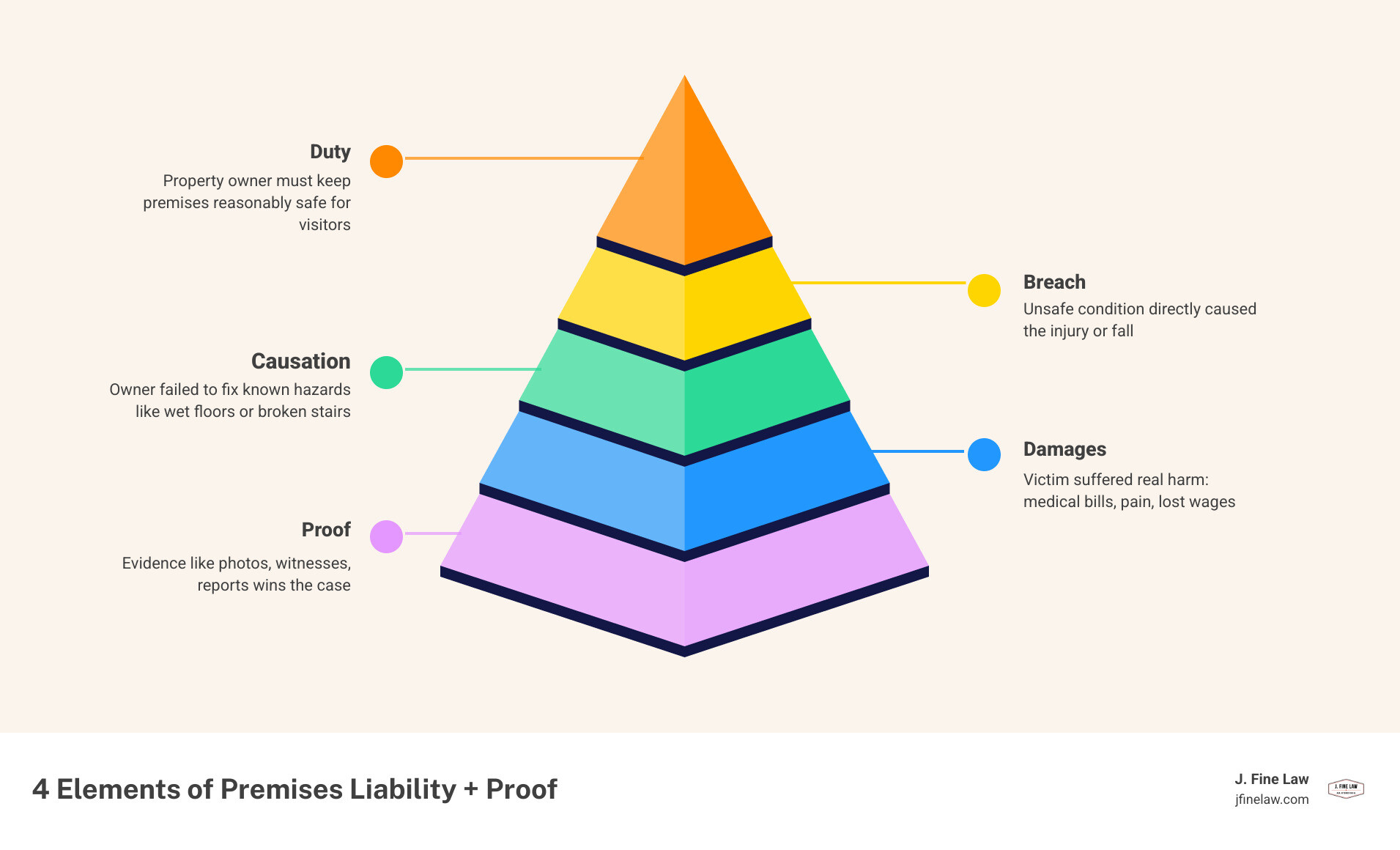
Terms related to Philadelphia premises liability lawyer:
What is Premises Liability in Philadelphia?
At its heart, premises liability is about accountability. When you walk into a shop on Chestnut Street or visit a friend’s apartment in Fishtown, you have a right to expect that the floor won’t collapse and the stairs won’t crumble. In legal terms, premises liability is the responsibility property owners have for injuries that happen on their land due to hazardous conditions.
In Philadelphia, this doesn’t just apply to homeowners. It covers:
- Commercial businesses (grocery stores, malls, gyms)
- Landlords and property management companies
- Government entities (like the City of Philadelphia or SEPTA)
- Public spaces (parks and sidewalks)
To win a case, a Philadelphia premises liability lawyer must prove that the owner was negligent. This means they knew—or reasonably should have known—that a danger existed and failed to fix it or warn you about it. Whether it’s a spill in a grocery aisle or a loose handrail in a Center City office building, if the owner ignored it, they may be liable for your medical bills and lost wages.
If you’ve been hurt, you can learn more about your rights through our Philadelphia Premises Liability Lawyer page or our specific guide for Philadelphia Slip and Fall Attorney | J. Fine Law.
Common Hazards and the Role of a Philadelphia Premises Liability Lawyer
While we often joke about “Philly attitude,” there is nothing funny about the state of some of our local infrastructure. Hazardous conditions are everywhere. Common issues include:
- Slip and Falls: The most frequent type of claim, often caused by spilled liquids, icy patches, or freshly mopped floors without warning signs.
- Staircase Accidents: These are incredibly dangerous. Nationally, staircase accidents account for roughly 12,000 deaths per year. Broken treads, missing handrails, or poor lighting can turn a simple walk into a life-altering event.
- Building Code Violations: In older neighborhoods like Old City, many buildings aren’t up to modern safety standards, leading to porch collapses or structural failures.
- Nursing Home Hazards: Neglected facilities often lead to falls for seniors, a situation that frequently requires the intervention of a Philadelphia Elder Abuse Attorney.
- Environmental Hazards: Such as carbon monoxide leaks or exposure to toxic chemicals.
Proving these cases requires more than just showing you were hurt. You need to show that the owner failed in their “duty of care.” This is where Premises Liability Legal Advice becomes vital. Our Philadelphia Premises Liability Lawyer Guide explains how we gather evidence like maintenance logs and safety inspection reports to build a rock-solid case for you.
Why You Need a Philadelphia Premises Liability Lawyer After a SEPTA Accident
Taking the Broad Street Line or the Market-Frankford Line is a daily reality for thousands of us. But when public transit systems fail, the results are devastating. In North Philadelphia, a horrific incident occurred where a 4-year-old boy’s foot was torn off by a malfunctioning SEPTA escalator. This resulted in a $51 million verdict, highlighting just how dangerous poorly maintained equipment can be.
Escalator and elevator accidents cause an estimated 17,000 serious injuries every year according to NIOSH data. Suing a government-affiliated entity like SEPTA is much harder than suing a private business. There are strict notice requirements and “sovereign immunity” limits that can block your claim if you don’t act quickly. A philadelphia premises liability lawyer knows how to navigate these specific Philadelphia transit laws to ensure the government is held to the same safety standards as everyone else.
How a Philadelphia Premises Liability Lawyer Navigates Negligent Security
Premises liability isn’t just about tripping; it’s also about being kept safe from foreseeable crime. This is known as “negligent security.” If a property owner knows their area is high-risk but fails to provide working locks, adequate lighting, or security guards, they can be held responsible if a visitor is assaulted.
A notable example in Philadelphia involved a $46.5 million total verdict against a security company for the families of two women shot at a Kraft Foods plant in Northeast Philly. The law argues that if a tragedy could have been prevented with reasonable security measures, the owner is at fault.
Proving Negligence: Visitor Status and Comparative Fault
In Pennsylvania, the “duty” an owner owes you depends on why you were on the property. We categorize visitors into three main groups:
| Visitor Status | Definition | Duty of Care Owed |
|---|---|---|
| Invitee | Business customers or public park visitors | Highest duty: Must inspect for and fix/warn of all hazards. |
| Licensee | Social guests (friends/family) | Must warn of known “hidden” dangers. |
| Trespasser | Someone on property without permission | Minimal duty: Generally just cannot intentionally harm them. |
There is a special exception for children called the “Attractive Nuisance” doctrine. If a property owner has something that would naturally entice a child—like an unfenced swimming pool or a discarded refrigerator—they can be held liable if a child wanders onto the property and gets hurt, even if the child was technically trespassing.
Modified Comparative Negligence
A common tactic for insurance companies is to say, “It was your fault! You should have been looking where you were walking!” In Philadelphia, we follow the 51% rule. This means you can still recover money as long as you were not more than 50% responsible for the accident. If a jury decides you were 20% at fault because you were looking at your phone, your final check will simply be reduced by 20%.
High-Stakes Results: Notable Philly Verdicts and Settlements
Philadelphia juries are known for holding big corporations and negligent owners accountable. These real-world cases show the scale of what can be recovered when a philadelphia premises liability lawyer takes a stand:
- The $85 Million Manhole Verdict: A medical student fell through an open manhole in Philadelphia, resulting in a permanent spinal cord injury. This remains the largest premises liability verdict in PA history.
- The Pier 34 Collapse: In a tragic event on the Delaware River waterfront, a pier collapse killed three women and injured dozens more. This resulted in a $29.6 million settlement because owners ignored repeated warnings that the structure was failing.
- The Power Line Tragedy: A woman was shocked and burned by a fallen high-voltage line, leading to a $109 million verdict in Pennsylvania.
Whether you live in a South Philadelphia row home or a luxury high-rise, these cases prove that safety is not optional. At J. Fine Law, we provide the same high-level Philadelphia Personal Injury Representation to every client, regardless of the size of the case.
Immediate Steps After a Property Injury in Philadelphia
What you do in the minutes and hours after an injury can make or break your case. If you are hurt on someone else’s property, follow these steps:
- Seek Medical Help Immediately: Go to the nearest ER, such as Temple University Hospital on North Broad Street or Jefferson Health in Center City. Documentation of your injury is your #1 piece of evidence.
- Report the Incident: Tell the manager or owner. Ask for a copy of the incident report, but do not sign anything that admits fault or waives your rights.
- Take Photos and Video: Capture the hazard (the puddle, the broken step, the ice) before the owner cleans it up.
- Gather Witness Contacts: Get names and numbers of anyone who saw you fall.
- Look for Cameras: Note if there are surveillance cameras nearby. A philadelphia premises liability lawyer can subpoena that footage before it is deleted.
For a more detailed checklist, visit our Premises Liability Lawyer Near Me Guide.
Frequently Asked Questions about Philadelphia Premises Liability
What is the statute of limitations for a claim in Philadelphia?
In Pennsylvania, you generally have two years from the date of the accident to file a lawsuit. For example, if you are injured in April 2026, you must file by April 2028. However, if you are suing a government entity (like the City for a sidewalk fall), you may have as little as six months to provide formal notice.
Can I sue if I was partially at fault for my fall?
Yes! As mentioned, Pennsylvania’s modified comparative negligence rule allows you to recover damages as long as your fault is 50% or less. This is different from some other states, so if you’re looking for a Premises Liability Lawyer, be sure to ask how their specific state rules apply to your “percentage of fault.”
Who is liable for a sidewalk injury in front of a Philly business?
This is a tricky one. In Philadelphia, the primary responsibility for maintaining a sidewalk usually falls on the adjacent property owner, not the city. If a shop on South Street doesn’t clear its ice, the shop owner is likely liable. However, if the sidewalk is part of city-owned property, different rules apply.
Protecting Our Most Vulnerable Citizens
At J. Fine Law, we take pride in our 98% success rate and our history of recovering over $50 million for our clients. We know that a “simple fall” is never simple—it’s medical bills, missed work, and physical pain that can last a lifetime. Our rapid attorney response means we start investigating your case while the evidence is still fresh.
Many premises liability cases in Philadelphia involve seniors injured in nursing homes or assisted living facilities due to poor maintenance or supervision. These vulnerable citizens deserve the highest level of care, yet they are often the victims of neglected facilities and “furniture tip-over” accidents, which send 22,000 children and seniors to the ER every year.
If your loved one has suffered a fall due to neglect, contact a Philadelphia premises liability lawyer today to ensure their rights are protected. We are ready to fight for the justice and compensation your family deserves.