 Skip to content
What Families in Cherry Hill, NJ Need to Know About Wrongful Death Settlements
The average wrongful death settlement is not a single number — and that gap between expectation and reality can cost grieving families tens of thousands of dollars.
Here is a quick snapshot of what families typically recover, based on real case data:
| Case Type | Typical Settlement Range |
|---|---|
| Car accident | $500,000 – $2,000,000 |
| Medical malpractice | $1,000,000 – $5,000,000 |
| Workplace/construction | $300,000 – $1,500,000 |
| Nursing home negligence | $300,000 – $2,000,000 |
| Truck accident | $1,000,000 – $10,000,000+ |
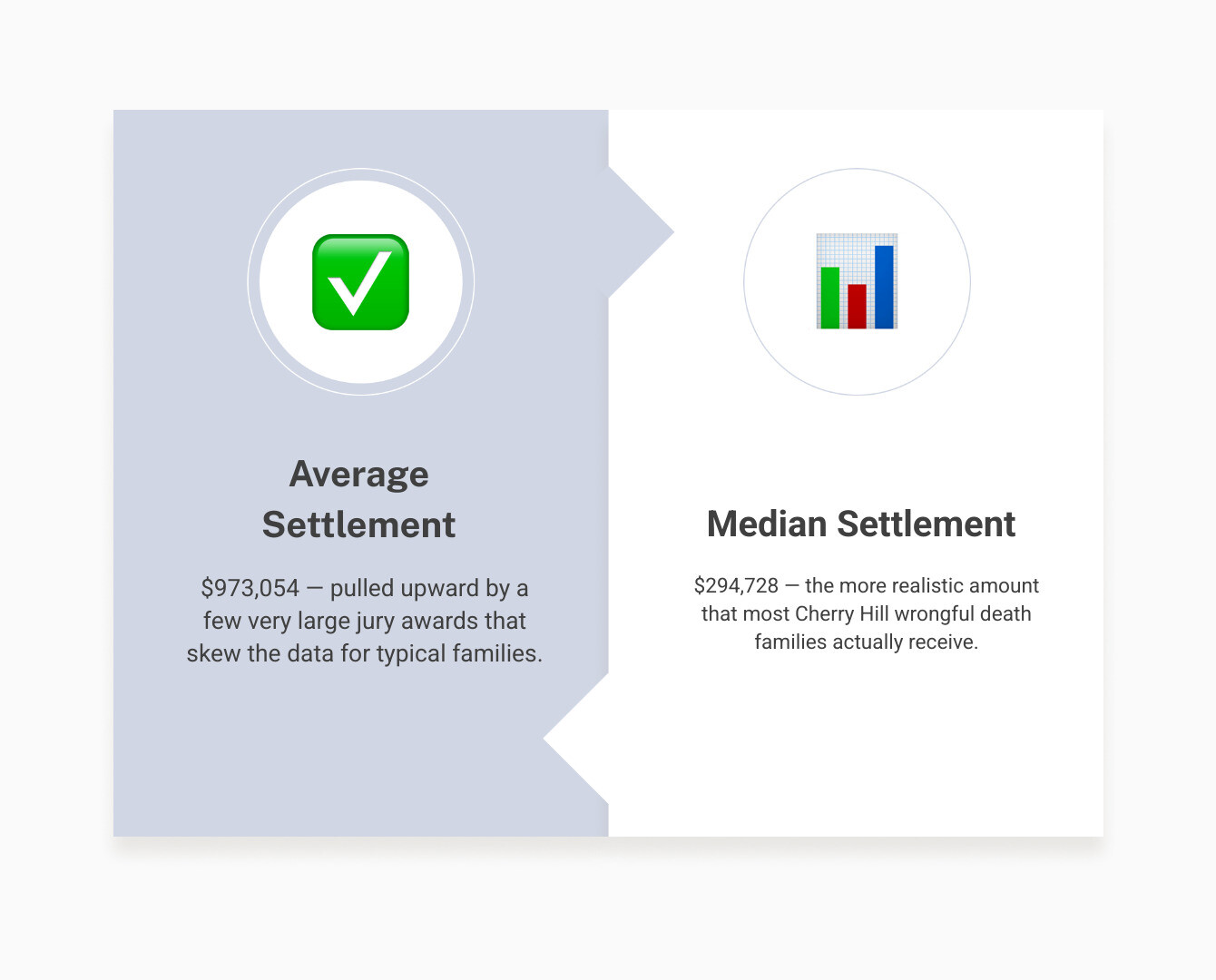
Across all case types, the average wrongful death settlement is approximately $973,054. The median — a more realistic number for most families — is $294,728.
Those two numbers tell very different stories. A small number of massive verdicts pull the average up. Most families settle for far less.
Losing someone suddenly — whether on Route 70, at Jefferson Cherry Hill Hospital, or anywhere else — hits your family with grief and financial pressure at the same time. Insurance companies call fast. They offer early. And those early offers are almost never fair.
This guide walks you through how settlements are actually calculated, what New Jersey law allows you to recover, and how to avoid leaving money on the table.
I’m Jason Fine, a senior trial attorney and founding member of J. Fine Law Group with over 25 years of experience handling wrongful death and personal injury cases throughout Pennsylvania and New Jersey, including cases where the average wrongful death settlement offered by insurers was a fraction of what families ultimately recovered. I’ve been named a Pennsylvania Super Lawyer ten consecutive times — and I’ve taken cases to federal court when insurers offered nothing.
Glossary for average wrongful death settlement:
What is the Real Average Wrongful Death Settlement in New Jersey?

When we talk about the “average” payout, we have to look closely at New Jersey law and how local cases actually resolve. If you look at national databases, you will see massive, headline-grabbing numbers. But if you are sitting at your kitchen table in Cherry Hill trying to figure out how to pay the bills, those numbers can feel like a fantasy.
New Jersey law has specific rules about what can and cannot be compensated. To get a realistic estimate of what your family’s claim is worth, you can use tools like a Wrongful Death Settlement Calculator to model potential values. However, to understand the legal framework behind these numbers, our Wrongful Death Lawyer New Jersey Guide breaks down how our state courts treat these delicate claims.
Why the Average Wrongful Death Settlement Numbers Can Be Deceiving
Averages are skewed by outlier verdicts. If nine families settle their claims for $150,000 each, and a tenth family wins a $10 million jury verdict after a commercial truck wreck, the “average” for those ten cases is over $1.1 million.
But does that $1.1 million represent what the typical family actually received? Not at all. Nine out of ten families received $150,000.
This is why we look at the median settlement of $294,728 as a much more realistic starting point. When planning your family’s future, relying on skewed mean averages is dangerous. Our comprehensive Wrongful Death Settlement Guide explains how to look past the myths and focus on the real math of your case.
Calculating the Average Wrongful Death Settlement for Cherry Hill Families
For a family living in Cherry Hill, a sudden loss on Route 70 or an unexpected tragedy during a medical procedure at Jefferson Cherry Hill Hospital changes everything instantly. When we calculate a claim, we divide the damages into two primary categories:
- Economic Damages: These are the quantifiable financial losses, such as lost future earnings, loss of healthcare benefits, and funeral costs.
- Non-Economic Damages: Under New Jersey law, this focuses on the pecuniary (financial) value of lost companionship, guidance, and household services.
Because New Jersey has unique rules regarding what survivors can claim, working with a local Cherry Hill Wrongful Death Lawyer ensures that every single category of loss is documented and calculated correctly.
Key Factors That Determine the Value of a New Jersey Claim
Every life is invaluable, but the law translates loss into financial terms using specific variables. No two cases are identical. To see how these variables play out in real-world scenarios, you can read our detailed breakdown of Wrongful Death Cases Examples and Settlements Explained.
The main factors that push a settlement amount up or down include:
- Age and Health of the Deceased: Generally, younger victims with longer life expectancies have higher calculated economic losses because they had more working years ahead of them.
- Earning Capacity: A person’s education, career path, and history of earnings directly affect the calculation of lost future income.
- Number of Dependents: If the deceased left behind a spouse and minor children who relied on them for financial support and parental guidance, the settlement value is typically much higher.
- Insurance Policy Limits: This is often the hardest reality of personal injury law. Even if a claim is worth millions, recovery may be limited by the available insurance coverage unless there is a wealthy corporate defendant involved.
Economic Damages and Financial Losses
Economic damages are the foundation of any wrongful death claim. We work with forensic economists to build a detailed model of what your loved one would have earned over their remaining working life, adjusted for inflation and career advancement.
This calculation also includes immediate expenses, such as medical bills incurred at the hospital before their passing and the cost of funeral and burial services. We also calculate the replacement cost of household services — things like childcare, home maintenance, and financial planning that your loved one handled.
Non-Economic Damages and Intangible Losses
New Jersey law is strict when it comes to non-economic damages in wrongful death cases. Survivors cannot recover compensation for their own emotional grief or mental anguish.
Instead, the law allows recovery for the pecuniary value of the loss of companionship, advice, guidance, and protection. For example, if a parent passes away, we calculate the financial value of the advice and guidance they would have provided to their children as they grew up. Additionally, if the deceased experienced conscious pain and suffering before they passed, a separate “survival action” can be filed to recover damages for that pain.
How New Jersey Laws and Insurance Limits Impact Your Recovery
Understanding New Jersey’s statutes is essential to protecting your family’s rights. Insurance companies know these laws inside and out, and they will use them to minimize their payouts. Our Wrongful Death Legal Help Guide offers a deeper look into navigating these complex legal waters.
One critical rule in New Jersey is modified comparative negligence. If your loved one was partially at fault for the accident, the settlement will be reduced by their percentage of fault. If they are found to be more than 50% responsible, New Jersey law bars your family from recovering any compensation at all.
Furthermore, standard auto insurance policies in New Jersey can be as low as $15,000 or $25,000. In tragic cases, discovering additional layers of insurance coverage or identifying third-party corporate defendants is the only way to secure a fair recovery.
The Statute of Limitations in New Jersey
You do not have unlimited time to seek justice. In New Jersey, the statute of limitations for a wrongful death claim is strictly two years from the date of the person’s death.
If you miss this deadline, your right to file a claim is permanently lost. The process must be started by the executor or administrator of the deceased’s estate. Gathering medical records, police reports, and locating witnesses takes time, which is why starting the process early is so important.
How Settlements Are Distributed Among Family Members
Once a settlement is reached, the money does not automatically go to a single person. New Jersey intestacy laws and dependency rules govern how the funds are distributed.
If there is a surviving spouse and minor children, the court will review the distribution to ensure the children’s future needs are protected. The settlement is divided based on actual financial dependence on the deceased, meaning family members must show how much they relied on the loved one’s support.
Frequently Asked Questions About Wrongful Death Claims
Are wrongful death settlements taxed by the IRS?
In most cases, the compensatory damages received from a wrongful death settlement are not taxable under federal or state law. The IRS rules state that damages received on account of personal physical injuries or physical sickness are tax-exempt.
However, there are exceptions. If a portion of the settlement is specifically allocated to punitive damages (which are meant to punish the defendant for gross negligence), that portion is taxable. Additionally, any interest that accumulates on a settlement while the case is pending is subject to income tax.
How do wrongful death settlements compare to jury verdicts?
A settlement is a guaranteed, private payout that avoids the stress and cost of a trial. The vast majority of wrongful death cases settle out of court because trials are unpredictable.
While a jury verdict can sometimes result in a massive, record-breaking award, it also carries the risk of walking away with nothing if the jury finds the defendant not liable. Furthermore, a jury verdict is often subjected to years of appeals, delaying recovery for families who need help immediately.
Can a nursing home abuse claim turn into a wrongful death case?
Yes. Tragically, elder abuse and nursing home neglect often lead to fatal complications. If a loved one passes away due to untreated bedsores, medication errors, or falls at a facility along Kings Highway or other Cherry Hill areas, the personal injury claim becomes a wrongful death and survival action.
In these cases, we look closely at the facility’s history, staffing levels, and medical records to prove that systemic neglect caused the untimely passing of your parent or grandparent.
Conclusion
Losing a family member is a devastating experience, and trying to handle insurance adjusters while grieving is an unfair burden. At J. Fine Law, we believe your family deserves space to heal while we handle the legal heavy lifting.
We bring a 98% success rate, a commitment to rapid response, and a track record of recovering over $50 million for our injured clients and their families. We know how to stand up to insurance companies that try to undervalue your loss.
If you suspect your loved one’s passing was caused by neglect or abuse at a care facility, please contact our experienced elder abuse attorney team today. Our dedicated legal team is ready to fight for justice and help you find the path to accountability and financial peace of mind.
For our Spanish-speaking neighbors, we invite you to read our guide: Abogado de Muerte Injusta en Nueva Jersey to learn more about your rights. Reach out to J. Fine Law today for a free, compassionate consultation with a skilled elder abuse attorney.