 Skip to content
How to File a Wrongful Death Lawsuit in New Jersey — What Cherry Hill Families Need to Know
Understanding the steps to file a wrongful death lawsuit in New Jersey can feel overwhelming when you’re grieving — but knowing what to do, and when, protects your family’s legal rights.
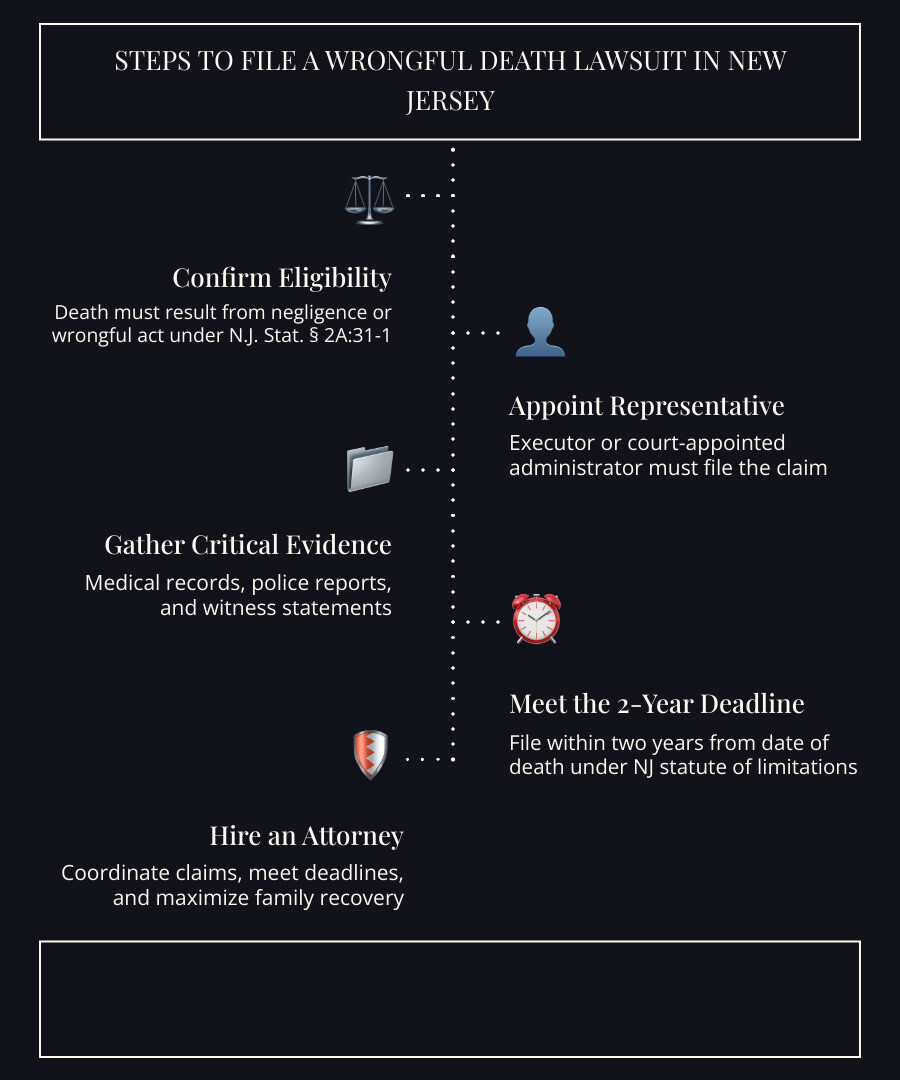
Here is a quick overview of the key steps:
- Confirm the death qualifies — The death must have been caused by negligence, a wrongful act, or default under N.J. Stat. § 2A:31-1.
- Identify or appoint a personal representative — Only the executor of the deceased’s estate (or a court-appointed administrator) can file the lawsuit.
- Gather key evidence — Medical records, police reports, and witness statements build the foundation of your claim.
- File within the deadline — New Jersey’s statute of limitations is two years from the date of death for most wrongful death claims.
- Determine whether a survival action applies — A separate claim may exist for the deceased’s own pain and suffering before death.
- Work with an attorney — A wrongful death attorney helps you coordinate claims, meet deadlines, and maximize recovery for your family.
Losing someone you love is devastating. When that loss was caused by someone else’s negligence — whether in a car accident on Route 70, a medical error at Cooper University Hospital, or a workplace incident — New Jersey law gives your family the right to seek financial justice. But the legal process involves strict deadlines, specific filing rules, and complex damage calculations that are easy to get wrong without guidance.
I’m Jason Fine, founding attorney at J. Fine Law in Cherry Hill, NJ, with over 25 years of experience helping families through the steps to file wrongful death lawsuits in New Jersey and recovering the compensation they deserve. In the sections ahead, I’ll walk you through exactly what the law requires and how to protect your claim.
Relevant articles related to steps to file wrongful death lawsuit new jersey:
Understanding the Legal Steps to File Wrongful Death Lawsuit New Jersey Actions
To build a strong foundation for your legal claim, we must first look at how New Jersey law defines a wrongful death. Under N.J. Stat. § 2A:31-1, a wrongful death occurs when a person’s death is caused by a wrongful act, neglect, or default of another party. If the deceased person would have been entitled to file a personal injury lawsuit had they survived, then their estate has the legal grounds to pursue a civil action.
One of the most common points of confusion for Cherry Hill families is who actually files the lawsuit. Unlike in some other states, surviving family members cannot file a wrongful death lawsuit directly in New Jersey courts.
Instead, the law dictates that only the personal representative (also known as the executor or administrator) of the deceased person’s estate has the legal standing to file the claim. If the deceased left behind a will, they likely named an estate executor. If there is no will, we must petition the local court to appoint an administrator.
Even though the personal representative files the paperwork, any financial recovery obtained is held in trust and distributed to the eligible surviving dependents. To learn more about how standing and estate eligibility work, read our Wrongful Death Lawyer New Jersey Guide or review the comprehensive overview of New Jersey Wrongful Death Law .
Step-by-Step Guide to Initiating Your Claim
Taking the first steps toward a lawsuit while dealing with funeral arrangements is incredibly difficult. However, acting quickly helps preserve critical evidence and ensures your family does not miss key deadlines.
Here is how the administrative process begins in Cherry Hill:
- Step 1: Open the Estate – We must visit the Camden County Surrogate’s Court to legally establish the estate and have the personal representative or administrator officially appointed.
- Step 2: Investigate and Build the Case – Our legal team gathers all relevant records, consults with reconstruction professionals, and interviews witnesses.
- Step 3: Draft and File the Complaint – We draft a formal legal complaint detailing the negligence that caused the death and file it in the appropriate New Jersey Superior Court.
- Step 4: Serve the Defendant – The legal summons and complaint are formally served to the negligent party, initiating the litigation process.
For a deeper dive into this timeline, you can explore The Steps to Filing a Wrongful Death Lawsuit and utilize our Wrongful Death Legal Help Ultimate resource.
Crucial Evidence Needed for the Steps to File Wrongful Death Lawsuit New Jersey Cases
In civil court, the standard of proof is a “preponderance of the evidence.” This means we must prove it is more likely than not that the defendant’s negligence caused your loved one’s death. To meet this standard, we must gather:
- Complete medical records from facilities like Jefferson Cherry Hill Hospital or Cooper University Hospital showing the treatment received and the official cause of death.
- Police accident reports, especially if the death resulted from a motor vehicle crash on Route 70 or Interstate 295.
- Physical evidence from the scene, video surveillance footage, and eyewitness statements.
- Financial documents, including tax returns, pay stubs, and benefits statements, to prove the exact economic loss to the household.
Having organized, solid evidence is the key to negotiating a fair settlement or winning at trial. For more guidance on what to collect, check out our Wrongful Death Legal Help Guide.
Meeting the Strict Deadlines and Steps to File Wrongful Death Lawsuit New Jersey Requirements
Time is of the essence. In New Jersey, the standard statute of limitations for a wrongful death lawsuit is two years from the date of the person’s death. If you fail to file a claim within this window, your family will permanently lose the right to seek justice.
However, there are a few critical exceptions to keep in mind:
- Criminal Acts: New Jersey has no statute of limitations for wrongful death claims if the death resulted from murder, manslaughter, or aggravated manslaughter, provided the perpetrator was convicted, found not guilty by reason of insanity, or adjudicated delinquent.
- Survival Action Grace Period: If a personal injury survival action’s deadline is nearing expiration at the time of death, New Jersey law provides a six-month grace period for the estate to file the survival claim, even if the original statute would have otherwise expired sooner.
To ensure your family meets these strict timelines, consult our New Jersey Wrongful Death Law Firm Guide 2026.
Calculating Recoverable Damages and Financial Losses
New Jersey’s wrongful death laws focus heavily on compensating survivors for their “pecuniary” (financial) losses. Because the law does not allow survivors to recover damages for their own emotional grief, mental suffering, or loss of emotional satisfaction, we must translate your loved one’s contributions into clear economic terms.
To calculate these losses, we analyze:
- Lost Financial Support: The net earnings the deceased would have provided to their dependents, factoring in taxes, inflation, and retirement contributions.
- Loss of Services: The tangible value of household chores, childcare, cooking, and maintenance. For example, New Jersey courts have upheld significant valuations (such as $45 per hour) for the marketplace cost of hiring professionals to replace these services.
- Loss of Companionship and Guidance: While you cannot recover for grief, you can recover for the economic value of the care, advice, and guidance your loved one provided, particularly to surviving children.
- Expenses: Medical bills resulting from the final injury, as well as reasonable funeral and burial costs.
For detailed rules on how juries assess these calculations, you can read the official New Jersey judicial guidelines in 8.43 Wrongful Death and explore real-world examples in Wrongful Death Cases Examples and Settlements Explained.
Comparing Wrongful Death vs. Survival Action Damages
| Feature | Wrongful Death Claim (N.J.S.A. 2A:31-1) | Survival Action (N.J.S.A. 2A:15-3) |
|---|---|---|
| Primary Purpose | Compensates survivors for their financial losses. | Compensates the deceased’s estate for losses prior to death. |
| Key Damages | Lost financial support, loss of household services, funeral costs. | Deceased’s pain, suffering, and medical bills before passing. |
| Who Receives Funds | Distributed directly to dependent survivors (spouse, children, etc.). | Paid to the estate (subject to estate debts and wills). |
| Filing Deadline | Strict 2 years from the date of death. | 2 years from original injury (with a 6-month grace period if applicable). |
Wrongful Death vs. Survival Actions and Workers’ Compensation
When a fatal accident occurs, we often file two parallel legal claims: a wrongful death action and a survival action under N.J.S.A. 2A:15-3. The survival action essentially “survives” the deceased, allowing the estate to recover damages for the physical pain, mental suffering, and medical expenses your loved one endured between the moment of injury and their actual time of death.
Another layer of complexity arises if your loved one was killed while on the job. Under New Jersey’s workers’ compensation system, dependents generally cannot sue their loved one’s employer directly due to employer immunity. Instead, you must seek benefits through the state’s workers’ compensation program, which covers funeral costs and a percentage of weekly wages.
However, we always look for third-party liability. If an outside contractor, equipment manufacturer, or negligent driver caused the fatal workplace accident, we can bypass employer immunity and file a third-party wrongful death lawsuit. This allows your family to recover full pecuniary damages beyond the limits of workers’ compensation. Learn more about these dual legal paths in The Path to Justice: Exploring Your Wrongful Death Legal Rights.
Frequently Asked Questions About New Jersey Wrongful Death Claims
Who is legally authorized to file a wrongful death lawsuit in New Jersey?
Only the personal representative or executor of the deceased’s estate is legally authorized to file the lawsuit. However, any recovered damages are distributed to eligible survivors—such as a surviving spouse, children, grandchildren, parents, or siblings—provided they can demonstrate actual financial dependency on the deceased.
Can you recover damages for emotional grief or mental anguish in New Jersey?
No. New Jersey law strictly limits wrongful death damages to pecuniary (financial) losses. You cannot recover compensation for emotional distress or grief. However, you can recover the economic value of the deceased’s companionship, advice, and household services by proving what it would cost to hire a professional in the marketplace to perform those same duties.
How does an on-the-job death affect your right to file a lawsuit in Cherry Hill?
If your loved one passed away due to a workplace accident, workers’ compensation laws generally protect the employer from a direct lawsuit. However, if a third party (such as a negligent driver on Route 70 or an outside subcontractor on a construction site) caused the accident, you can file a third-party wrongful death claim to recover full financial damages.
Secure Justice for Your Family with Trusted Cherry Hill Legal Representation
Losing a family member is one of the hardest things you will ever experience. During this painful time, you should not have to navigate complex court filings, surrogate negotiations, and aggressive insurance adjusters on your own.
At J. Fine Law, we treat our clients like family. Operating out of our Cherry Hill office, our team provides a rapid attorney response to ensure your questions are answered immediately. We are proud of our 98% success rate and have recovered over $50 million in settlements for injured individuals and grieving families across New Jersey and Pennsylvania.
If your loved one’s death was caused by neglect or mistreatment in an assisted living facility or nursing home, our dedicated elder abuse attorney is here to investigate the negligence and fight for the justice your family deserves. We work on a contingency fee basis, meaning you pay nothing upfront, and we only get paid if we win your case.
To understand how our fees work, read Wrongful Death Lawyer Fees Explained Contingency and Costs. If you suspect your loved one’s passing was due to poor care in a facility, get More info about nursing home abuse services and contact our elder abuse attorney today for a free, compassionate consultation. Let us handle the legal burden so you can focus on healing.