 Skip to content
The Complete Guide to Hiring a Cherry Hill, New Jersey Wrongful Death Attorney
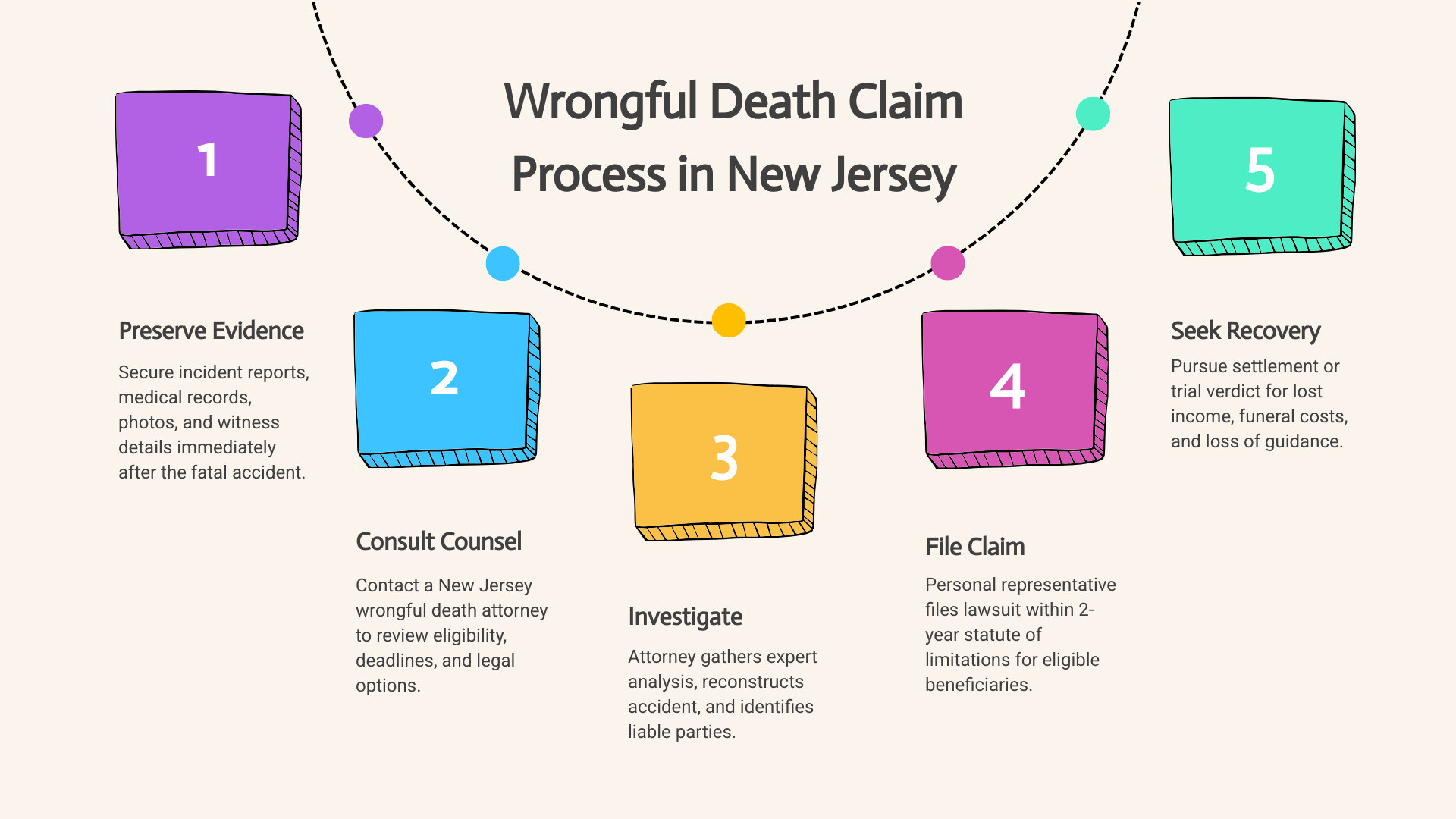
After a fatal accident in Cherry Hill, a New Jersey wrongful death attorney can help your family protect evidence, identify who may be legally responsible, and pursue the financial support allowed by law. Act quickly: save records, avoid signing insurer paperwork without legal advice, and ask about the filing deadline, which is generally two years from the date of death.
A wrongful death claim may arise from a fatal car crash, medical negligence, a workplace incident, or a dangerous product. In New Jersey, the personal representative of the estate usually brings the claim for eligible family members who suffered financial loss, such as lost income, household services, funeral costs, and loss of guidance.
I am Jason Fine, founding attorney at J. Fine Law, with more than 25 years representing people harmed in serious motor vehicle, work, construction, nursing home, and other injury cases. As a New Jersey wrongful death attorney resource, I work with families and partner firms to pursue clear answers and fair accountability after a preventable loss.
Explore more about New Jersey wrongful death attorney:
Understanding New Jersey Wrongful Death Law and Statutory Eligibility
Losing a family member due to someone else’s carelessness leaves an overwhelming emotional and financial burden. Under state law, specific statutes govern how surviving relatives seek justice and compensation across New Jersey. The foundational rule is codified under N.J.S.A. 2A:31-1, which defines an actionable death as one caused by a wrongful act, neglect, or default that would have entitled the injured person to file a personal injury lawsuit had they survived.
In Cherry Hill, when a fatal event occurs—whether along the busy corridors of Route 70, near Route 38, or during treatment at Jefferson Cherry Hill Hospital—the right to file the formal action rests with the executor or personal representative of the decedent’s estate. While the personal representative initiates the lawsuit, they do so on behalf of eligible surviving beneficiaries who relied on the deceased for financial or emotional support:
- The surviving spouse or domestic partner
- Surviving children or grandchildren
- Dependent parents
- Other dependent relatives who can prove actual reliance on the deceased person’s financial contributions
New Jersey law prioritizes distributees based on intestacy rules and financial dependency. If no surviving spouse or children exist, parents or dependent siblings may receive the proceeds recovered in the action.
Wrongful Death Claims vs. Survival Actions
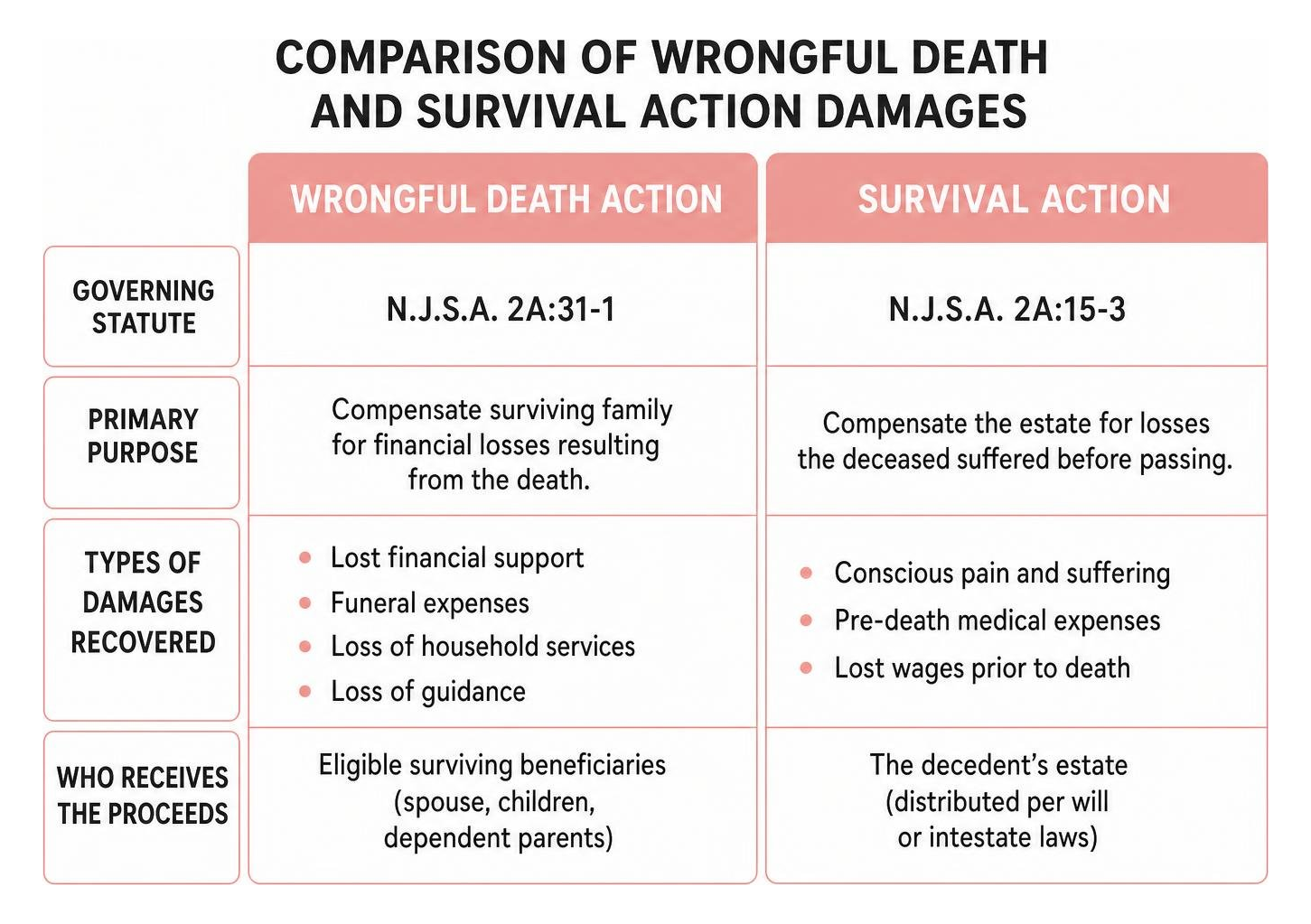
Many families are surprised to learn that New Jersey law divides post-death claims into two distinct legal actions: a wrongful death claim and a survival action under N.J.S.A. 2A:15-3. Understanding the difference ensures that every category of loss is pursued.
A wrongful death action compensates the surviving family members for their pecuniary (financial) losses caused by the death. In contrast, a survival action allows the decedent’s estate to recover damages the deceased person suffered between the moment of injury and the time of death, including conscious pain and suffering, as well as medical bills incurred before passing.
| Legal Action | Governing Statute | Primary Purpose | Types of Damages Recovered | Who Receives the Proceeds |
|---|---|---|---|---|
| Wrongful Death Action | N.J.S.A. 2A:31-1 | Compensate surviving family for financial losses resulting from the death | Lost financial support, funeral expenses, loss of household services, loss of guidance | Eligible surviving beneficiaries (spouse, children, dependent parents) |
| Survival Action | N.J.S.A. 2A:15-3 | Compensate the estate for losses the deceased suffered before passing | Conscious pain and suffering, pre-death medical expenses, lost wages prior to death | The decedent’s estate (distributed per will or intestate laws) |
How a New Jersey Wrongful Death Attorney Proves Liability
Securing accountability requires proving four core elements of negligence under New Jersey tort principles:
- Duty of Care: Establishing that the defendant owed the decedent a legal obligation to act reasonably (for example, a motorist driving safely along Haddonfield Road or a property owner maintaining secure premises).
- Breach of Duty: Demonstrating that the defendant violated that standard through action or inaction, such as running a red light, failing to repair a hazard, or committing medical errors.
- Direct Causation: Showing that the breach directly caused the fatal injuries.
- Damages: Documenting measurable economic and non-economic harm suffered by the estate and surviving dependents.
Our team at J. Fine Law gathers critical evidence immediately—interviewing witnesses, securing surveillance footage, and preserving vehicle black box data. For detailed guidance on navigating these claims, review our Wrongful Death Lawyer New Jersey Guide.
Why Hiring an Experienced New Jersey Wrongful Death Attorney Matters
Navigating fatal accident litigation requires a firm understanding of insurance tactics, state evidentiary rules, and complex financial calculations. Insurance carriers often try to minimize settlements when families are at their most vulnerable. Our firm steps in to manage all legal burdens, protect your rights, and provide rapid communication throughout the process.
With a 98% success rate and over $50 million recovered for injury victims and grieving families, we understand how to prepare every case for trial. Having strong representation means insurers know you will not accept undervalued offers. Learn more about selecting representation in our guide on Why You Need a Top Wrongful Death Law Firm in New Jersey.
Common Causes of Fatal Accidents in New Jersey
Approximately 2,500 people die annually in New Jersey from unintentional injuries, including workplace mishaps, vehicle collisions, and dangerous premises conditions. In 2022 alone, New Jersey recorded 668 fatal motor vehicle crashes.

Frequent causes of fatal injury claims in Cherry Hill and throughout Camden County include:
- Fatal Motor Vehicle Collisions: High-speed impacts on routes like Interstate 295, the New Jersey Turnpike, and Kings Highway often cause catastrophic trauma.
- Commercial Vehicle Collisions: Semi-trucks and delivery vehicles present major hazards due to severe weight imbalances; our team handles complex Truck Accident Wrongful Death claims against motor carriers and freight companies.
- Medical Negligence: Fatal diagnostic errors, surgical mistakes, and medication overdoses in clinical settings.
- Workplace and Construction Incidents: Falls from heights, equipment malfunctions, and structural collapses on commercial job sites.
- Defective Products: Malfunctioning automobile components, industrial machinery, and consumer goods that fail safety standards.
Comparative Negligence and Calculating Claim Value
New Jersey operates under a modified comparative negligence system (N.J.S.A. 2A:15-5.1). Under this rule, a claimant can recover damages as long as the decedent’s share of fault does not exceed 50 percent (the 51 percent bar). If the deceased is found partially at fault, the total financial award is reduced in proportion to that percentage.
Calculating the value of a claim involves assessing multiple economic components:
- Lost Future Financial Support: Projected earnings and benefits the deceased would have provided throughout their working life.
- Loss of Household Services: The monetary replacement value of childcare, maintenance, cooking, and administrative support.
- Loss of Guidance and Companionship: The pecuniary value of parental advice, training, and education lost by surviving children.
- Medical and Funeral Expenses: Direct out-of-pocket costs associated with emergency care, hospitalization, burial, and memorial services.
Typical wrongful death settlements in New Jersey range from $500,000 to well over $1 million, depending on earning history, age, surviving dependents, and insurance policy limits. To explore the formulas behind these valuations, read The Average Wrongful Death Settlement Guide Math Myth and Reality.
Critical Legal Steps and Deadlines in New Jersey Fatal Accident Claims
The days following a fatal accident require prompt action to ensure critical records are not lost or destroyed.
Important steps for families in Cherry Hill include:
- Obtain Official Records: Secure certified copies of the death certificate, initial police accident reports from the Cherry Hill Police Department, and complete medical records from treating facilities like Virtua Voorhees Hospital or Cooper University Hospital.
- Preserve Tangible Evidence: Keep damaged personal belongings, clothing, and photographic evidence of the incident scene.
- Avoid Premature Statements: Decline recorded statements to third-party insurance adjusters before speaking with legal counsel.
- Open an Estate: Appoint an administrator or executor through the Camden County Surrogate’s Court.
The Two-Year Statute of Limitations for Filing
Under New Jersey law, the statute of limitations for filing a wrongful death lawsuit is strictly two years from the date of the person’s death. Failing to file within this statutory window permanently forfeits your family’s right to pursue financial recovery in court.
Exceptions to this deadline are rare. While survival actions accrue on the date the injury occurred, wrongful death claims accrue on the date of death. To prevent missing mandatory deadlines, review our resource on Understanding the Two Year Limit for NJ Wrongful Death Claims.
What to Expect When Consulting a New Jersey Wrongful Death Attorney
When you reach out to our team, we begin with a clear, straightforward case evaluation. We review incident details, examine liability, and explain how state laws apply to your circumstances.
We operate entirely on a contingency fee basis. This means:
- You pay zero upfront costs or out-of-pocket legal fees.
- Our firm advances all necessary litigation costs, including filing fees, professional witness evaluations, and accident reconstruction.
- We receive an agreed-upon percentage of the financial recovery only when we successfully resolve your case through settlement or verdict.
For a full breakdown of how litigation expenses are managed, see our Step by Step Guide to Wrongful Death Lawsuit Cost in New Jersey.
Frequently Asked Questions About New Jersey Wrongful Death Claims
Who receives the compensation recovered in a New Jersey wrongful death settlement?
Wrongful death proceeds are distributed directly to statutory beneficiaries who suffered an actual financial loss due to the death. The distribution is reviewed and approved by a Superior Court judge in Camden County or the appropriate local vicinage to ensure fair allocation among spouses, children, or dependent parents.
Can families pursue punitive damages in a New Jersey wrongful death lawsuit?
Under N.J.S.A. 2A:31-5, punitive damages are generally not recoverable in a pure wrongful death claim, which is limited to pecuniary losses. However, punitive damages may be pursued through a companion survival action if the defendant acted with actual malice or willful and wanton disregard for human safety.
How do legal fees work for fatal injury claims in New Jersey?
Legal fees are governed by New Jersey Court Rule 1:21-7, which establishes standard contingency fee limits for personal injury and fatal accident litigation. Your family never pays hourly bills; legal fees are collected solely as a percentage of the final settlement or court award.
Seeking Justice and Protecting Your Family’s Future
When negligence or institutional neglect claims the life of an elderly relative, your family deserves compassionate guidance, rapid answers, and aggressive advocacy. At J. Fine Law, our 98% success rate and record of recovering over $50 million reflect our commitment to holding negligent drivers, corporate care facilities, and nursing homes accountable in Cherry Hill.
If your loved one suffered fatal harm or mistreatment in a residential care setting, consulting an elder abuse attorney is crucial to uncovering the truth. Contact an experienced elder abuse attorney and Cherry Hill Wrongful Death Lawyer today to protect your rights and demand the accountability your family deserves.