 Skip to content
Key Factors That Define the Best Injury Attorney in Philadelphia
The best injury attorney in Philadelphia combines deep courtroom familiarity, strong peer recognition, and a clear history of substantial case recoveries. State licensing is merely the baseline. High-stakes injury claims demand an advocate who regularly litigates complex disputes before the Philadelphia Court of Common Pleas and who prepares every file as though it will be decided by a jury.
An accident can disrupt your daily life within seconds. Whether you are navigating traffic near City Hall, walking along Market Street, or commuting past the Philadelphia Museum of Art, a sudden collision or fall leaves you facing physical recovery and mounting financial stress. Congested corridors such as the Schuylkill Expressway (I-76), Roosevelt Boulevard, and the Vine Street Expressway (I-676) present frequent collision hazards where negligent drivers cause catastrophic harm. Securing fair financial recovery requires strong legal support. At J. Fine Law, we maintain a 98% success rate and have recovered over $50 million in settlements and verdicts for injured individuals across Pennsylvania.
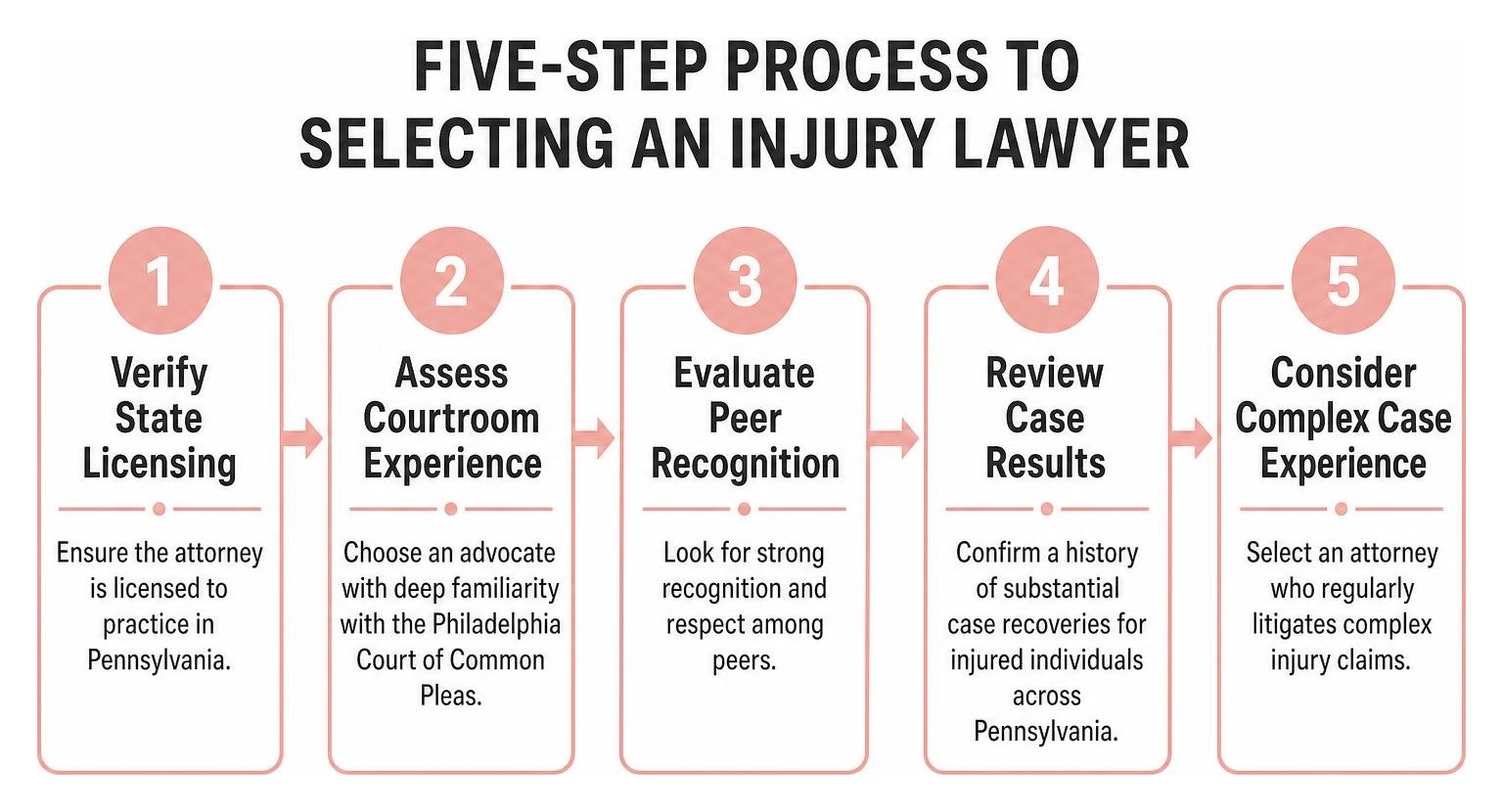
Key evaluation factors include:
- Verified Case Recoveries: Look for documented six- and seven-figure recoveries in cases similar to yours rather than generalized advertising claims.
- Trial Readiness: Insurance carriers know which lawyers settle quickly for discounted sums and which legal teams prepare every file for a jury verdict.
- Professional Standing: Peer-reviewed honors, such as Super Lawyers listings and high Martindale-Hubbell ratings, reflect sustained standing among fellow attorneys and judges.
- Rapid Response and Direct Access: Timely answers prevent costly legal missteps during the early stages of a claim.

How J. Fine Law Manages Your Case from Start to Finish
Our firm pairs substantial trial funding with rapid, direct attorney communication. When you retain J. Fine Law, your claim receives personalized attention from dedicated lead counsel who has the resources to build a complete case file. We advance the capital needed for accident reconstruction, medical analysis, economic impact projections, and courtroom exhibits. Throughout the entire process, we keep you informed with transparent updates at every stage. This approach allows us to pursue full and fair compensation rather than settling early for a discounted sum before the complete scope of your long-term medical care is known.
How the Best Injury Attorney Investigates and Proves Negligence
Establishing liability under Pennsylvania law requires proving that the responsible party breached their legal duty of care, directly causing measurable harm. As a dedicated Philadelphia personal injury attorney, we conduct comprehensive factual investigations immediately to safeguard vital proof:
- Securing Critical Scene Evidence: We immediately obtain traffic camera recordings, surveillance footage from nearby commercial properties, PennDOT roadway data, and emergency dispatch logs.
- Reviewing Police and Official Incident Reports: We cross-check documentation prepared by local law enforcement against physical vehicle damage, crush depth measurements, and roadway skid marks.
- Engaging Independent Analysis: We collaborate with accident reconstruction professionals, biomechanical authorities, life-care planners, and vocational professionals to explain technical collision dynamics clearly to a jury.
- Auditing Medical Records: We connect clinical diagnostic imaging from facilities like Thomas Jefferson University Hospital, Penn Presbyterian Medical Center, and Temple University Hospital directly to the trauma caused by the accident.
How Personal Injury Compensation Is Calculated
Valuing a personal injury claim requires examining both immediate out-of-pocket losses and long-term disruptions to your standard of living. Insurance adjusters frequently utilize automated software programs that undervalue serious bodily injuries and ignore future complications. When assessing what a case is worth, we calculate comprehensive recovery packages by dividing damages into two main categories:
Economic Damages (Tangible Financial Losses)
- Medical Treatment Costs: Past, present, and future medical costs, including emergency room care, hospital admissions, surgeries, physical therapy, prescription medications, assistive mobility devices, and home modifications.
- Loss of Income and Earning Potential: Lost wages from missed workdays and diminished future earning capacity if long-term impairments force you into reduced duties, part-time schedules, or early retirement.
- Out-of-Pocket Expenses: Property repair expenses, vehicle replacement costs, and ongoing transportation costs for attending medical consultations across Philadelphia.
Non-Economic Damages (Intangible Losses)
- Pain and Suffering: Enduring physical pain, chronic discomfort, emotional trauma, anxiety, and the loss of life’s daily pleasures.
- Disfigurement and Impairment: Permanent scarring, disfigurement, loss of bodily function, or persistent physical limitations that alter your daily lifestyle.
- Loss of Consortium: Deprivation of companionship, affection, and everyday family support experienced by your spouse and household.
Pennsylvania follows a modified comparative negligence rule (58 Pa.C.S. § 7102). Under this legal standard, you can recover financial compensation as long as your share of responsibility is 50% or less. If you share partial responsibility, your overall monetary award is reduced proportionally by your percentage of fault. For example, if a jury awards $500,000 but finds you 10% responsible, your total net recovery will be $450,000. Our legal team aggressively protects you against unfair comparative fault allegations raised by insurance adjusters.
Understanding Contingency Fees and Litigation Expenses
A clear fee agreement ensures financial security after an unexpected injury. We represent clients on a contingency fee arrangement:
- Zero Upfront Retainers: You pay nothing out of pocket to retain our legal team or launch an investigation.
- Aligned Incentives: Legal fees are deducted as an agreed-upon percentage only when we secure a financial recovery through settlement or jury verdict.
- Covered Case Costs: We advance the necessary capital for court filing fees, medical record retrieval, court reporter deposition transcripts, and visual trial exhibits, which are reimbursed only upon a successful financial recovery.
Critical Steps to Take After an Accident to Protect Your Rights
The hours and days immediately following an accident determine the strength of your future legal claim. Insurance carriers often begin building their defense within hours of a crash. Following our Pennsylvania injury lawyer guide safeguards your rights against common insurance tactics and helps preserve crucial evidence.
- Prioritize Immediate Medical Care: Visit an emergency center, such as Jefferson Health or Penn Medicine, or an urgent care clinic right away. Delaying medical attention provides insurers with an opportunity to argue that your physical trauma occurred elsewhere or was not severe.
- Document the Scene Thoroughly: Capture detailed photographs and high-definition video footage of vehicle resting positions, debris fields, roadway conditions, weather factors, damaged property, and all visible bodily injuries.
- Gather Witness Information: Collect names, phone numbers, and home addresses of all neutral eyewitnesses before they leave the scene. Unbiased witness accounts carry significant weight during settlement negotiations and trial proceedings.
- Decline Recorded Statements: Insurance adjusters are trained to ask leading, misleading questions designed to minimize your payout or shift liability onto you. Direct all insurance adjusters and investigators to your legal counsel before answering any questions.
- Follow All Medical Directives: Attend every follow-up appointment, complete physical rehabilitation regimens, and retain detailed receipts for all prescriptions and assistive medical devices.
What to Ask When Interviewing the Best Injury Attorney for Your Case
Schedule a free consultation with a Philadelphia injury attorney to ask direct questions about how your file will be managed from intake through resolution:
- Will you personally litigate my case, or will it be passed off to a junior associate or case manager?
- What is your track record in taking contested cases to a jury verdict before the Philadelphia Court of Common Pleas?
- How quickly does your office return client phone calls and provide detailed case updates?
- Do you have the financial resources and trial capital to hire leading accident reconstruction professionals and medical authorities?
- What specific legal strategy do you propose to maximize the recovery value of my individual injury claim?
Frequently Asked Questions About Hiring a Philadelphia Injury Lawyer
When should I hire a personal injury lawyer after an accident?
Retain counsel immediately following your initial medical assessment. While the Pennsylvania statute of limitations generally provides two years from the incident date to file a formal lawsuit, crucial physical evidence, vehicle black-box data, and commercial surveillance tapes can be erased or lost within days. Engaging an attorney early ensures that critical proof is preserved before insurance companies attempt to control the narrative.
How do I assess an attorney’s reputation beyond online reviews?
Review verified trial outcomes, documented settlement recoveries, active good standing with the Disciplinary Board of the Supreme Court of Pennsylvania, peer-reviewed directory listings such as Super Lawyers and Martindale-Hubbell, and active leadership roles in regional trial bar associations. Direct courtroom results and peer respect provide the most dependable benchmarks of legal ability.
What happens if my injury case goes to trial?
If the insurance carrier refuses to offer fair compensation during pre-litigation negotiations, your attorney files a formal complaint with the court. The litigation process involves formal discovery, depositions, pre-trial motions, jury selection (voir dire), opening arguments, evidence presentation, and witness examination before a judge and jury. Meaningful settlement discussions can still take place at any point during trial before the jury issues a final verdict.
Securing Real Legal Results When You Need Them Most
Recovering from serious physical trauma requires responsive, results-driven advocacy. At J. Fine Law, we provide attentive client support while building strong, evidence-backed claims that force insurance companies to treat you fairly. Our Philadelphia team has recovered over $50 million in settlements and verdicts, and we maintain a 98% success rate by preparing every case for trial from the first day. Beyond vehicular and workplace accidents, vulnerable community members often face harm in residential facilities. If an aging loved one has suffered unexplained fractures, bedsores, or severe decline due to substandard care, contact our firm immediately to discuss holding neglectful facilities accountable through an experienced elder abuse and nursing home neglect claim.
Schedule a free consultation with our Philadelphia team today to review your case and protect your financial future.