 Skip to content

How a Philadelphia Work Injury Law Firm Can Help After an Accident
After a workplace injury, get medical care, tell your employer as soon as possible, and save records of what happened. If you’re looking for a philadelphia work injury law firm, ask whether it handles workers’ compensation claims and lawsuits against other responsible parties. Ask who will handle your case and how fees work before you sign.
This guide covers common job injuries, claim deadlines, and the steps from filing a claim to resolving a dispute.
I’m Jason Fine, founding attorney of J. Fine Law, and I’ve represented people hurt in work and construction accidents for more than 25 years. If you need a philadelphia work injury law firm to review your options, Contact Jason Fine.
When you need a Philadelphia workplace accident lawyer, our office is prepared to help.
What Immediate Steps Should You Take After a Workplace Accident?
After a workplace accident, seek emergency medical care immediately, report your injury to your employer in writing, and document the incident scene thoroughly. Preserving physical evidence and securing witness statements strengthens your statutory wage and medical benefit claims under state law before insurance carriers attempt to dispute your injury.
First, seek emergency medical attention at local facilities such as Penn Presbyterian Medical Center or Jefferson Torresdale Hospital. Immediate treatment protects your well-being and creates official medical records linking your injuries to your job duties. Tell the treating medical team that the incident occurred at work.
Next, report the injury in writing to your supervisor right away. Giving prompt notice complies with mandatory state rules and creates an indisputable timeline. Failing to provide timely notice can bar you from receiving benefits.
Collect contact details from witnesses and take photos of hazards on Broad Street, Market Street, or your local job site. For common job hazards, review guidance on Pennsylvania workplace accidents and consult municipal guidelines from the City of Philadelphia.
How Does Pennsylvania Workers’ Compensation Protect Injured Employees?
Pennsylvania workers’ compensation protects injured employees by providing mandatory medical treatment coverage and wage-loss benefits without requiring proof of employer fault. Benefit amounts depend on your average weekly wage, medical documentation, and disability status, paying up to statutory state maximums for temporary total disability or specific loss injuries.
The Pennsylvania Workers’ Compensation Act (77 P.S. § 1 et seq.) operates as a no-fault system. Covered employees receive payment for all reasonable and necessary medical treatments related to their job injuries. For legal definitions regarding statutory harm, review how authorities define an injury.
According to national workplace surveillance from the U.S. Bureau of Labor Statistics, private industry employers report over 2.6 million nonfatal workplace injuries annually. In Pennsylvania, injured employees missing work receive temporary total disability or partial disability payments to cover lost income.
What Are the Crucial Deadlines in Pennsylvania Claims?
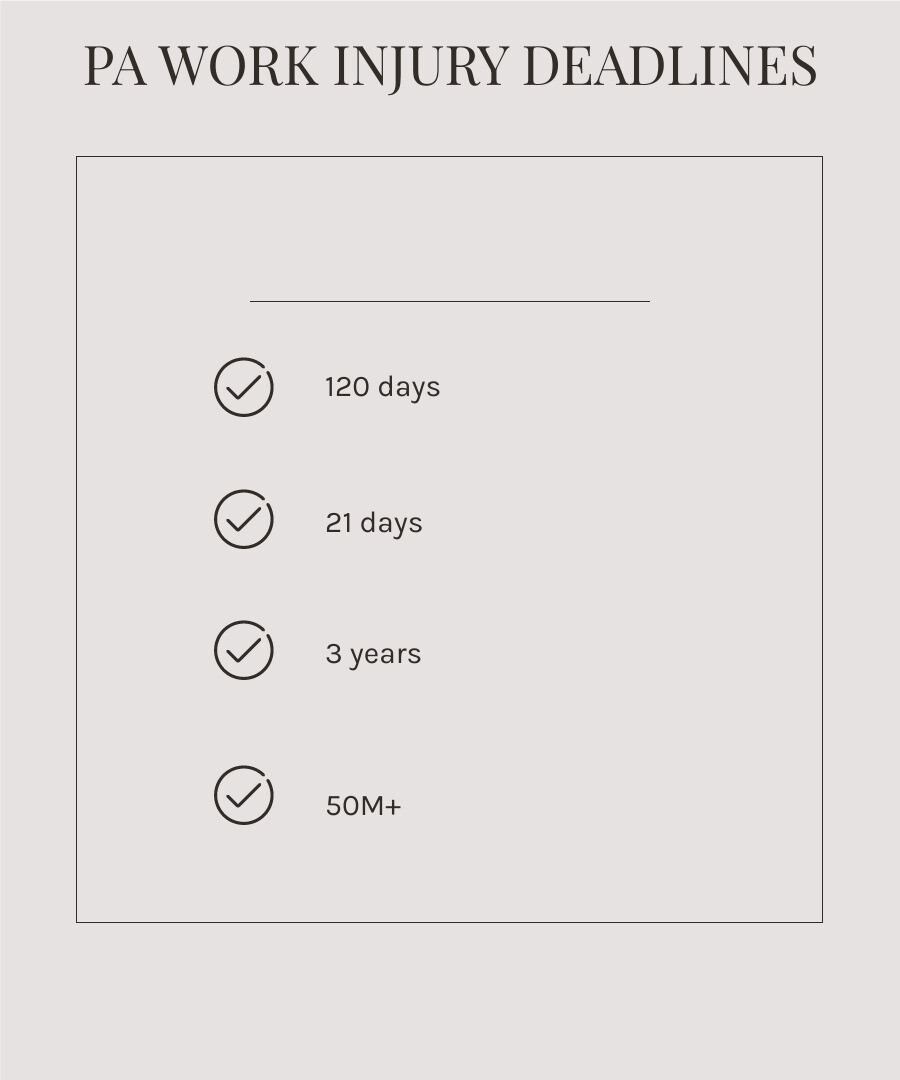
Under 77 P.S. § 631, you should give notice within 21 days to receive benefits retroactive to the injury date. Notice provided after 120 days completely bars your claim from receiving workers’ comp benefits.
In addition, 77 P.S. § 602 requires employees to file a formal Claim Petition within three years of the injury date. The Pennsylvania Bureau of Workers’ Compensation strictly enforces this statute of limitations.
When Can You Sue a Third Party Beyond Workers’ Comp Benefits?
You can sue a third party beyond workers’ comp when an outside party’s negligence causes your job-site injury. While direct employers are immune under statutory exclusive remedy rules, third-party civil lawsuits against negligent subcontractors, equipment manufacturers, or property owners allow recovery for pain, suffering, and full wage loss.
Workers’ compensation laws prevent you from suing your direct employer for negligence. However, third-party claims target outside entities whose carelessness contributed to your harm. For example, a delivery driver struck by an erratic driver on Interstate 95 can pursue a civil lawsuit against that motorist.
Similarly, construction workers injured by defective equipment on Center City jobs can sue equipment manufacturers. Third-party lawsuits allow victims to recover non-economic damages, such as physical pain and mental anguish.
What Distinguishes Workers’ Comp from Third-Party Lawsuits?
The table below highlights the differences between a statutory workers’ compensation claim and a third-party civil lawsuit.
| Feature | Workers’ Compensation Claim | Third-Party Personal Injury Lawsuit |
|---|---|---|
| Fault Requirement | No fault required | Must prove negligence |
| Target Entity | Direct employer / insurer | Negligent outside individual or entity |
| Pain and Suffering | Excluded by statute | Fully recoverable |
| Wage Recovery | Capped percentage (~66.6%) | 100% of past and future lost earnings |
| Medical Costs | Paid by statutory fee schedule | Full past and future medical recovery |
How Can a Philadelphia Work Injury Law Firm Maximize Your Settlement?
A Philadelphia work injury law firm maximizes your settlement by calculating future medical costs, establishing lost earning capacity, and negotiating structured Compromise and Release agreements. Legal representation counters insurer settlement tactics and presents compelling evidence before Workers’ Compensation Judges to ensure every statutory benefit is fully accounted for.
Settling a claim often involves executing a Compromise and Release (C&R) agreement under 77 P.S. § 736. A C&R usually pays a lump sum to resolve future wage-loss and medical obligations. A Workers’ Compensation Judge must review and approve the agreement during a formal hearing.
Our legal team evaluates ongoing medical needs, inflation, and future earning capacity before negotiating terms. We ensure that you do not waive critical statutory protections without adequate financial compensation.
How Do Contingency Fees Work in Pennsylvania Claims?
At J. Fine Law, work injury representation is handled on a contingency fee basis. Clients pay no upfront legal costs, and attorney fees are collected only when compensation is successfully recovered.
Under 77 P.S. § 998, attorney fees in Pennsylvania workers’ compensation cases are capped at 20 percent of wage benefits. Every fee agreement requires formal approval by a Workers’ Compensation Judge to safeguard the worker’s interests.
How Do Employers and Insurers Dispute Philadelphia Work Injury Claims?
Employers and insurance carriers dispute Philadelphia work injury claims by requesting Independent Medical Examinations, alleging pre-existing medical conditions, and arguing untimely injury notice. They also use vocational assessments to offer modified-duty positions, attempting to reduce or terminate ongoing wage-loss benefits without adequately addressing client limitations.
Insurers routinely require injured employees to attend an Independent Medical Examination (IME) with a physician chosen by the carrier. These doctors frequently issue reports claiming the worker has fully recovered or that the condition pre-dated the accident.
Carriers also attempt to modify benefits by alleging that light-duty positions within the worker’s physical capacity are available. Thorough medical documentation from your treating physicians is essential to defeat these insurer tactics.
How Can You Take Decisive Legal Action After a Workplace Accident?
You can take decisive legal action by consulting an attorney immediately to protect your rights, challenge denied petitions, and calculate full compensation. Early representation prevents missed statutory deadlines, stops insurance company overreach, and positions your claim for maximum recovery through workers’ compensation benefits and third-party negligence claims.
Workplace injuries create substantial physical pain, emotional distress, and financial strain for Philadelphia workers. Having aggressive legal representation ensures your statutory benefits are protected and deadlines are met.
At J. Fine Law, our team maintains a 98% success rate and has recovered over $50 million for clients across Pennsylvania. We move swiftly to contest claim denials, negotiate top settlements, and pursue every negligent party responsible for your injuries.
Whether you suffered a severe job injury or require a dedicated elder abuse attorney for an injured senior worker, do not negotiate with insurance adjusters alone. Contact Jason Fine today to schedule a free, confidential case review.
Frequently Asked Questions About Philadelphia Workplace Injuries
How much does it cost to hire an attorney for a workplace accident claim?
Workplace injury attorneys operate on a contingency fee basis, so you pay no upfront legal fees. Under Pennsylvania law, attorney fees are generally capped at 20 percent of wage benefits and must be approved by a Workers’ Compensation Judge. If you do not recover compensation, you do not owe attorney fees.
Can I be fired for reporting a workplace injury in Pennsylvania?
No, Pennsylvania law strictly prohibits employers from firing, demoting, or retaliating against workers for filing workers’ compensation claims. If an employer retaliates against you for asserting your legal rights, you may have grounds for a wrongful termination lawsuit.
What if my work injury claim is denied by the insurance carrier?
If your claim is denied through a Notice of Workers’ Compensation Denial, you must file a Claim Petition with the Bureau of Workers’ Compensation. A Workers’ Compensation Judge will review medical records, hear witness testimony, and issue a ruling, which can also be appealed.
{ “@context”: “https://schema.org”, “@type”: “FAQPage”, “mainEntity”: [ { “@type”: “Question”, “name”: “How much does it cost to hire an attorney for a workplace accident claim?”, “acceptedAnswer”: { “@type”: “Answer”, “text”: “Workplace injury attorneys operate on a contingency fee basis, so you pay no upfront legal fees. Under Pennsylvania law, attorney fees are generally capped at 20 percent of wage benefits and must be approved by a Workers’ Compensation Judge. If you do not recover compensation, you do not owe attorney fees.” } }, { “@type”: “Question”, “name”: “Can I be fired for reporting a workplace injury in Pennsylvania?”, “acceptedAnswer”: { “@type”: “Answer”, “text”: “No, Pennsylvania law strictly prohibits employers from firing, demoting, or retaliating against workers for filing workers’ compensation claims. If an employer retaliates against you for asserting your legal rights, you may have grounds for a wrongful termination lawsuit.” } }, { “@type”: “Question”, “name”: “What if my work injury claim is denied by the insurance carrier?”, “acceptedAnswer”: { “@type”: “Answer”, “text”: “If your claim is denied through a Notice of Workers’ Compensation Denial, you must file a Claim Petition with the Bureau of Workers’ Compensation. A Workers’ Compensation Judge will review medical records, hear witness testimony, and issue a ruling, which can also be appealed.” } } ] }