 Skip to content

What Determines Whether Uber or Lyft Is Liable for a Pedestrian Crash in Philadelphia?
Is Uber or Lyft Liable if I’m Hit as a Pedestrian in Philadelphia?
Usually, the driver is liable if negligence caused the crash, while Uber or Lyft coverage may apply only when the app was active. The driver’s app status, trip phase, and available insurance determine whether a personal or company-backed policy may pay medical bills and other losses.
Rideshare companies classify their drivers as independent contractors under Pennsylvania law. Because drivers are not formal employees, Uber and Lyft often argue they are not directly responsible for a driver’s carelessness.
In busy areas like Center City, University City, and along major corridors such as Broad Street and Market Street, rideshare vehicles create serious pedestrian hazards. According to the Pennsylvania Department of Transportation, Philadelphia records thousands of pedestrian crashes each year, with sudden drop-offs and double-parking adding risk. In-app GPS and dispatch alerts can distract drivers on dense city streets.
Pennsylvania tort law protects pedestrians who are struck by negligent motorists. Required coverage can provide a source of recovery when a rideshare driver causes harm while using the network.
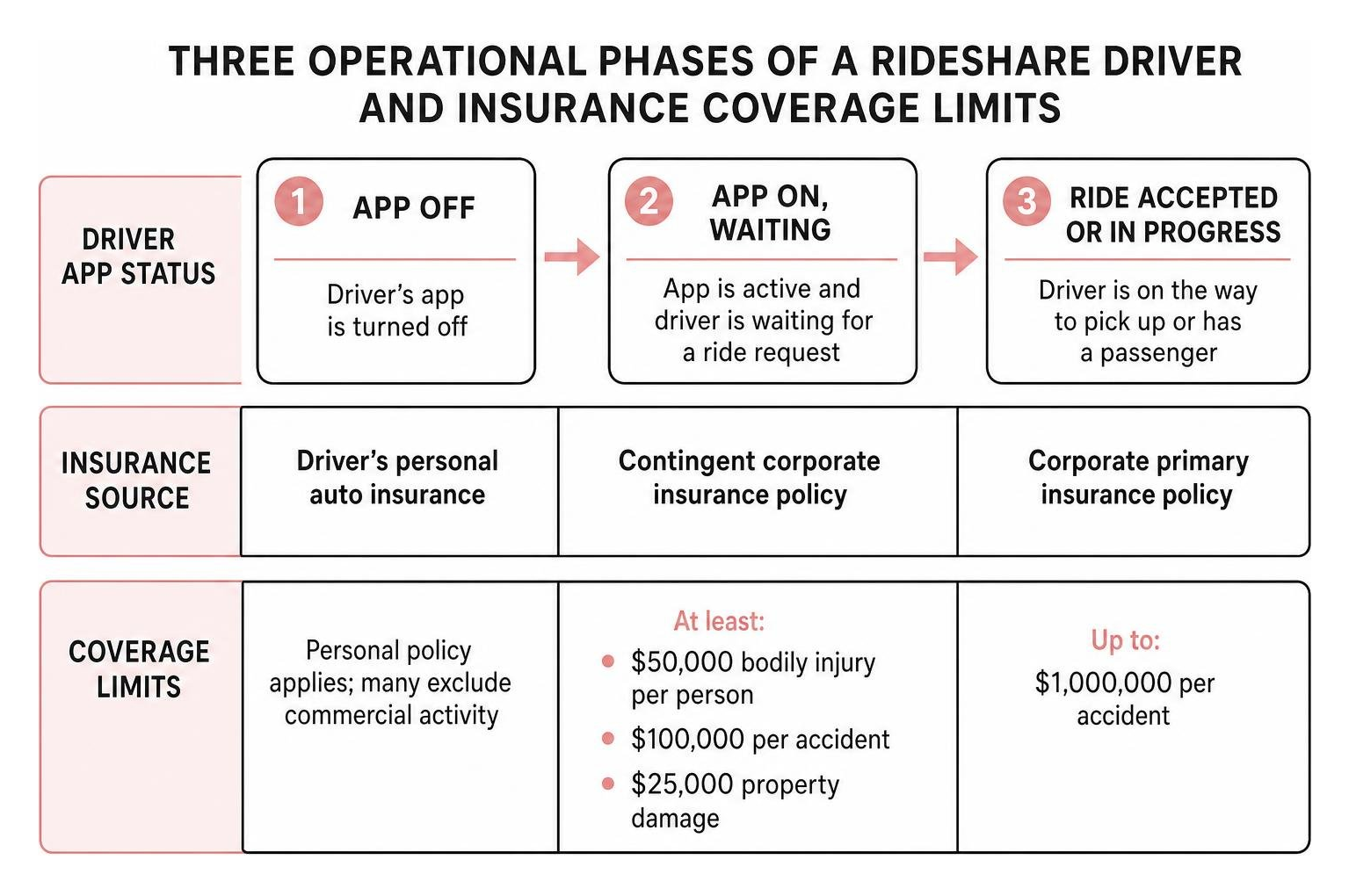
How Do Rideshare Insurance Tiers Apply to Struck Pedestrians in Pennsylvania?
Pennsylvania coverage rules turn on the driver’s app activity at the time of the crash. Available coverage may come from the driver’s personal insurer, a contingent policy, or a rideshare company’s commercial policy.
Under the Pennsylvania Transportation Network Company (TNC) Act published by the Pennsylvania General Assembly (66 Pa.C.S. § 2603.1), rideshare platforms must maintain coverage across three phases. In Tier 1, when the app is turned off, only the driver’s personal auto policy applies. If the app is active and the driver is waiting for a request (Tier 2), state law mandates contingent coverage of $50,000 for bodily injury per person, $100,000 per accident, and $25,000 for property damage.
Once a driver accepts a trip or transports a passenger (Tier 3), Uber and Lyft provide up to $1,000,000 in primary third-party liability insurance. This comprehensive commercial coverage protects pedestrians who suffer severe injuries caused by active rideshare operators.
| Insurance Tier | Driver App Status | Applicable Policy Limits | Primary Insurer |
|---|---|---|---|
| Tier 1: Offline | App is turned off | Driver’s personal policy limits (PA minimum: $15k/$30k/$5k) | Personal Auto Insurer |
| Tier 2: Available | App on; waiting for ride request | $50,000 per person / $100,000 per accident / $25,000 property damage | Uber/Lyft Contingent Policy |
| Tier 3: Active Ride | En route to pickup or transporting rider | $1,000,000 third-party liability coverage | Uber/Lyft Commercial Policy |
These layered policies require the driver’s app records and trip timestamp. An injured pedestrian can explore available coverage through a rideshare accident claim and speak with a rideshare attorney.
Can You Sue Uber or Lyft Directly as an Injured Pedestrian in Philadelphia?
You can sue Uber or Lyft directly after a pedestrian accident, but doing so requires proving direct corporate negligence rather than standard vicarious liability. Direct lawsuits usually target negligent hiring, inadequate driver background checks, or company policies that encourage dangerous distracted driving on Philadelphia roadways.

Rideshare platforms commonly rely on independent-contractor defenses, so direct lawsuits face demanding standards in the Philadelphia Court of Common Pleas. A claim may be viable if a platform failed to conduct adequate driving-history checks or retained a driver with known safety violations.
Rideshare app interfaces also create inherent driving hazards. Ride-dispatch prompts can distract drivers near crowded intersections such as 15th Street and Chestnut Street. When a platform’s design directly contributes to that distraction, a direct-negligence claim may be viable.
Furthermore, if an Uber or Lyft driver strikes a pedestrian while driving under the influence of alcohol or drugs, victims may pursue punitive damages. These claims often require strategic discovery, as explained in our guide on how to sue Uber.
What Steps Should You Take Immediately After Being Struck by a Rideshare Vehicle?
Immediately after being struck by a rideshare vehicle, call 911 for emergency medical care and request an official Philadelphia Police crash report. Photograph the vehicle, its license plate, and driver app screen, gather witness contacts, and report the collision through the platform without giving recorded statements to insurance adjusters.
Taking prompt action preserves crucial digital evidence before telematics logs are overwritten. We recommend following these critical steps after any pedestrian collision:
- Seek immediate emergency medical evaluation: Transport to trauma centers such as Penn Presbyterian Medical Center or Thomas Jefferson University Hospital establishes a formal medical record of crash-related injuries.
- Ensure an official police report is filed: Request the responding Philadelphia Police Department officers to document the driver’s rideshare status in their formal accident report.
- Preserve digital and physical evidence: Take photos of vehicle damage, street crosswalk markings, and screenshots of the driver’s phone showing an active trip if possible.
- Collect driver and witness credentials: Obtain the driver’s personal insurance, rideshare trade dress decals, and contact details from neutral bystanders.
- Report the crash via the app safety portal: Notify Uber or Lyft about the pedestrian crash, but decline to give recorded statements to insurance claims handlers.
Insurers may contact injured pedestrians within days. A pedestrian accident lawyer in Philadelphia can seek to preserve dispatch logs, GPS data, and vehicle telematics through formal spoliation letters.
What Legal Deadlines and Pennsylvania Laws Apply to Your Pedestrian Accident Claim?
Pedestrian injury claims in Pennsylvania must be filed within two years under the state’s personal injury statute of limitations. Compensation may also depend on comparative negligence rules and statutory no-fault medical coverage.
Under Pennsylvania’s personal injury statute of limitations outlined in 42 Pa.C.S. § 5524, injured pedestrians have exactly two years from the collision date to file a formal lawsuit. Missing the deadline can bar a claim for damages.
Pennsylvania’s modified comparative negligence statute (42 Pa.C.S. § 7102) also influences financial recovery. If an insurer claims you crossed outside a marked crosswalk or against a signal, damages may be reduced by your share of fault. Recovery remains possible when your share is 50 percent or less.
Under the Pennsylvania Motor Vehicle Financial Responsibility Law (MVFRL), injured pedestrians receive first-party medical benefits through Personal Injury Protection (PIP). Pedestrians are exempt from limited tort restrictions under 75 Pa.C.S. § 1705, giving you full rights to pursue non-economic damages for pain and suffering. At J. Fine Law, our legal team maintains a 98% success rate and has recovered over $50 million in settlements and verdicts for injured clients.
Securing Your Financial Recovery After a Philadelphia Rideshare Pedestrian Crash
After a pedestrian collision, protect your health and legal rights promptly. Rideshare claims can involve deadlines, corporate defenses, and layered insurance policies.
Preserving app logs and witness testimony early can protect key evidence. J. Fine Law can review the available insurance and the evidence needed for a claim.
Contact Jason Fine for a free case evaluation.
Frequently Asked Questions
What if the Uber or Lyft driver fled the scene after hitting me in Philadelphia?
If a rideshare driver commits a hit-and-run, call 911 immediately so police can canvas the area for surveillance footage from SEPTA buses, traffic cameras, and local storefronts. You can recover compensation through Uninsured Motorist (UM) coverage on your own auto policy or through the Pennsylvania Assigned Claims Plan if you lack household auto insurance.
Does Pennsylvania’s limited tort selection prevent me from recovering pain and suffering damages?
No, limited tort restrictions do not apply to pedestrians struck by motor vehicles in Pennsylvania. Under 75 Pa.C.S. § 1705, pedestrians and non-occupants are automatically treated under full tort rules, allowing you to seek financial compensation for physical pain, emotional distress, and reduced quality of life without meeting a verbal injury threshold.
Who pays for my medical bills if I do not own a car or carry auto insurance in Philadelphia?
Pennsylvania’s MVFRL sets a statutory priority of payment for pedestrian medical expenses. If you do not own a car or live with an insured family member, your initial medical bills are covered by the striking rideshare vehicle’s mandatory PIP insurance policy up to state minimum limits before third-party liability coverage applies.
How much does it cost to retain an attorney for a rideshare pedestrian accident claim?
Retaining legal representation for a rideshare pedestrian accident involves no upfront or out-of-pocket costs. Our firm operates on a contingency fee basis, meaning our legal fees are paid solely as a percentage of the financial compensation we recover on your behalf.