 Skip to content

Who Is Legally Responsible for Snow and Ice Removal in Philadelphia Rental Properties?
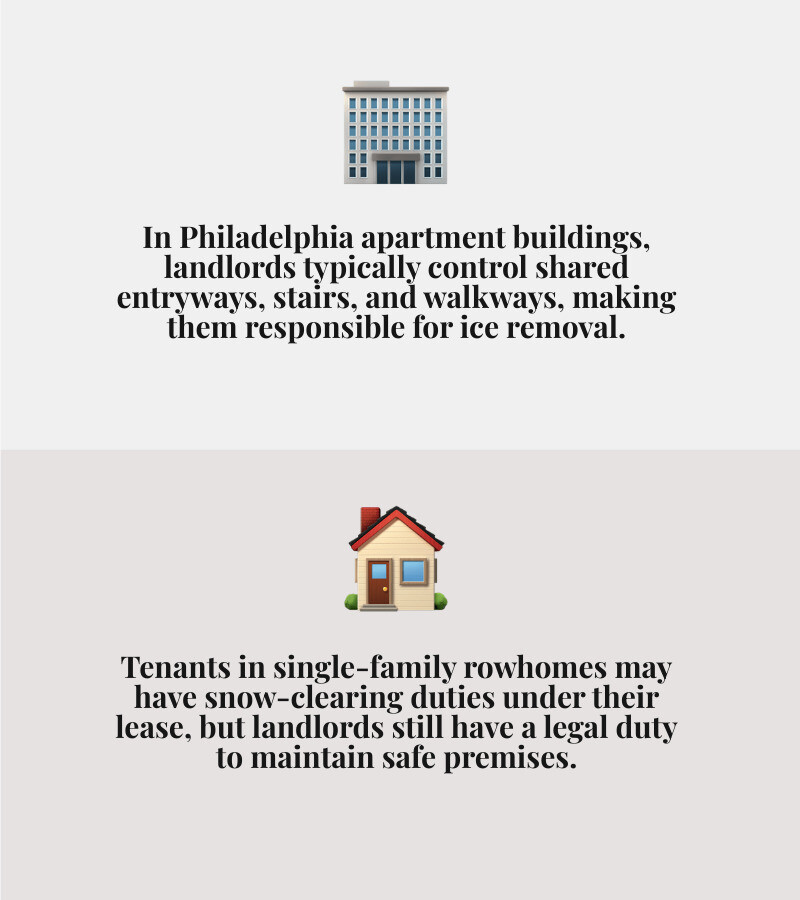
Often, yes, if the landlord controls the icy area. In a Philadelphia apartment building, that includes shared steps and walkways, while rowhome leases may assign snow-clearing duties to tenants.
Philadelphia requires owners or occupants to clear a sidewalk path within six hours after snowfall stops. If you fall, seek medical care promptly and photograph the icy conditions safely. Tell your landlord in writing and preserve prior hazard complaints.
I’m Jason Fine, founding attorney of J. Fine Law, and I’ve spent over 25 years representing injured slip-and-fall victims across Pennsylvania. This article provides a guide for Philadelphia renters on whether their landlord is responsible for ice under city codes and state premises liability principles. In my practice, securing early maintenance records often determines whether a landlord is held liable for dangerous winter hazards.
Responsibility depends heavily on who possesses and controls the area where someone falls. Landlords commonly control shared areas, while tenants handle leased spaces assigned under written contracts. Applicable state tort law and city ordinances determine ultimate legal accountability.
Under Pennsylvania common law, courts evaluate liability through the legal standard of possession and control. According to the Restatement (Second) of Torts § 343, a landlord in possession must exercise reasonable care to discover dangerous conditions. An out-of-possession landlord who leases an entire single-family property generally transfers control of everyday surface maintenance to the tenant.
| Property Type | Area of Hazard | Typical Responsible Party | Key Legal Consideration |
|---|---|---|---|
| Multi-Family Complex | Shared Stairs, Lobbies, Common Walks | Landlord / Property Management | Landlord retains possession and control under Restatement (Second) of Torts § 343 |
| Multi-Family Complex | Abutting Public Sidewalk | Landlord / Property Management | Phila. Code § 10-720 mandates clearance within 6 hours of snowfall cessation |
| Single-Family Rowhome | Exclusive Walkways & Steps | Tenant (if assigned in lease) | Out-of-possession landlord doctrine transfers maintenance duties to tenant |
| Single-Family Rowhome | Structural Defect (Broken Downspout) | Landlord | Landlord duty to maintain structural integrity and prevent artificial hazards |
Is Your Landlord Responsible for Ice in Common Areas of Multi-Unit Buildings?
In multi-family apartment buildings across Philadelphia neighborhoods like Center City and University City, landlords retain exclusive control over common areas. Shared exterior staircases, front entryways, communal courtyards, and parking lots remain the direct responsibility of property owners. Landlords must inspect these locations regularly during freezing conditions.
Municipal guidelines require building management to maintain clear paths for emergency egress. When property managers neglect ice formation on communal steps or parking walkways, their failure creates significant fall risks for tenants.
A Guide for Philadelphia Renters on Whether Their Landlord Is Responsible for Ice in Single-Family Homes
Single-family rowhome rentals operate under different legal principles because tenants usually take exclusive possession of the entire grounds. When a lease assigns exterior shoveling to the tenant, the tenant must clear the private walkways and front steps. Landlords cannot be held liable for surface conditions they do not manage daily.
However, landlords cannot pass city-issued sidewalk citations directly onto renters unless this arrangement is explicitly stated in a signed lease addendum.
What Are the Key Philadelphia Snow and Ice Removal Ordinances for Landlords?
Philadelphia’s snow and ice rules require property owners or occupants to clear sidewalks within a specified period and leave a passable path. These public requirements do not automatically determine who is liable for an injury inside a rental property. The lease and who controlled the area also matter; see the Snow events | Department of Streets | City of Philadelphia guidelines.
Under Philadelphia Code § 10-720, property owners and occupants must clear a continuous pathway of at least 36 inches on abutting sidewalks. This work must be completed within six hours after snowfall stops. Failure to comply can result in municipal fines ranging from $50 to $300 per violation.
Municipal code citations and civil injury liability involve separate legal standards. A city ticket penalizes a municipal violation directly. Establishing injury liability requires proving negligence and causation under Pennsylvania tort law.

How Does the Implied Warranty of Habitability Apply to Winter Hazards?
Pennsylvania recognizes an implied warranty of habitability in all residential leases, established under Pugh v. Holmes, 405 A.2d 897 (Pa. 1979) and reinforced by the Landlord and Tenant Act of 1951 (68 P.S. § 250.101 et seq.). This statutory framework ensures tenants have safe, sanitary, and livable residential housing. Serious structural winter hazards that block safe entrance into a building violate this standard.
Tenants facing unaddressed winter maintenance failures can reference their rights in the city’s official FAIR HOUSING GUIDE. Landlords must address winter emergencies promptly to maintain habitable properties.
What Makes a Landlord Liable When Defective Gutters or Downspouts Cause Ice?
A landlord may face liability when a property defect they knew about or should have addressed causes an unreasonable ice hazard. For example, a broken downspout that repeatedly sends water across a walkway may create unnatural ice accumulation. The circumstances and evidence determine whether the landlord may be responsible.
Under the Pennsylvania “Hills and Ridges” doctrine, property owners are generally shielded from liability for naturally occurring, smooth sheets of ice during ongoing winter storms. However, this defense does not protect landlords when an artificial condition creates the danger. Defective gutters, cracked drain spouts, and improper roof grading force water runoff onto pedestrian paths, creating localized ice traps.
When structural neglect turns routine snowmelt into an isolated sheet of black ice, property owners remain responsible for injuries stemming directly from neglected building repairs.
Is Your Landlord Responsible for Ice? A Guide for Philadelphia Renters on Lease Agreements and Disability Exceptions
A lease may assign some snow-clearing tasks to a tenant, but it cannot necessarily override city rules or remove all landlord responsibilities. Renters with disabilities may also request reasonable accommodations. Whether a lease provision or accommodation applies depends on the property, the request, and the specific circumstances.
While single-family rental leases can assign surface maintenance to tenants, provisions that attempt to waive all landlord liability for structural defects are unenforceable under Pennsylvania law. Landlords must maintain the property’s primary structural components in a safe state regardless of lease language.
Under the federal Fair Housing Act and the Pennsylvania Human Relations Act (43 P.S. § 955), tenants with physical disabilities can request a reasonable accommodation. If an assigned maintenance duty cannot be safely performed due to a documented mobility impairment, landlords must adjust exterior maintenance arrangements accordingly.
What Steps Should You Take Immediately After Slipping on Ice at Your Rental?
Get medical care promptly and document the hazard before it melts or changes, if you can do so safely. Notify the landlord in writing and keep copies of messages. Preserve records of your injuries, treatment, expenses, and any witnesses who saw the fall or the ice.
Prompt action preserves crucial evidence before weather changes alter the scene. Working with a qualified attorney ensures your legal rights remain protected while you focus on recovery.
Critical evidence to gather immediately after an icy fall includes:
- Clear photographs and videos of the ice patch, including wider shots showing downspouts, rooflines, and exterior lighting.
- The precise date, time, and prevailing temperature when the fall took place.
- Written notification sent to the property owner, alongside records of any prior maintenance complaints.
- Contact information from eyewitnesses, neighbors, or delivery drivers who saw the incident.
- Medical documentation and discharge papers from local facilities such as Penn Presbyterian Medical Center or Temple University Hospital.
According to data from the Snow and Ice Management Association, the average claim for a snow- or ice-related injury is $33,000. Building a comprehensive evidentiary record protects your ability to seek fair compensation for these significant medical costs and lost wages.
Holding Negligent Property Owners Accountable Across Philadelphia
Navigating premises liability claims after a severe winter fall requires establishing who controlled the property and identifying structural defects. Our team reviews lease contracts, evaluates municipal code compliance, and gathers weather data to build strong cases. We help injured renters seek full recovery for their medical care, rehabilitation, and lost earnings.
Elderly tenants and senior care residents face severe risks when property owners neglect winter hazards. Our firm maintains a 98% success rate, provides rapid attorney response times, and has recovered over $50 million in settlements for injured clients. We represent tenants throughout Philadelphia injured by neglected property hazards, broken gutters, and untreated common entryways.
Contact Jason Fine at J. Fine Law today to consult with a dedicated Philadelphia premises liability lawyer and elder abuse attorney about your injury case.
Frequently Asked Questions About Landlord Ice Removal in Philadelphia
Can a Philadelphia landlord pass city snow fines to the tenant?
A landlord cannot deduct city-issued sidewalk snow fines from a tenant’s security deposit or demand payment unless the written lease agreement contains an explicit nonstandard rental provision authorizing the charge. Even with lease clauses, the city issues citations under Philadelphia Code § 10-720 directly to the recorded deed owner of the property.
How long does a landlord have to remove ice after a winter storm in Philly?
Under Philadelphia Code § 10-720, property owners have six hours after snowfall stops to clear a 36-inch pathway on abutting public sidewalks. For overnight storms ending late, the compliance clock begins at sunrise. Landlords must clear private common walkways and steps within a reasonable timeframe.
What is the Pennsylvania Hills and Ridges doctrine in ice slip and falls?
The Pennsylvania Hills and Ridges doctrine requires an injured person to prove that ice accumulated in dangerous ridges or mounds that obstructed travel, that the property owner had notice of the condition, and that reasonable time to clear it had elapsed. It does not apply to unnatural ice caused by building defects like broken gutters.