 Skip to content

TBI Law: Your Rights After a Brain Injury in Philadelphia
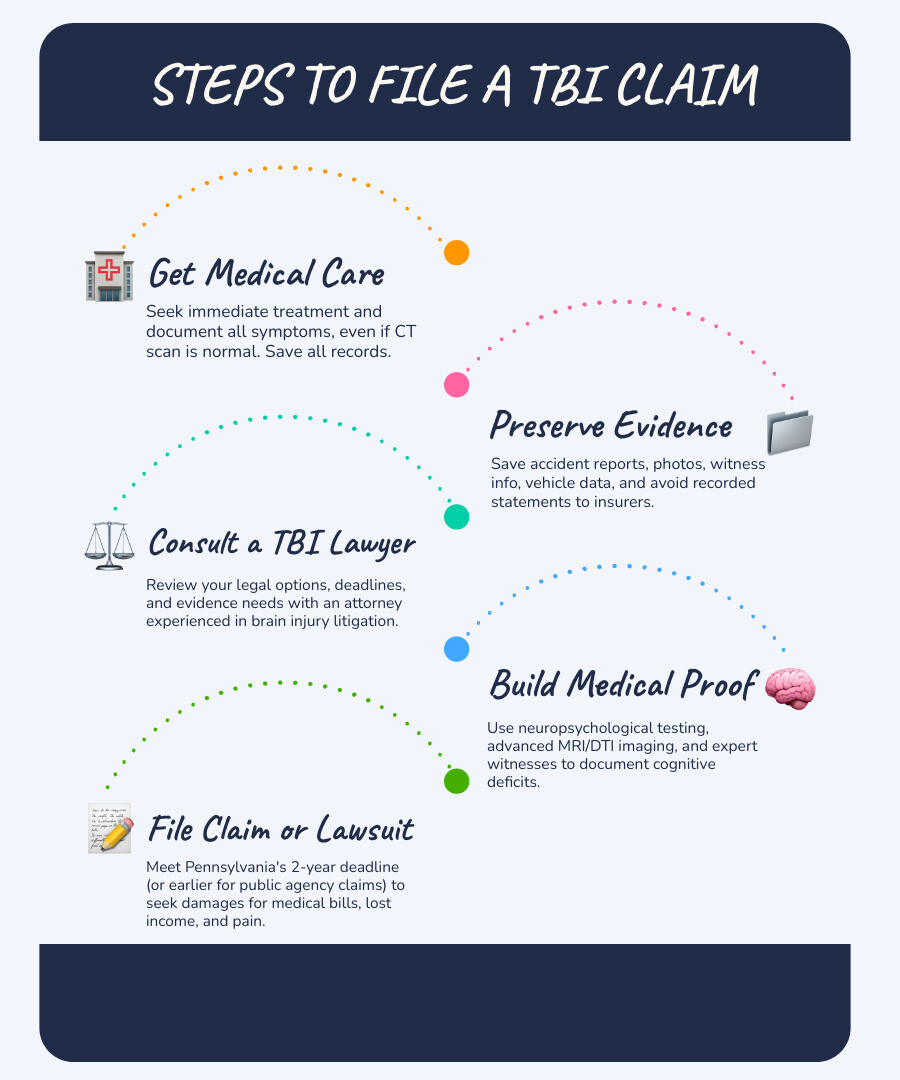
TBI law helps people injured in Philadelphia accidents seek payment when another person or company caused their brain injury. Here are five crucial facts families should know:
- Prompt medical care protects health and evidence. Medical records can document symptoms that may not appear on an initial scan.
- A normal CT scan does not automatically end a claim. Neuropsychological testing and other appropriate medical evidence may document cognitive changes.
- Deadlines can be short. Pennsylvania injury claims often have a two-year filing deadline, while public-agency claims may require earlier notice.
- Compensation can address present and future losses. A claim may seek payment for medical bills, lost income, reduced earning ability, long-term care, and pain and suffering.
- Early legal guidance can help preserve key proof. Accident evidence, vehicle data, witness accounts, and treatment records can become harder to obtain over time.
Brain injuries can be hard to see. A normal emergency-room CT scan does not always rule out cognitive problems after a crash. Medical records, neuropsychological testing, and, when appropriate, advanced imaging can help document memory, focus, mood, or executive-function changes that affect daily life and work.
Deadlines matter. In Pennsylvania, many injury claims have a two-year filing deadline, but claims involving a public agency may require much earlier written notice. Early action also helps preserve vehicle data, witness accounts, and treatment evidence.
I am Jason Fine, founding trial attorney at J. Fine Law, with more than 25 years representing people injured in motor vehicle, truck, bus, fall, workplace, and construction accidents. My work in TBI law focuses on helping injured people understand their options while insurance companies assess their claims.
Similar topics to tbi law:
- traumatic brain injury attorney
- how a lawyer can help with traumatic brain injury recovery
- brain injuries lawyer
Understanding TBI Law and Brain Injury Claims
Traumatic brain injuries alter lives in an instant. Across the United States, brain trauma accounts for 30% of all injury-related fatalities. Each year, roughly 1.5 million Americans sustain a brain injury, leading to more than 230,000 hospital admissions and leaving between 80,000 and 90,000 individuals facing lifelong disabilities. In 2019 alone, approximately 61,000 people lost their lives due to brain trauma complications. Nationwide, between 3.2 million and 5.3 million survivors manage long-term cognitive and physical limitations, creating an estimated national economic impact of $76.5 billion in direct healthcare and indirect productivity losses.
In Philadelphia, our legal practice focuses on navigating the complex personal injury frameworks that protect brain trauma survivors.
| Injury Classification | Glasgow Coma Scale (GCS) Score | Loss of Consciousness Duration | Typical Cognitive & Physical Symptoms |
|---|---|---|---|
| Mild TBI (Concussion) | 13–15 | Less than 30 minutes (or none) | Headaches, brain fog, light sensitivity, sleep disruption, emotional irritability |
| Moderate TBI | 9–12 | 30 minutes to 24 hours | Prolonged confusion, memory deficits, speech difficulties, balance problems |
| Severe TBI | 3–8 | Greater than 24 hours (coma) | Major motor dysfunction, permanent cognitive impairment, loss of executive function |
Medical Classifications and Causes of Brain Trauma
Brain trauma occurs through several mechanisms, including closed head trauma, direct impact, and rotational acceleration forces that cause diffuse axonal injury (DAI). When the head experiences rapid deceleration, the brain strikes the inside of the skull, stretching and tearing microscopic nerve fibers.
Common causes in our region include:
- Violent collisions and auto accidents on major Philadelphia corridors like I-95, Roosevelt Boulevard, and the Schuylkill Expressway (I-76).
- Serious slip and falls on poorly maintained commercial properties along Market Street or Broad Street.
- Workplace incidents, sports impacts, and physical assaults.
These incidents often result in significant cognitive impairment, memory loss, emotional volatility, and post-traumatic stress. Studies indicate that 7 to 8 percent of Americans will experience post-traumatic stress disorder (PTSD) during their lifetimes, a condition that frequently co-occurs with physical head trauma.
How Federal TBI Law Protects Survivors and Advances Research
Federal statutory frameworks provide vital support systems for injury survivors, funding public health research, national surveillance, and first-responder education.
Key federal statutes include:
- The Traumatic Brain Injury Act of 2008, which established comprehensive surveillance systems through the CDC and funded state grant initiatives for improved rehabilitation.
- The TBI and PTSD Law Enforcement Training Act, authorizing $54 million annually to train first responders and police to recognize brain trauma and PTSD symptoms during crisis interventions.
- The Traumatic Brain Injury Reauthorization Act, allocating dedicated annual funding for federal coordination plans and protection and advocacy programs.
Proving Invisible Cognitive Deficits with Advanced Evidence

A frequent challenge in head injury claims is the “invisible” nature of mild-to-moderate brain damage. Insurance adjusters regularly point to normal emergency room CT scans to argue that a claimant has made a complete recovery. Overcoming this defense requires concrete, objective diagnostic documentation.
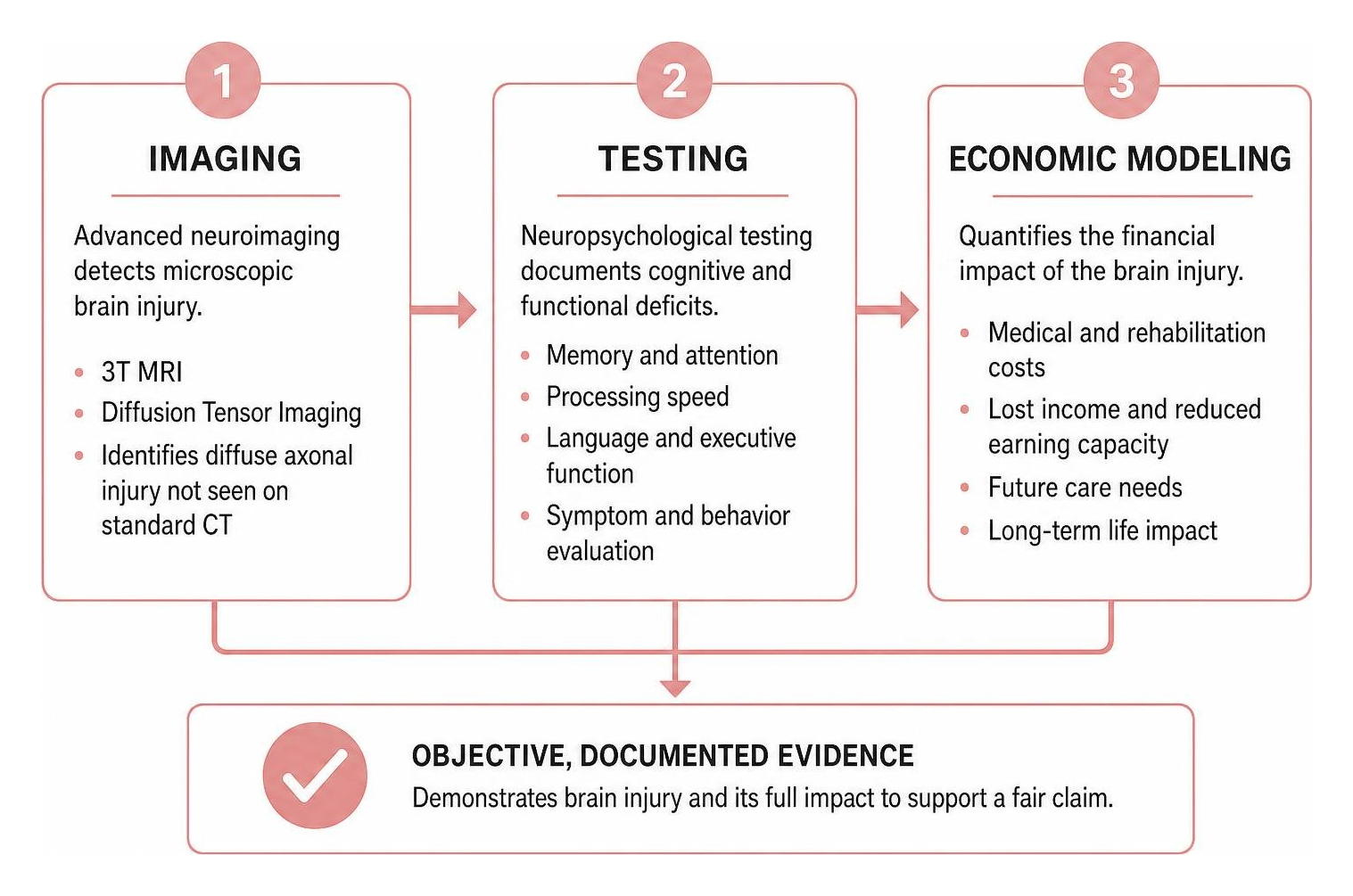
Advanced Neuroimaging: 3T MRI and Diffusion Tensor Imaging
Standard emergency department CT scans are designed to detect acute medical emergencies, such as skull fractures or large intracranial bleeds. They do not have the resolution required to identify microscopic cellular damage.
To prove diffuse axonal injury, our legal team utilizes advanced imaging technologies:
- 3-Tesla (3T) MRI: Delivers twice the magnetic field strength of standard hospital scanners, revealing micro-hemorrhages and structural lesions.
- Diffusion Tensor Imaging (DTI): Measures the movement of water molecules along white-matter tracts in the brain. By calculating fractional anisotropy values, DTI provides visible, objective evidence of torn or disrupted nerve pathways.
The Critical Role of Neuropsychological and Medical Witnesses
Objective imaging must be paired with comprehensive functional assessments. Neuropsychologists administer standardized cognitive test batteries to evaluate memory retention, processing speed, and executive functioning. These assessments include Symptom Validity Tests (such as the Test of Memory Malingering) to verify genuine effort and defeat insurance claims of symptom exaggeration.
Our firm coordinates with a multidisciplinary team:
- Treating Neurologists and Physiatrists: Detail medical diagnoses and physical limitations.
- Neuropsychologists: Quantify cognitive deficits through objective testing.
- Vocational Evaluators: Assess how cognitive deficits restrict work performance and career progression.
- Forensic Economists: Calculate lifetime wage loss and adjust for future inflation.
Calculating Damages and Lifetime Case Valuation
Brain trauma litigation requires evaluating both current losses and decades of future financial needs.
Economic Damages: Earning Capacity and Life Care Plans
Economic damages address the direct financial impact of an injury:
- Past and Future Medical Bills: Hospital stays at facilities like Penn Presbyterian Medical Center or Jefferson Health, surgeries, and ongoing outpatient therapies.
- Lost Earning Capacity: The difference between what a survivor would have earned over their working life and what they can earn post-injury.
- Life Care Plans: Comprehensive assessments prepared by certified life care planners detailing future medical visits, prescription drugs, cognitive rehabilitation, home modifications, and daily personal attendant care.
Non-economic damages compensate for physical pain, emotional suffering, loss of life enjoyment, and hedonic loss. While mild head trauma settlements often exceed $100,000, catastrophic injuries requiring lifetime support can result in multi-million-dollar recoveries.
State Trust Funds and Community Assistance Programs
Beyond civil litigation, survivors can access state-level assistance frameworks designed to facilitate community integration:
- State programs, such as those established under the Colorado Brain Injury Trust Fund Act, allocate public revenues—including traffic surcharges—directly to services (at least 55%), research (at least 25%), and education.
- Specialized Medicaid frameworks, such as the Medicaid TBI Waiver, offer home- and community-based services that help survivors remain in independent living environments rather than long-term institutional care facilities.
Legal Deadlines and Admissibility Standards in Litigation
Statutes of Limitations and Filing Timelines
In Pennsylvania, the statute of limitations for personal injury lawsuits is generally two years from the date of the accident under 42 Pa.C.S. § 5524. However, specific scenarios have distinct deadlines:
- Claims Against Government Agencies: If an injury involves a public entity, such as the City of Philadelphia or SEPTA, written formal notice must be filed within six months.
- Wrongful Death Claims: If a brain injury results in a fatality, family members have two years from the date of death to pursue wrongful death claims.
- The Discovery Rule: In limited situations where an injury was not immediately detectable despite reasonable diligence, statutory clocks may be paused until the harm is discovered.
Navigating State TBI Law and Evidentiary Standards
Presenting complex scientific and medical testimony requires strict adherence to legal evidentiary standards. In Pennsylvania courts, specialized medical testimony must rely on generally accepted scientific methodologies under the Frye standard.
Attorneys must establish that advanced tools like DTI imaging, volumetric MRI analysis, and neuropsychological test batteries rest upon solid scientific principles. Demonstrating this reliability ensures our medical evidence is fully admissible before Philadelphia judges and juries.
Frequently Asked Questions about Brain Injury Claims
How much is a typical traumatic brain injury lawsuit worth?
Case value depends on injury severity, liability clarity, available insurance coverage, and demonstrated financial loss. Mild concussions with full recovery may resolve for tens of thousands to over $100,000. Moderate to severe injuries involving permanent loss of earning capacity and lifetime care plans routinely result in settlements and verdicts reaching into the millions of dollars.
Can I file a TBI lawsuit if my initial hospital CT scan was normal?
Yes. Standard hospital CT scans regularly miss microscopic white-matter damage, torn axons, and subtle cellular shearing. A valid legal claim can be established using 3T MRI scans, Diffusion Tensor Imaging, and objective neuropsychological testing that demonstrates functional cognitive decline.
How long do I have to file a traumatic brain injury claim?
In most Pennsylvania cases, you have two years from the date of injury to file a lawsuit. If a government entity or municipal vehicle was involved, you must provide written notice within six months. Contacting legal counsel immediately helps preserve essential evidence, black box data, and medical records.
Protecting Your Future and Securing Brain Injury Justice
Traumatic brain injuries can fundamentally alter your life, career, and family security. Navigating complex medical diagnoses, insurance defense tactics, and statutory filing deadlines requires responsive, determined trial advocacy. At J. Fine Law, our legal team brings a 98% success rate and a track record of securing over $50 million in settlements and verdicts for injured clients across Philadelphia.
We act swiftly to protect your rights, connect you with top medical resources, and build the evidence needed to demand full compensation. If you or a family member has sustained head trauma caused by another party’s negligence, reach out to our experienced Philadelphia traumatic brain injury lawyers today for a free case evaluation. If a loved one suffered a preventable head injury from facility neglect or mistreatment, consulting an elder abuse attorney at our firm ensures immediate legal protection and dedicated advocacy to hold negligent caregivers accountable.