 Skip to content
Should You Talk to the Other Driver’s Insurance Adjuster After a Philadelphia Crash?
No—before hiring a Philly accident lawyer, you generally do not have to give the other driver’s insurance adjuster a recorded statement or discuss your injuries, fault, or medical history.
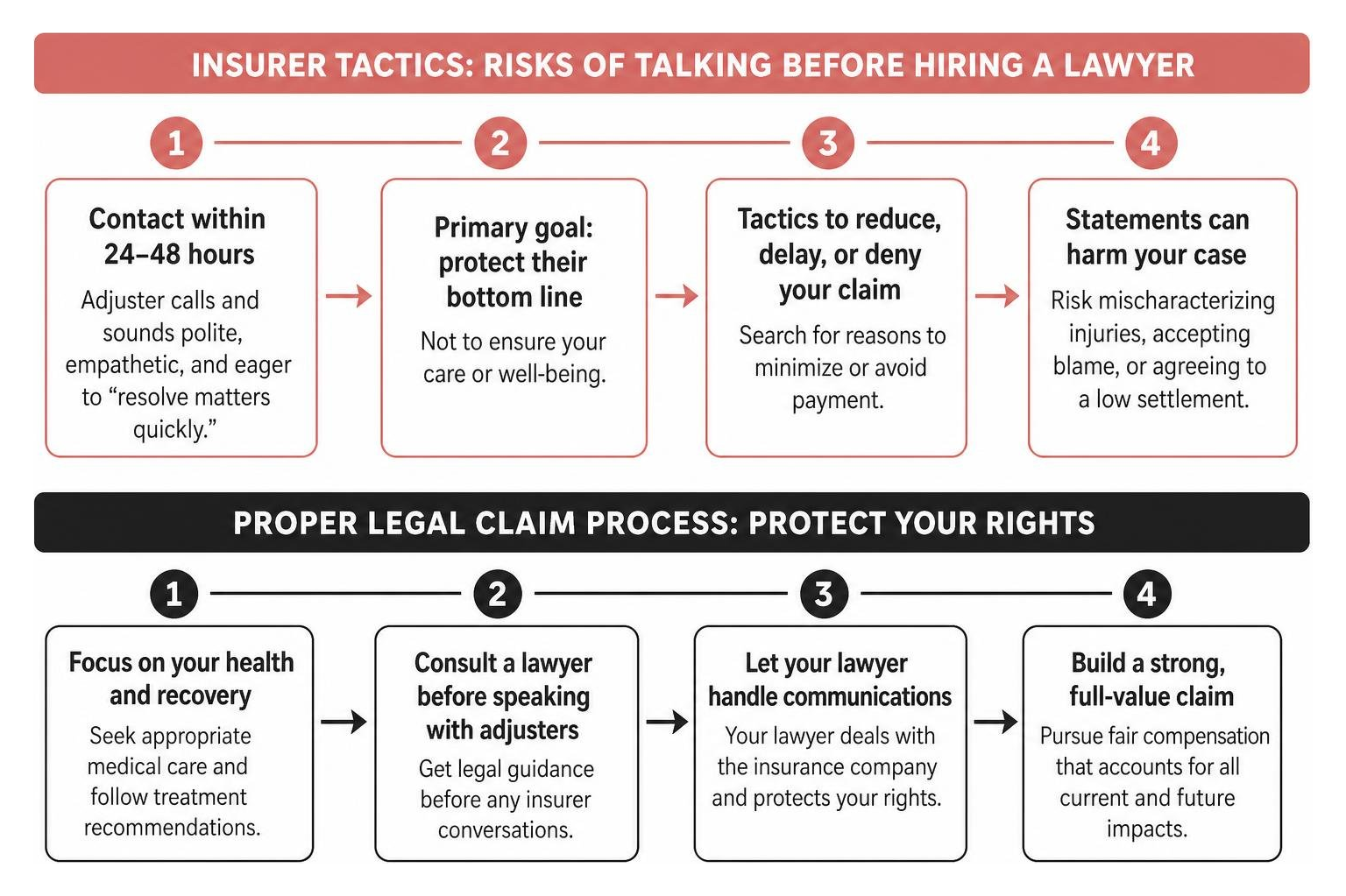
After a collision on Roosevelt Boulevard, I-95, or the Schuylkill Expressway (I-76), the other driver’s insurer may contact you within 24 to 48 hours. The representative may sound polite, empathetic, and eager to resolve the claim quickly, but you are not required to provide a recorded interview before speaking with a lawyer.
You may confirm basic identifying information and the crash date, but it is usually wise to avoid detailed discussions until you understand your injuries and legal options. A premature conversation can affect how the insurer evaluates fault and damages.
When you speak directly with an adjuster without legal guidance, you risk:
- Making offhand statements that mischaracterize your physical condition
- Inadvertently accepting partial blame for the collision
- Agreeing to a premature, low settlement before you understand the long-term impact of your injuries
Are You Legally Obligated to Speak with the Other Driver’s Insurance Company?
No. In Philadelphia, you generally have no legal or contractual duty to give the at-fault driver’s insurance company a recorded statement after a crash in Center City, near I-95, or elsewhere in the city.
Many Philadelphia motorists assume that cooperating with every insurance carrier involved in a wreck is mandatory. It is important to distinguish between your duties at the scene of an accident and a third-party insurer’s post-crash claim investigation.
Under the Pennsylvania Motor Vehicle Code, you are required to stop at the scene, exchange contact and vehicle registration details with the other motorist, and provide your insurance policy information. If the crash involves injuries, death, or severe vehicle disablement, you may also have reporting duties.
Once you leave the scene, your obligations diverge sharply:
- Your Own Insurance Carrier: Your personal auto policy is a binding contract. It may contain a cooperation clause requiring you to promptly report the crash and cooperate with its investigation so you can access first-party benefits, including Pennsylvania medical benefits.
- The Other Driver’s Insurance Carrier: You have no contractual relationship with the at-fault party’s insurer. You generally do not have to give it a recorded interview, discuss your medical history, or answer detailed questions about the collision.
Third-party adjusters may frame their inquiries as routine administrative steps, using phrasing like, “We just need your official statement to complete the liability review.” If a claim later proceeds in the Philadelphia County Court of Common Pleas, the evidence—not a pressured early phone call—will matter.
| Duty / Action | Your Own Insurance Carrier | At-Fault Driver’s Insurance Carrier |
|---|---|---|
| Contractual relationship | Yes, through your policy | No |
| Obligation to report | Follow your policy’s reporting deadline | None solely because the insurer calls |
| Recorded statement | May be required by your policy | Generally not required |
| Medical-record authorization | May be relevant to first-party benefit review | Do not sign a broad authorization without understanding it |
| Primary objective | Process contractual policy benefits | Evaluate and limit its driver’s financial exposure |
By understanding Philadelphia auto accident law, you can better protect your claim from day one.
What Are the Major Risks of Speaking with an Adjuster Without Legal Representation?

Insurance adjusters undergo extensive training in strategic communication. They know how to ask open-ended or leading questions that box claimants into problematic answers.
1. The Trap of Delayed Symptoms
In the immediate aftermath of a collision at a congested intersection like Broad Street and Vine Street, adrenaline masks physical trauma. Severe conditions such as whiplash, spinal disc herniations, and mild traumatic brain injuries often take days or even weeks to produce noticeable symptoms.
If you are discharged from the emergency room at Penn Presbyterian Medical Center or Thomas Jefferson University Hospital and tell an adjuster the next morning that you “feel okay,” that single comment will be entered into your file. When severe nerve pain develops two weeks later, the insurer will point to your initial statement to argue that your injuries were caused by an unrelated event.
2. Pleasantries Turned Into Evidence
Adjusters often open calls with conversational greetings such as, “Good morning, how are you doing today?” A reflexive, polite response like “I’m doing fine, thanks” can be recorded and used in settlement negotiations to suggest you were not experiencing significant pain or distress.
3. Exploiting Financial Stress with Quick Releases
Adjusters frequently offer swift checks within days of an accident, promising to cover initial vehicle repairs and emergency room co-pays if you sign a general release. Signing that release extinguishes your legal right to demand further compensation—leaving you personally responsible for subsequent surgeries, physical therapy, and lost income.
For a deeper look at these pitfalls, review these common reasons accident claims fall apart.
How Does Pennsylvania’s Comparative Negligence Law Impact What You Say?
Pennsylvania’s 51% bar rule means you can recover compensation only if you are 50% or less at fault; if you are found 51% or more responsible, you cannot recover damages from the other party.
Pennsylvania follows a modified comparative negligence system under 42 Pa.C.S. § 7102. For a Philadelphia crash claim, the rule works this way:
- You can recover compensation as long as your share of responsibility is 50% or less.
- If you are found to be 51% or more at fault, you are legally barred from recovering compensation from the other party.
- Any percentage of fault assigned to you directly reduces your financial award by that proportion.
Adjusters may look for details they can use to shift partial blame onto you after a crash on Roosevelt Boulevard, Broad Street, or I-95. Innocent remarks can be characterized as evidence of fault, including:
- “I didn’t see their car until the last second” — which may be characterized as inattention
- “I was running a couple of minutes late for work” — which may be used to suggest speeding or hurried driving
- “The weather was awful and visibility was bad” — which may be used to suggest unsafe driving for the conditions
An experienced car accident insurance lawyer can handle insurer communications and help ensure your words are not treated as admissions of fault.
What Exactly Should You Say If the Other Driver’s Adjuster Calls You?
If the opposing insurance company calls your phone, remain polite, calm, and brief. Follow these practical communication steps:
What You May Safely Provide:
- Your full legal name and current contact details
- The date, approximate time, and general location of the accident
- Confirmation of the vehicles involved
What You Must Strictly Decline to Discuss:
- Detailed explanations of how the crash occurred
- Any assessment of fault, speed, or road conditions
- Specific injury descriptions, diagnoses, or pain levels
- Your past medical history
- Any agreement to provide a recorded statement
Safe Word-for-Word Phone Scripts:
When asked to give an account of the collision:
“I am not prepared to provide a detailed statement at this time. Once I have concluded my medical evaluations and retained legal counsel, my attorney will handle all factual inquiries.”
When asked to consent to a recorded statement:
“I do not consent to any audio recording. Please forward all written inquiries to my legal counsel.”
When pressed to discuss your physical injuries:
“I am currently undergoing medical evaluation and treatment. I will not discuss my injuries until my care is complete.”
If you have already provided a recorded statement before reading this guide, do not panic. Write down everything you remember discussing, obtain a copy of the claim number and adjuster’s contact details, and contact an attorney immediately to take corrective measures.
How Does a Philadelphia Accident Lawyer Shield You from Insurance Tactics?
Retaining legal representation shifts the balance of power back in your favor. The moment an attorney enters an appearance on your behalf, formal legal notice is served to all insurance carriers. Under Pennsylvania ethics rules and insurance guidelines, the adjuster must immediately stop calling you directly. All correspondence, record requests, and negotiations must go through your lawyer’s office.
What Legal Representation Provides:
- Total Communication Buffer: You are freed from high-pressure phone calls and confusing paperwork while you focus on medical rehabilitation.
- Accurate Case Valuation: Your damages are calculated using comprehensive documentation—including future medical projections, lost earning potential, physical impairment, and emotional trauma.
- Aggressive Settlement Negotiation: Insurers are forced to negotiate based on verifiable evidence rather than pressure tactics.
Our firm provides steadfast protection against insurance company shenanigans. At J. Fine Law, we advocate for Philadelphia injury victims with a 98% success rate, rapid attorney response times, and over $50 million recovered for our clients.
To evaluate your legal options, schedule a Philadelphia injury attorney free consultation.
What Are the Most Frequently Asked Questions About Talking to Insurance Adjusters?
Find additional practical guidance in our detailed Philadelphia car accident lawyer FAQ.
Can I withdraw or correct a recorded statement I already gave to the other insurer?
Once an audio statement is recorded, it becomes part of the insurer’s formal file and cannot simply be deleted or erased. However, an attorney can counter problematic statements by presenting objective police accident reports, traffic camera footage, accident reconstruction findings, and certified medical records from providers across Philadelphia.
What happens if I refuse to give a recorded statement to the other driver’s insurance adjuster?
Nothing negative happens to your legal rights. Refusing an opposing insurer’s recorded interview is standard legal practice. The adjuster cannot dismiss your bodily injury claim solely because you declined to give a statement. They remain legally obligated to investigate the facts based on evidence, witness statements, and police reports.
Why is the insurance adjuster offering to settle my claim within days of the accident?
Insurers make rapid settlement offers to close claims before the full extent of your physical injuries is uncovered. By dangling an immediate payout, they attempt to secure a signed release of liability that cuts off your right to demand compensation for necessary future treatments or missed work.
Protect Your Rights and Financial Recovery After a Philadelphia Crash
Following a car collision in Philadelphia, your top priority must always be your health and physical recovery. Seeking immediate medical care at a regional facility, declining to give recorded statements to third-party adjusters, and avoiding premature settlements are the most effective ways to preserve your claim.
Insurance companies have teams of adjusters and defense lawyers working to limit their financial responsibility. When vehicular collisions impact vulnerable senior citizens, or when post-accident injuries expose systemic neglect in care facilities or assisted transport, having the right legal advocate makes all the difference. Whether navigating complex crash claims or seeking counsel from an elder abuse attorney to safeguard an injured loved one’s rights, our dedicated team is here to help. Reach out to J. Fine Law today to protect your family and take control of your recovery.