 Skip to content

What Determines a Wrongful Death Claim Amount in Cherry Hill?
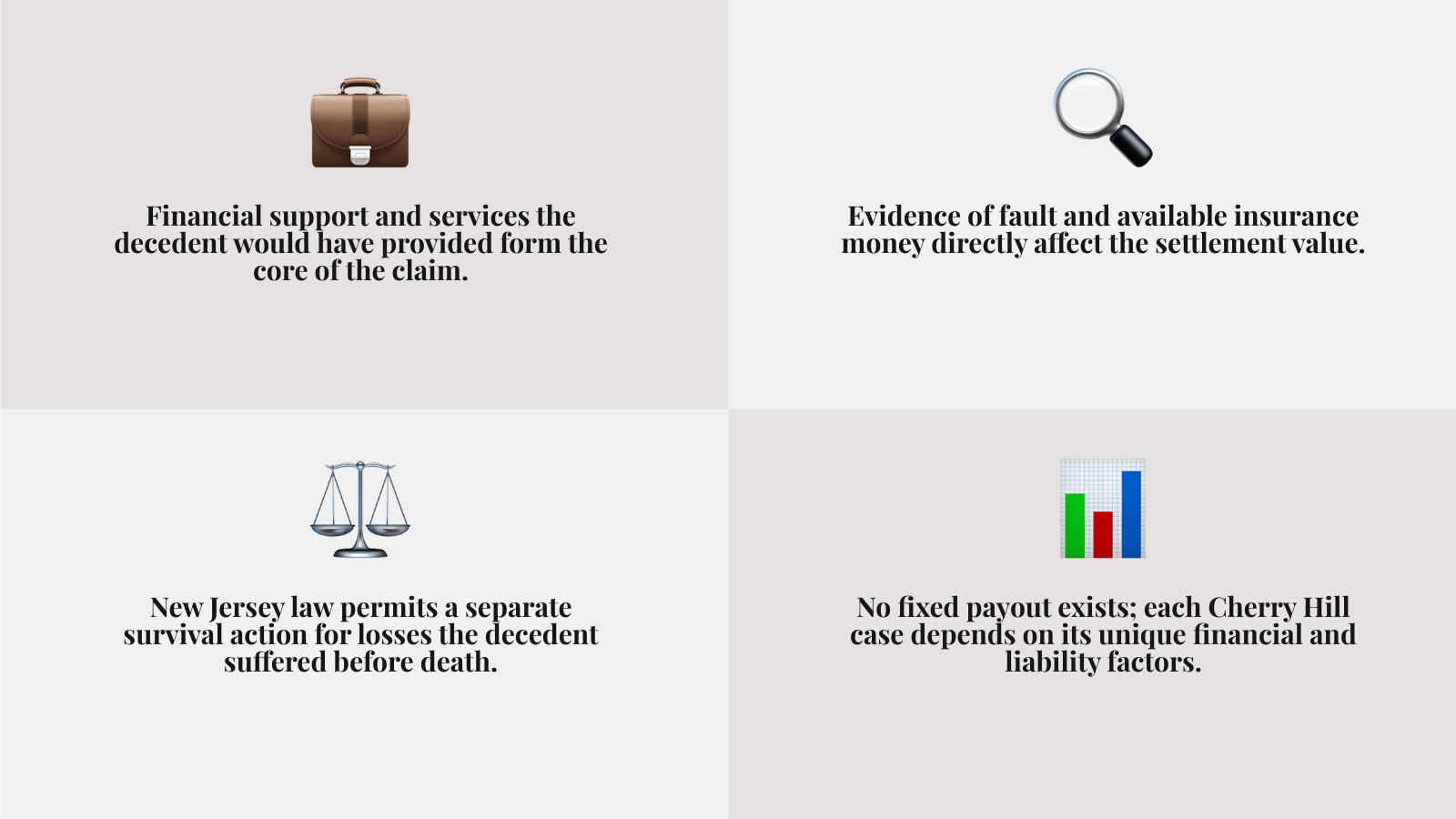
Four key elements guide the value of a wrongful death claim amount in Cherry Hill: income and benefits the family has lost, unpaid household work the person provided, proof that another party caused the death, and the coverage or assets available for recovery. The final value depends on the facts and documentation in the case. A survival claim may also compensate the estate for qualifying harm experienced before the death.
I’m Jason Fine, founding member of J. Fine Law, with more than 25 years representing people harmed in serious accidents. If you need help assessing a wrongful death claim amount, contact Jason Fine to discuss your family’s case.
What Factors Determine a Wrongful Death Claim Amount in New Jersey?
A New Jersey wrongful death claim amount depends on the financial losses suffered by eligible survivors and the evidence supporting those losses. Relevant factors include the decedent’s expected earnings, household services, medical expenses before death, and the strength of the liability case. Available insurance coverage also affects recovery limits.
Every fatal accident involves distinct financial and personal circumstances. When securing fair compensation with an NJ wrongful death lawyer in Cherry Hill, our team evaluates each statutory loss driver under N.J.S.A. 2A:31-1. We examine lifetime earnings, loss of parental guidance, and necessary end-of-life expenses.
How Decedent Age and Earnings Impact the Wrongful Death Claim Amount
A person’s age and income trajectory heavily influence the overall financial recovery. Younger individuals with decades of potential career advancement create substantial future loss projections for their dependents.
To calculate these economic damages accurately, attorneys evaluate several key variables:
- Current salary, benefits, and projected raises
- Anticipated work life expectancy based on health and career history
- Total value of lost household contributions, including childcare and home maintenance
- Number and ages of dependent children requiring ongoing care
How Liability Evidence and Insurance Policy Limits Affect Settlement Value
Clear evidence of fault increases negotiation leverage against insurance carriers. Whether a fatal collision occurs along Route 70 or Route 38, physical evidence and witness testimony establish legal responsibility.
Available insurance policies set practical recovery ceilings. An individual auto policy may carry limited coverage, while commercial trucking crashes often involve multi-million dollar umbrella policies. In high-stakes national litigation, a court ruling on multi-million dollar collision damages shows how clear liability can result in major awards when policy resources exist.
What Is the Average Settlement Range for Fatal Accident Claims?
There is no single average settlement range that reliably predicts an individual fatal accident claim’s value. Published figures are often skewed by unusually large verdicts, and outcomes depend on specific facts, proven losses, liability evidence, and insurance limits. Every claim requires examining verifiable economic losses.

Media reports often highlight record-breaking verdicts that do not reflect typical local recoveries. Our attorneys evaluate Camden County benchmarks based on hard economic proof rather than statistical generalizations.
Comparing Average vs Median Wrongful Death Claim Amount Statistics
Across national datasets, the average wrongful death settlement reaches approximately $973,054, but the median settlement sits at $294,728. The median provides a realistic benchmark because multi-million dollar results pull mathematical averages upward.
Severe industrial catastrophes like a major plant explosion wrongful death recovery can result in eight-figure payouts. These rare outcomes create broad statistical ranges, spanning from $80,000 to over $15 million.
Settlement Ranges by Incident Type Across New Jersey
Different incident categories involve varying insurance structures and liability standards. Below is an overview of how claim types commonly resolve across New Jersey:
| Incident Type | Typical Settlement Range | Primary Valuation Factors |
|---|---|---|
| Motor Vehicle Crashes | $500,000 – $2,000,000 | Available auto policy limits, comparative fault, passenger status |
| Medical Malpractice | $1,000,000 – $5,000,000 | Hospital insurance tiers, standard of care breaches, pre-existing health |
| Commercial Trucking | $1,000,000 – $10,000,000+ | Federal motor carrier insurance, corporate liability, severity of impact |
| Workplace Accidents | $500,000 – $3,500,000 | Third-party contractor negligence, equipment defects, employer safety rules |
How Do New Jersey Laws and Survival Actions Influence Total Compensation?
New Jersey law provides distinct legal paths for wrongful death losses and estate claims. The wrongful death claim compensates eligible family survivors, while a survival action recovers damages for conscious pain and suffering the decedent endured before death. Both actions together ensure full accountability under state law.
Families must understand both statutes. The New Jersey Wrongful Death Act (N.J.S.A. 2A:31-1) compensates surviving family members for pecuniary losses, while the New Jersey Survival Act (N.J.S.A. 2A:15-3) preserves the decedent’s personal injury claim for the estate.
Wrongful Death Claims vs Survival Actions in Camden County
Wrongful death actions focus on survivors’ direct losses, such as lost financial support, lost parental guidance, and funeral costs. These proceeds pass directly to statutory beneficiaries without passing through the general estate debt process.
Survival actions address the harm the victim experienced between injury and death. If the person survived for any period at Jefferson Cherry Hill Hospital, the estate can seek compensation for conscious pain and suffering.
Absence of Non-Economic Damage Caps Under New Jersey Law
Unlike many states, New Jersey places no statutory cap on damages in standard wrongful death cases. However, recovery remains strictly limited to pecuniary losses, meaning grief itself is not compensable.
Under New Jersey’s comparative negligence statute (N.J.S.A. 2A:15-5.1), compensation is reduced if the decedent shared fault, and is barred entirely if the decedent is more than 50% responsible.
Who Is Legally Eligible to File a Fatal Accident Claim in Cherry Hill?
In New Jersey, the personal representative generally brings a wrongful death lawsuit for the benefit of eligible survivors. Who may share in a recovery and how it is allocated depend on the applicable law and the family’s circumstances. Financial dependency and inheritance rules may be relevant to determining beneficiaries.
State law sets a strict order of priority for who receives financial recovery. The court evaluates actual financial dependency rather than emotional closeness when dividing settlement proceeds.
Primary Beneficiaries and Inheritance Distribution Rules
The law prioritizes those who relied directly on the decedent for financial support. Recovery distribution follows clear statutory guidelines:
- Surviving spouses and dependent children receive top priority in settlement allocations.
- Surviving parents may recover damages if no spouse or dependent child exists, or if they prove actual financial dependency.
- Siblings and other extended relatives are eligible only if they establish complete financial dependence on the decedent.
- Camden County courts hold formal allocation hearings to distribute funds fairly among multiple beneficiaries.
Role of the Estate’s Personal Representative
Individual family members cannot file separate, competing wrongful death lawsuits in New Jersey courts. The action must be filed by the court-appointed personal representative of the estate.
If the decedent left a valid will, the named executor brings the action. If no will exists, the Camden County Surrogate Court appoints an Administrator Ad Prosequendum to lead the litigation on behalf of all heirs.
What Is the Timeline and Process to Settle a Fatal Accident Case?
A fatal accident claim typically takes between one and three years to resolve through investigation, negotiation, and potential litigation. The timeline varies based on evidence complexity, liability disputes, insurer cooperation, and judicial approval requirements. Families must also meet statutory filing deadlines.
Most fatal accident cases resolve through settlement negotiations before trial. Complex cases involving corporate defendants or disputed liability may require more time for discovery and trial preparation.
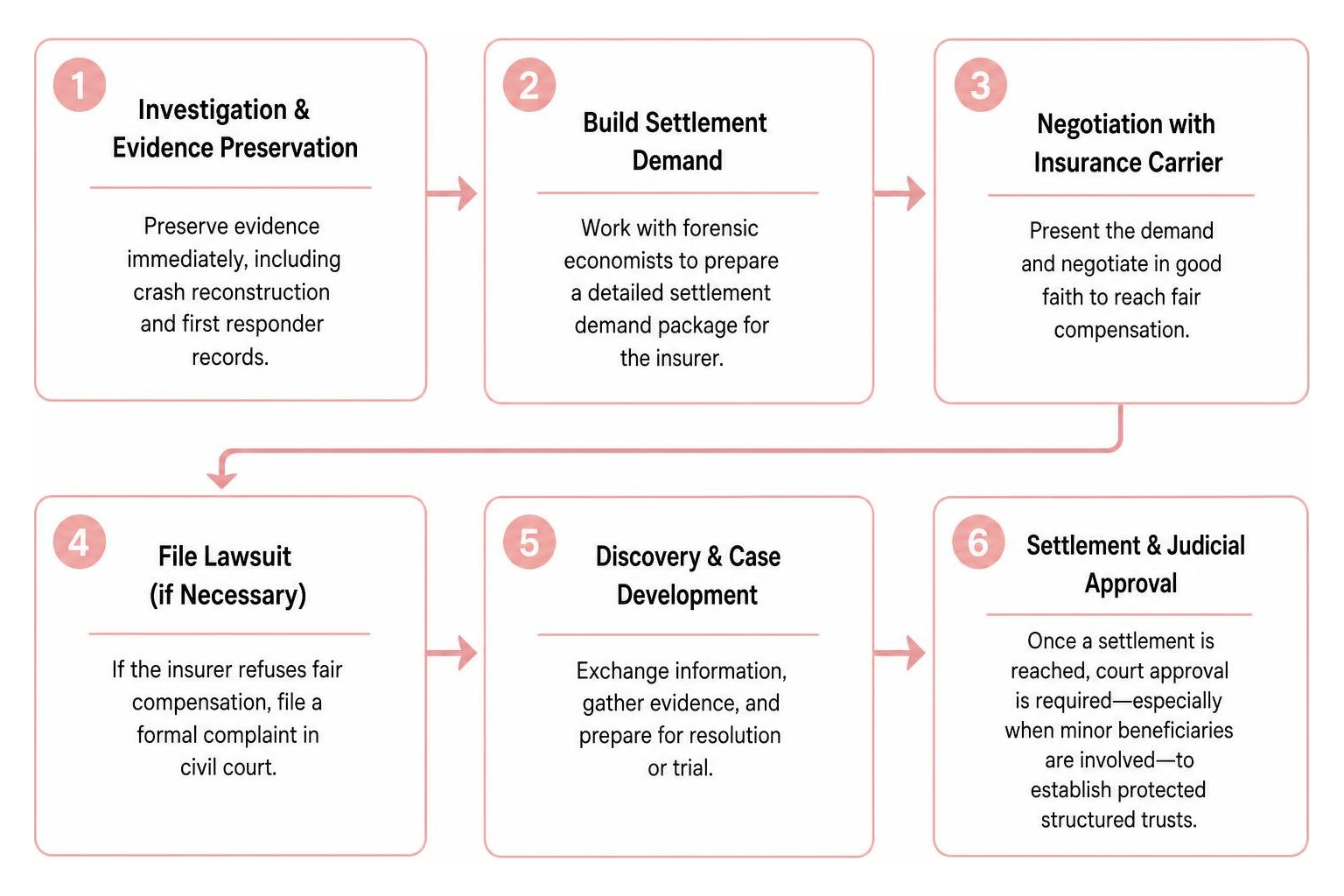
Investigation, Settlement Demand, and Judicial Approval Stages
The claim begins with evidence preservation, including crash reconstruction and gathering records from local first responders. Our team works with forensic economists to build a settlement demand package for the insurer.
If the insurer refuses fair compensation, we file a formal complaint in civil court. Once a settlement is reached, New Jersey law requires judicial approval for settlements involving minor beneficiaries to establish protected trusts.
Two-Year New Jersey Statute of Limitations Deadline
Families must monitor the strict filing deadlines set by state law. Under N.J.S.A. 2A:31-3, claims must be filed within two years of the date of death.
Missing this deadline permanently eliminates your legal right to compensation. If the claim involves a public entity, such as a municipal vehicle on Haddonfield Road, a formal Title 59 notice must be filed within 90 days.
Protecting Your Family’s Financial Future
Every fatal injury case turns on precise financial proof, survivor needs, and available insurance coverage. With a 98% success rate and over $50 million recovered for injury victims, J. Fine Law stands ready to protect your legal rights.
If your family lost a loved one due to nursing home neglect or care facility mistreatment, consult an elder abuse attorney today. Contact Jason Fine to schedule a free case evaluation.
Frequently Asked Questions About Fatal Injury Claims
Can an online calculator accurately determine my case value?
Online calculators cannot provide an accurate case valuation. They cannot account for complex liability disputes, comparative negligence rules, specific insurance policy caps, or the quality of evidence. Only a detailed legal evaluation of financial and medical records can determine realistic compensation.
Are fatal accident settlement proceeds taxable in New Jersey?
Under IRS Section 104, compensatory settlements recovered for wrongful death and personal physical injuries are generally non-taxable at federal and state levels. However, any portion of an award specifically designated as punitive damages or accrued interest is subject to standard income taxation.
How long does an insurance payout take after reaching an agreement?
Once both parties sign formal release agreements, settlement payouts typically arrive within four to eight weeks. If the settlement requires approval from the Camden County Surrogate Court or involves resolving outstanding medical liens, the disbursement process can take slightly longer.
{ “@context”: “https://schema.org”, “@type”: “FAQPage”, “mainEntity”: [ { “@type”: “Question”, “name”: “Can an online calculator accurately determine my case value?”, “acceptedAnswer”: { “@type”: “Answer”, “text”: “Online calculators cannot provide an accurate case valuation. They cannot account for complex liability disputes, comparative negligence rules, specific insurance policy caps, or the quality of evidence. Only a detailed legal evaluation of financial and medical records can determine realistic compensation.” } }, { “@type”: “Question”, “name”: “Are fatal accident settlement proceeds taxable in New Jersey?”, “acceptedAnswer”: { “@type”: “Answer”, “text”: “Under IRS Section 104, compensatory settlements recovered for wrongful death and personal physical injuries are generally non-taxable at federal and state levels. However, any portion of an award specifically designated as punitive damages or accrued interest is subject to standard income taxation.” } }, { “@type”: “Question”, “name”: “How long does an insurance payout take after reaching an agreement?”, “acceptedAnswer”: { “@type”: “Answer”, “text”: “Once both parties sign formal release agreements, settlement payouts typically arrive within four to eight weeks. If the settlement requires approval from the Camden County Surrogate Court or involves resolving outstanding medical liens, the disbursement process can take slightly longer.” } } ] }