 Skip to content
The moments following a motor vehicle collision on high-risk Philadelphia roadways like Broad Street, Roosevelt Boulevard, or the Schuylkill Expressway can be chaotic. However, the actions you take in the immediate aftermath are critical to protecting both your physical health and your legal right to financial recovery.
Your first priority must always be safety. If you are involved in a crash, stop your vehicle immediately in a safe location. If the vehicle is operable and it is safe to do so, move it to the shoulder of the road to prevent secondary collisions on busy city streets. Turn on your hazard lights, check yourself and your passengers for injuries, and immediately call 911 to request the Philadelphia Police and emergency medical services.
While waiting for emergency responders to arrive, you must gather essential information and document the scene. Exchange contact, driver’s license, and insurance details with all involved motorists. It is vital to record the insurance company name and policy number exactly as they appear on the card. Additionally, look for eyewitnesses who saw the crash occur and collect their names and phone numbers; unbiased witness statements are invaluable if liability is later disputed.
Use your smartphone to thoroughly document the scene. Take high-quality photos and videos from multiple angles showing:
- Vehicle damage (both interior and exterior)
- The positions of the vehicles relative to the roadway
- Road conditions, skid marks, and debris
- Traffic signals, stop signs, and temporary construction zones
- Visible physical injuries
Even if you believe your injuries are minor, you must seek an immediate medical evaluation. Gaps in medical treatment are one of the most common reasons insurance companies deny claims. Many serious injuries, including whiplash, concussions, internal trauma, and soft tissue damage, may not show symptoms right away due to the adrenaline of the event.
Visit a local emergency room or urgent care facility, such as Temple University Hospital, Penn Presbyterian Medical Center, or Jefferson Health, within 24 hours of the crash. Prompt medical records serve as objective, third-party evidence linking your injuries directly to the accident. If you delay medical care, insurance adjusters will argue that your injuries were either pre-existing or caused by an unrelated event. For a deeper understanding of how these medical evaluations translate into financial recovery, read our guide on Demystifying Damages: Your Guide to Personal Injury Compensation.
How Do You File a Claim and Determine Liability in Pennsylvania?
Pennsylvania operates under a unique “choice no-fault” auto insurance system. This means that regardless of who caused the accident, your own auto insurance policy’s Personal Injury Protection (PIP) coverage is responsible for paying your initial medical bills.
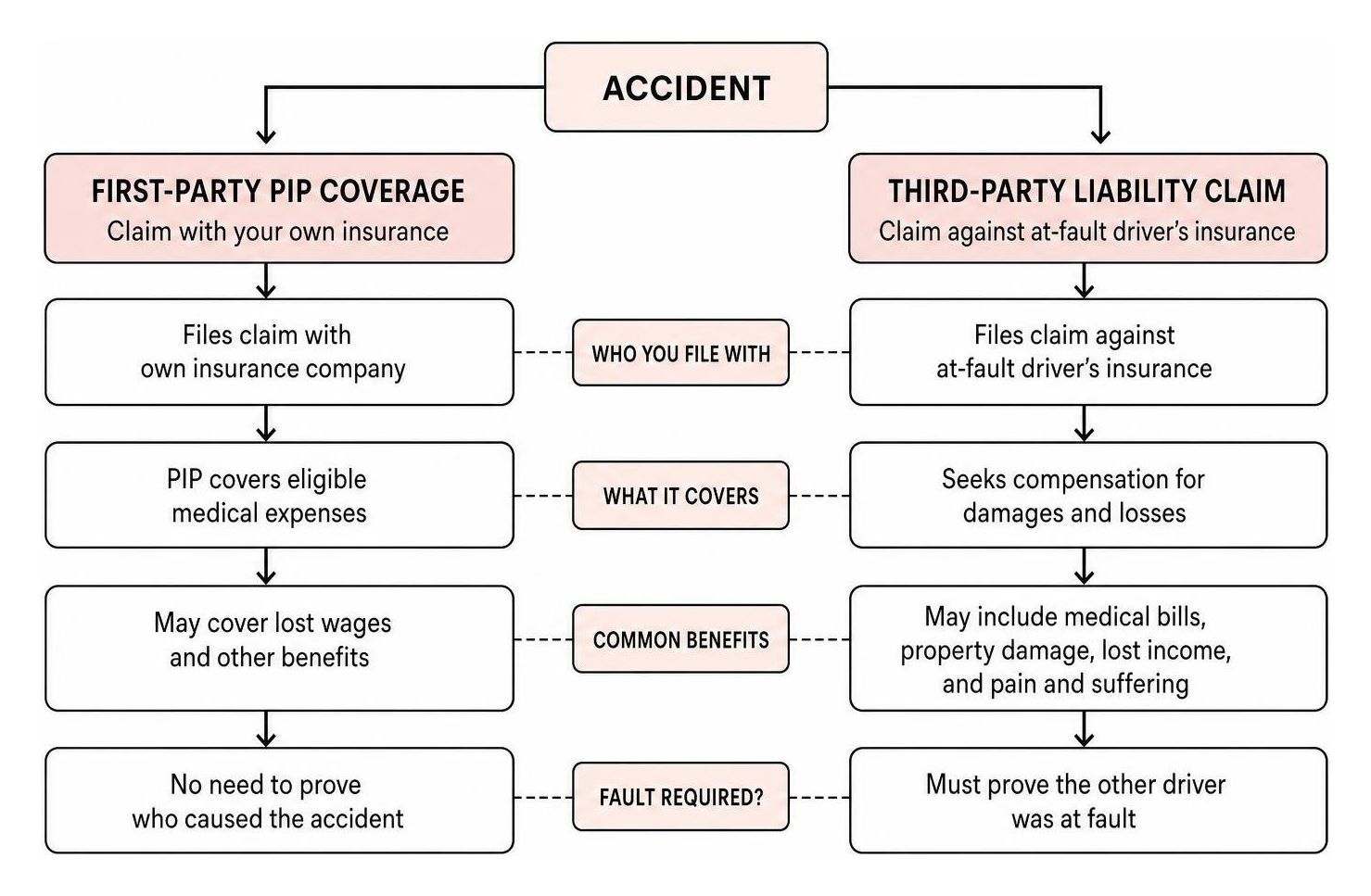
When you are ready to seek compensation for vehicle damage, lost wages, and severe injuries, the process involves two distinct types of claims:
- First-Party Claim: Filed with your own insurance company to cover medical expenses under your PIP coverage and vehicle repairs if you carry collision coverage.
- Third-Party Claim: Filed against the at-fault driver’s insurance carrier to recover compensation for property damage, outstanding medical bills, lost income, and pain and suffering.
Once a claim is filed, insurance adjusters from both companies will launch investigations to determine fault. Adjusters review the physical evidence, photograph damages, take statements, and examine the official police accident report. In Philadelphia, the police report is a foundational piece of evidence used to establish liability, as it contains the responding officer’s objective observations and any citations issued at the scene.
If the other driver’s insurance company disputes fault or claims you share responsibility for the crash, Pennsylvania’s modified comparative negligence rule comes into play. Under this law, you can still recover compensation as long as your percentage of liability is 50% or less. However, your final financial recovery will be reduced by your exact percentage of fault. For example, if you are awarded $100,000 but are found to be 20% at fault for failing to avoid the collision, your final payout will be $80,000. If you are found to be 51% or more at fault, you are legally barred from recovering any compensation from the other party. To learn more about how fault is established, review our detailed breakdown of the Car Accident Claim process.
What Types of Compensation Can You Recover for Your Injuries?
When seeking financial recovery, your compensation is divided into two primary categories: economic damages and non-economic damages.
Economic damages represent your concrete, measurable financial losses resulting from the accident. These are proven using bills, receipts, and employment records, and include:
- Medical Expenses: Past, present, and future medical bills, including emergency room visits, surgeries, physical therapy, prescription medications, and medical devices.
- Lost Wages: Income lost due to time taken off work to recover from your injuries.
- Diminished Earning Capacity: Compensation if your injuries prevent you from returning to your previous job or working at the same capacity as before the accident.
- Out-of-Pocket Expenses: Travel costs to medical appointments, home modifications for accessibility, and property damage.
Non-economic damages compensate you for the intangible, non-financial impacts of the crash. These are more complex to calculate and include physical pain and suffering, emotional distress, loss of consortium, and a loss of enjoyment of life.
In Pennsylvania, your ability to recover non-economic damages is heavily influenced by whether you selected “limited tort” or “full tort” coverage when purchasing your auto insurance policy. If you have full tort coverage, you retain the unrestricted right to seek compensation for pain and suffering regardless of the severity of your injury. If you selected limited tort, you gave up the right to sue for pain and suffering unless your injuries meet the legal threshold of a “serious impairment of body function.”
Understanding these distinctions is vital to maximizing your recovery. For a comprehensive look at what you can recover, read about making a Car Accident Compensation Claim.
How Do You Negotiate a Settlement and Avoid Common Insurance Pitfalls?
Negotiating with insurance companies requires caution. Insurance adjusters are trained to minimize payouts and protect their company’s bottom line. One of their most common tactics is to offer a quick, lowball settlement immediately after the crash, hoping you will sign away your rights before the true physical and financial scope of your injuries is fully known.
To secure a fair settlement, you must build a solid, evidence-backed case. This begins with obtaining, reviewing, and correcting any factual errors in your official medical reports. Your medical records must clearly document the diagnosis, treatment plan, and long-term prognosis. Consistent medical treatment is vital; missing doctor appointments or failing to complete prescribed physical therapy gives the insurance company a reason to claim your injuries are not as severe as you state.
When communicating with insurance adjusters, keep these rules in mind:
- Do not provide recorded statements: Adjusters can use your own words against you to shift blame or downplay your pain.
- Stick to the facts: Do not speculate about fault, speed, or the extent of your injuries.
- Never sign a release agreement prematurely: Once you sign a release and cash a settlement check, you cannot seek additional compensation if your injuries worsen.
Once your medical treatment is complete or you have reached Maximum Medical Improvement (MMI), a comprehensive demand letter should be drafted and sent to the insurer. This letter details the facts of the accident, establishes the other driver’s liability, outlines your medical treatments, and presents an itemized list of your economic and non-economic damages.
If the insurance company refuses to negotiate fairly, you must be prepared to stop negotiating and take your case to court. Having a dedicated legal team manage all communications and build your case is the most effective way to avoid these pitfalls and secure maximum compensation. For professional guidance, consider consulting a Personal Injury Settlement Lawyer and explore our resources on Car Accident Settlement Help.
What Are the Deadlines and Legal Options If Your Claim Is Denied?
If negotiations stall or the insurance company denies your claim, you have the legal right to file a civil lawsuit. In Pennsylvania, the statute of limitations for filing a personal injury lawsuit is strictly two years from the date of the accident.
Missing this two-year deadline permanently bars you from seeking financial recovery in court, regardless of how severe your injuries are or how clear the other driver’s liability is. While property damage claims may have different timelines, starting the legal process immediately after a crash is essential to preserve critical physical evidence, secure traffic camera footage, and obtain fresh witness testimonies.
If you must file a lawsuit, the case is typically initiated in the Philadelphia Court of Common Pleas. The litigation process involves filing a formal complaint, entering the discovery phase where both sides exchange evidence, and participating in depositions.
Fortunately, filing a lawsuit does not mean you will end up in a lengthy courtroom trial. The vast majority of car accident cases are successfully resolved through strategic, out-of-court negotiations and mediations before ever reaching a jury.
At J. Fine Law, we utilize a rapid-response approach to protect our clients’ rights from day one. Our firm has achieved a 98% success rate, securing over $50 million in settlements for injured victims across Pennsylvania and New Jersey. We understand how to counter bad-faith insurance denials and build trial-ready cases that force insurers to offer fair compensation. To see how we have helped others in similar situations, review our history of Pennsylvania Settlements.
Frequently Asked Questions About Philadelphia Car Accident Claims

How long do I have to file a car accident claim in Pennsylvania?
In Pennsylvania, you have a strict two-year statute of limitations from the exact date of the crash to file a personal injury lawsuit. If you fail to file within this window, you lose your right to sue the at-fault party. Property damage claims generally carry a longer timeline, but you should always initiate your insurance claims immediately to ensure evidence is preserved and witness memories remain clear.
Can I still claim compensation if the accident was partially my fault?
Yes. Pennsylvania follows a modified comparative negligence rule. You can recover compensation as long as your share of the blame for the accident is 50% or less. However, your final financial recovery will be reduced by your percentage of fault. Having an aggressive legal advocate on your side is crucial to prevent insurance companies from unfairly shifting the blame to you in order to lower their payout.
What should I do if the at-fault driver does not have auto insurance?
If you are hit by an uninsured motorist or are the victim of a hit-and-run, you can seek compensation through the Uninsured Motorist (UM) or Underinsured Motorist (UIM) coverage on your own auto insurance policy. These claims are filed directly with your insurer and can cover your medical bills, lost wages, and pain and suffering up to your policy limits. Because your own insurer may still try to minimize your payout, navigating these claims requires the same level of legal preparation as a standard third-party lawsuit.
Secure Your Financial Recovery with Trusted Philadelphia Advocacy
Claiming car accident compensation quickly and successfully requires immediate action, thorough documentation, and a clear understanding of Pennsylvania’s complex insurance laws. From the moment a crash occurs on busy streets like Broad Street or Roosevelt Boulevard, the decisions you make will directly impact your physical and financial recovery.
You do not have to fight insurance companies alone. Having an aggressive legal team on your side makes a measurable difference in your final settlement outcome. The dedicated attorneys at J. Fine Law have spent more than two decades standing up to insurance companies, protecting the rights of injured motorists, passengers, and pedestrians throughout the Philadelphia area.
If you or a loved one has been injured in a motor vehicle collision, contact us today for a free, no-obligation consultation. We will review your case, handle the insurance adjusters, and fight to secure the maximum compensation you deserve.
Additionally, if you have vulnerable family members in local care facilities and suspect they are suffering from mistreatment, our legal team is also prepared to step in. Reach out to us to speak with an experienced elder abuse attorney who can protect your loved ones and hold negligent facilities accountable.