 Skip to content

Why Do You Need a Wrongful Death Case Evaluation in Cherry Hill?
By Jason Fine, Founding Attorney at J. Fine Law
A wrongful death case evaluation in Cherry Hill helps your family determine whether another party’s negligence caused your loved one’s death. This comprehensive review examines medical evidence, calculates future financial losses, identifies statutory beneficiaries, and ensures all legal actions meet strict New Jersey filing deadlines before critical evidence disappears.
When an unexpected tragedy occurs on Route 70 or during a stay at Jefferson Cherry Hill Hospital, the legal aftermath feels overwhelming. Our team at J. Fine Law investigates the underlying incident to build a foundation for legal accountability. We have recovered over $50 million in settlements for clients with a 98% success rate, giving grieving families the leverage they need against insurance carriers.
Who Has Standing to File in New Jersey?
Under the New Jersey Wrongful Death Act (N.J.S.A. 2A:31-1), an individual action cannot be filed directly by every grieving relative. The lawsuit must be brought by the court-appointed personal representative or administrator of the decedent’s estate.
Any financial recovery is distributed strictly to eligible statutory beneficiaries who suffered a pecuniary loss. These beneficiaries typically include the surviving spouse, dependent children, or surviving parents.
Statutory Deadlines and the Discovery Rule
In New Jersey, families must comply with strict New Jersey wrongful death claim deadlines under N.J.S.A. 2A:31-3. The statute of limitations requires the claim to be filed within two years from the exact date of death.
If the fatal incident involved a public entity or municipal employee, the New Jersey Tort Claims Act requires a formal notice of claim within 90 days. Waiting too long can permanently bar your family from securing justice.
What Is the Difference Between a Wrongful Death and Survival Action?
A wrongful death claim compensates surviving family members for the financial support, household services, and guidance they lost due to their loved one’s passing. In contrast, a survival action allows the decedent’s estate to recover damages for the conscious pain, suffering, and medical bills endured prior to death.
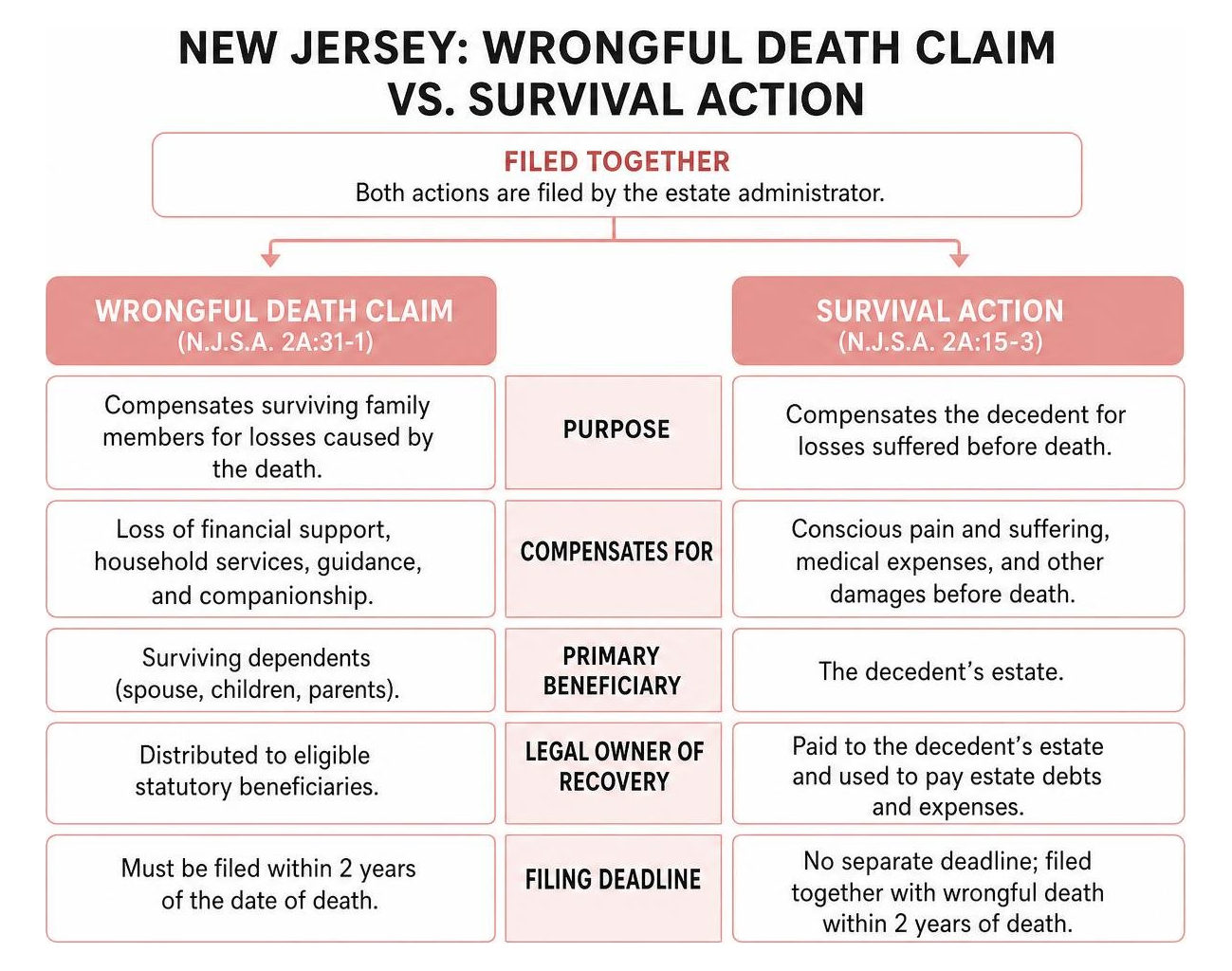
Understanding how these dual claims function is essential when filing a wrongful death lawsuit in New Jersey. Both actions are filed together by the estate administrator but serve distinct legal functions under New Jersey law.
| Claim Element | Wrongful Death Claim (N.J.S.A. 2A:31-1) | Survival Action (N.J.S.A. 2A:15-3) |
|---|---|---|
| Primary Beneficiary | Surviving dependents (spouse, children, parents) | The decedent’s estate |
| Key Recoverable Losses | Lost financial support, lost household services, advice | Conscious pain and suffering, pre-death medical bills |
| Tax and Creditor Impact | Distributed directly to dependents; shielded from estate debts | Subject to estate administration and creditor claims |
| Time Period Covered | Losses occurring after the date of death | Losses occurring between initial injury and death |
Types of Damages Recoverable Under Each Claim
Survival actions under N.J.S.A. 2A:15-3 preserve the rights the decedent would have possessed had they survived. This allows the estate to recover hospital expenses incurred at facilities like Cooper University Hospital and compensation for pre-death physical suffering.
Wrongful death actions focus outward on the family’s future deprivation. These claims seek compensation for funeral expenses, lost inheritance, and the replacement value of daily parental support.
Proving Pecuniary Loss for Surviving Dependents
New Jersey limits wrongful death damages to measurable pecuniary or financial losses rather than direct emotional grief. Our firm evaluates detailed family contributions to determine fair wrongful death settlement calculations.
We quantify lost household chores, child care, career coaching, and financial dependency. This ensures the full economic impact on surviving family members is clearly documented.
How Are Economic and Future Losses Calculated During Case Review?
Calculating economic losses requires analyzing the decedent’s earning history, fringe benefits, life expectancy, and household contributions. Forensic financial models project lifetime earnings while subtracting personal consumption, ensuring the resulting settlement figure accurately reflects the true financial support the surviving family lost.
Proper case valuation requires deep familiarity with forensic calculations of economic damages to ensure calculations withstand defense scrutiny. Employer fringe benefits frequently account for 25% of private-sector compensation and 40% of public-sector compensation, making thorough documentation vital.
Forensic Projections in a Wrongful Death Case Evaluation
During an evaluation, we analyze historical W-2 forms, tax returns, and worklife expectancy tables. We apply the Life, Participation, and Employment method to project career trajectory and nominal wage growth.
From these gross figures, we deduct estimated personal consumption expenditures using Consumer Expenditure Survey benchmarks. The remaining balance represents the net financial support the decedent would have provided to their household.
Present Value Discounting and Prejudgment Interest
Future earnings awards must be reduced to present value using reliable discount rates based on low-risk securities. This ensures that an invested lump sum matches the decedent’s projected future earnings without creating a financial windfall.
Courts carefully balance discount rates against statutory interest accrual, as established in the landmark Toledo v. Ni Christo ruling on discounting and interest. Accrued out-of-pocket losses, such as immediate funeral and medical bills, are also evaluated for applicable interest.
How Do Courts Handle Causation and Preexisting Medical Conditions?
Courts resolve causation by determining whether the defendant’s negligent act was a substantial factor in causing the fatal outcome. When a preexisting medical condition is present, legal analysis focuses on whether the negligent conduct aggravated the condition or measurably reduced the patient’s overall probability of survival.
Proving liability in complex matters often relies on legal research on valuing the loss of chance of survival. Even if an individual had underlying health struggles, defendants remain legally responsible for harm caused by their negligence.
Assessing Medical Causation During a Wrongful Death Case Evaluation
Evaluating fatal outcomes requires a line-by-line review of diagnostic testing, treatment delays, and hospital monitoring logs. In medical malpractice wrongful death cases, we establish whether medical providers deviated from accepted standards of care.
Our attorneys analyze whether earlier medical intervention would have altered the outcome. We obtain objective opinions from healthcare professionals to satisfy New Jersey’s burden of proof.
Loss of Chance Valuation and Comparative Negligence
When medical negligence reduces a patient’s survival odds, courts value the lost opportunity using either a proportional percentage or a lump-sum method. If a doctor’s delay reduces a patient’s survival chance from 40% to 10%, the 30% lost chance represents compensable harm.
New Jersey also enforces a modified comparative fault rule under N.J.S.A. 2A:15-5.1. A claimant can recover damages as long as their share of fault does not exceed 50%, though any award is reduced by their assigned percentage of responsibility.
What Evidence Is Critical Across Different Fatal Accident Types?
Critical evidence includes electronic event data recorders, maintenance records, witness testimony, surveillance footage, and professional accident reconstructions. Preserving this evidence immediately after the incident prevents vital electronic information from being overwritten and stops physical proof from being altered by defendants.
Whether an incident occurs on Route 38, Interstate 295, or on commercial property, immediate investigation is essential. Gathering physical evidence early allows us to establish clear liability against all negligent parties.
Commercial Truck Collisions and Premises Liability Incidents
In fatal truck accident claims, we immediately secure electronic logging device logs, engine control module data, and driver qualification files. These records reveal hours-of-service violations and commercial safety breaches under federal trucking regulations.
In fatal premises liability or nursing home incidents, we subpoena internal surveillance footage, staffing logs, and incident reports. This evidence shows whether property owners or facilities ignored hazardous conditions.
Structuring Settlements for Minors and Estate Beneficiaries
When settlements involve minor children, funds are placed into structured settlement annuities or court-supervised trusts. These financial vehicles protect the recovery, providing guaranteed, tax-free distributions for college tuition and living expenses as the child matures.
All settlements involving estates require formal approval from the New Jersey Superior Court or local surrogate’s office. This ensures funds are allocated according to statutory guidelines.
Frequently Asked Questions About Wrongful Death Evaluations
How much does a comprehensive case evaluation cost?
At J. Fine Law, your initial case review is free. We handle wrongful death claims on a contingency fee basis, covering upfront investigation and filing costs. You owe us nothing unless we recover compensation for your family.
Can a family file a civil claim if criminal charges were dropped?
Yes, a civil wrongful death action is separate from criminal proceedings. Criminal courts require proof beyond a reasonable doubt, while civil claims rely on the lower preponderance-of-the-evidence standard. You can pursue a civil claim even if criminal charges were never filed or were dismissed.
How long does it take to settle a fatal accident claim?
A wrongful death claim can take months to over a year to resolve. The timeline depends on accident reconstruction complexity, the number of liable parties, and insurer responsiveness. We prepare every claim for trial so settlement talks reflect the full value of your loss.
{ “@context”: “https://schema.org”, “@type”: “FAQPage”, “mainEntity”: [ { “@type”: “Question”, “name”: “How much does a comprehensive case evaluation cost?”, “acceptedAnswer”: { “@type”: “Answer”, “text”: “At J. Fine Law, your initial case review is free. We handle wrongful death claims on a contingency fee basis, covering upfront investigation and filing costs. You owe us nothing unless we recover compensation for your family.” } }, { “@type”: “Question”, “name”: “Can a family file a civil claim if criminal charges were dropped?”, “acceptedAnswer”: { “@type”: “Answer”, “text”: “Yes, a civil wrongful death action is separate from criminal proceedings. Criminal courts require proof beyond a reasonable doubt, while civil claims rely on the lower preponderance-of-the-evidence standard. You can pursue a civil claim even if criminal charges were never filed or were dismissed.” } }, { “@type”: “Question”, “name”: “How long does it take to settle a fatal accident claim?”, “acceptedAnswer”: { “@type”: “Answer”, “text”: “A wrongful death claim can take months to over a year to resolve. The timeline depends on accident reconstruction complexity, the number of liable parties, and insurer responsiveness. We prepare every claim for trial so settlement talks reflect the full value of your loss.” } } ] }Take the First Step Toward Justice and Family Financial Security
Losing a family member to negligence brings immense emotional and financial strain. Securing a complete legal assessment ensures your family’s rights and financial stability remain protected under New Jersey law.
Our firm acts rapidly to preserve essential evidence, interview witnesses, and construct a compelling claim. Contact Jason Fine at J. Fine Law today to speak with a dedicated Cherry Hill wrongful death lawyer and elder abuse attorney about your case.