 Skip to content
Doctor’s Orders? Not Always Right: Consult a Malpractice Lawyer in Philadelphia
When Medical Trust is Broken: Understanding Malpractice in Philadelphia
A Medical malpractice lawyer helps injured patients hold negligent healthcare providers accountable and recover compensation for preventable harm caused by substandard medical care.
When You Need a Medical Malpractice Lawyer:
- A doctor, nurse, or hospital made an error that worsened your condition or caused new injuries
- You suffered harm from misdiagnosis, surgical mistakes, medication errors, or delayed treatment
- Medical bills are piling up from injuries that could have been prevented
- You need legal counsel to prove a healthcare provider breached the standard of care
- Pennsylvania’s two-year statute of limitations is approaching
Medical errors are shockingly common. According to Johns Hopkins patient safety researchers, more than 250,000 people die every year in the U.S. due to medical error, making it a leading cause of death. When you walk into Thomas Jefferson University Hospital, Penn Presbyterian Medical Center, or any healthcare facility along Roosevelt Boulevard in Philadelphia, you place enormous trust in the professionals treating you. But that trust isn’t always honored.
Medical malpractice isn’t just a bad outcome; it’s an injury caused by a healthcare provider’s negligence, meaning they failed to meet the accepted standard of care. Proving this is complex, as large insurance companies, like Medical Protective (MedPro), vigorously defend these claims. These cases are among the most challenging in personal injury law.
I’m Jason Fine, a ten-time Pennsylvania Super Lawyers nominee who has spent over 25 years representing injured patients throughout Philadelphia and Bucks County in complex medical malpractice cases. A Medical malpractice lawyer with trial experience can steer the aggressive defense tactics hospitals and insurance companies use to deny your claim.
What Legally Constitutes Medical Malpractice?
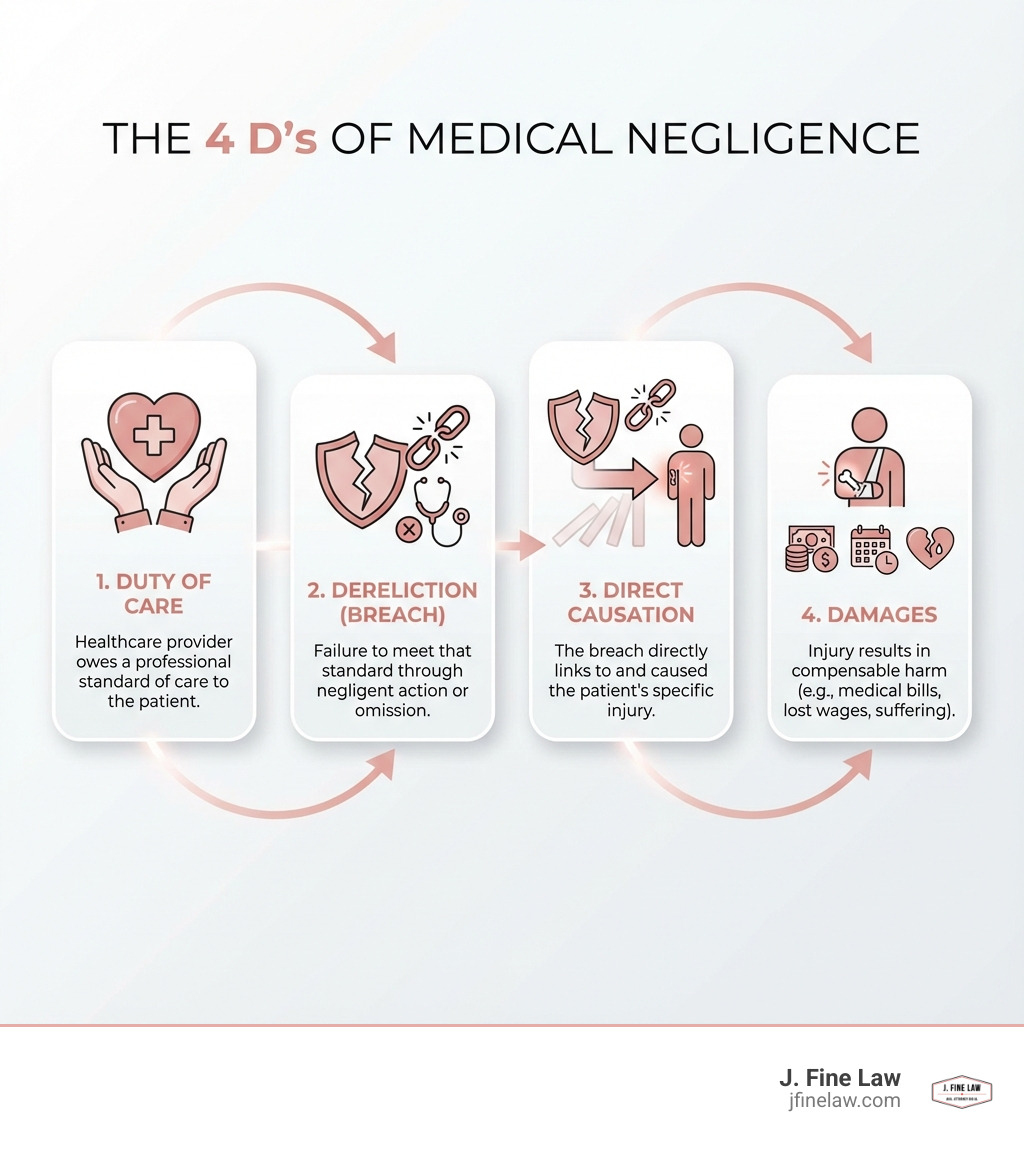
Medical malpractice, or medical negligence, occurs when a healthcare professional fails to provide care that meets the accepted standards of their profession, and this failure results in harm. To establish a medical malpractice claim in Philadelphia, our legal team must prove four key elements, known as the “four D’s of medical negligence”:
- Duty of Care: A doctor-patient relationship establishes a duty of care, meaning the provider agreed to treat you.
- Dereliction of Duty (Breach of Standard of Care): The provider breached this duty by failing to meet the accepted standard of care. This means their actions fell below what a competent peer would have done, such as misreading lab results in Philadelphia, leading to a delayed diagnosis.
- Direct Cause (Causation): The breach of duty must be the direct cause of your injury. We must prove the error itself, not an underlying condition, caused the harm. This is often the most challenging part of a case.
- Damages: You must have suffered significant damages—physical, emotional, or financial—due to the negligence. Without provable harm, there is no case.
An unfavorable outcome doesn’t automatically equal malpractice. As the American Bar Association (ABA) clarifies, there are no guarantees in medicine. We must prove an injury resulted from a deviation from the standard of care. For more details, you can refer to the ABA’s information on What is Malpractice? .
Common Types of Medical Negligence Cases
Medical negligence can happen in any healthcare setting, from major Philadelphia hospitals to local clinics in Cherry Hill, NJ. Here are some of the most common types of medical malpractice cases we handle:
- Misdiagnosis or Delayed Diagnosis: Failure to correctly or promptly diagnose a condition, leading to worsened outcomes. For example, a Feasterville, PA, doctor mistaking a heart attack for indigestion.
- Surgical Errors: Mistakes during an operation, such as wrong-site surgery, leaving instruments inside a patient, or damaging nerves.
- Anesthesia Mistakes: Anesthesia errors can cause brain damage or death. This includes incorrect dosage, poor monitoring of vital signs, or improper intubation.
- Birth Injuries: Negligence during childbirth causing lifelong injuries to a newborn, like cerebral palsy or brain damage from oxygen deprivation.
- Medication Errors: Prescribing, dispensing, or administering the wrong drug or dosage, leading to dangerous side effects or allergic reactions.
- Hospital-Acquired Infections: Failure by hospital staff to maintain sanitary conditions or follow sterilization protocols, leading to preventable infections.
- Failure to Treat: A correct diagnosis followed by a failure to provide timely or appropriate treatment, causing preventable harm.
- Nursing Home Negligence: Malpractice in nursing homes across the Philadelphia area, including medication errors, neglect leading to bedsores or falls, and inadequate supervision. For more information, you can read our guide on nursing-home-abuse-malpractice-lawyer-philadelphia.
How a Philadelphia Medical Malpractice Lawyer Builds Your Case

Suspecting medical negligence is overwhelming. A knowledgeable Medical malpractice lawyer in Philadelphia steps in to manage the complex legal process. Our first step is a meticulous investigation, starting with gathering all your medical records from institutions like Pennsylvania Hospital or Cooper University Hospital. We understand that hospitals and their insurers have powerful legal teams dedicated to denying claims. Our experience allows us to anticipate and counter their tactics, protecting your rights under Pennsylvania law.
Proving Your Case: The Role of a Medical Malpractice Lawyer
Proving medical malpractice is a rigorous process. As your Philadelphia medical malpractice lawyer, our role is to build a compelling case that links the provider’s negligence directly to your injuries.
In Pennsylvania, we must obtain an Affidavit of Merit. This is a statement from a qualified medical professional in the same field, confirming a reasonable probability that the care you received was substandard and caused your injury. This step shows why experienced legal guidance is vital from the start.
Proving a breach of the standard of care relies on testimony from qualified medical professionals. Juries need to hear from other medical professionals to understand what a competent doctor should have done. We work with a network of physicians, surgeons, and nurses who review your case and can clearly explain how the standard of care was breached. As the ABA notes, this testimony is critical for a jury to determine if a provider’s actions were negligent. You can learn more about this on the Medical Malpractice page.
Proving causation can be difficult. We must show that the provider’s negligence—not your original condition—directly caused your injury. This requires careful documentation of how the injury occurred and progressed.
In rare cases, the doctrine of “res ipsa loquitur” (“the thing speaks for itself”) applies. Negligence can be inferred if the injury is obvious, like a surgical instrument left in the body. However, most cases require detailed analysis from medical professionals.
Our firm is also prepared for the findy process, which includes deposing healthcare staff. Taking sworn testimony outside of court helps us gather facts, understand what happened, and prepare for settlement talks or trial.
Navigating Pennsylvania’s Strict Deadlines
Time is critical in medical malpractice cases. Pennsylvania has a strict two-year statute of limitations, meaning you generally have two years from the date of the negligent act to file a lawsuit. If you miss this deadline, you lose your right to pursue compensation.
However, this can be complicated by the findy rule. Under this rule, the two-year clock starts when you find, or reasonably should have finded, both the injury and that it was caused by someone else’s conduct. This is critical in cases like a delayed diagnosis where the harm isn’t immediately apparent.
For minors, the clock typically doesn’t start until they turn 18. Regardless of these exceptions, it is crucial to act quickly. Contacting a Medical malpractice lawyer in Philadelphia, Cherry Hill, or Feasterville as soon as possible ensures evidence is preserved and deadlines are met, preserving your right to sue.
The Path to Compensation and Justice

Pursuing a medical malpractice claim in Philadelphia is about seeking justice and financial recovery. Our firm guides you through the entire process, from investigation to settlement talks or trial. While many cases settle, we prepare every case as if it will go to court to ensure we are ready to fight for the compensation you need to recover.
What Damages Can Be Recovered in a Lawsuit?
A successful medical malpractice lawsuit aims to recover damages that address the wide-ranging impacts of a medical error. Damages are typically categorized into economic and non-economic.
| Type of Damage | Description |
|---|---|
| Economic Damages | These are calculable financial losses resulting from the malpractice. |
| Medical Bills | Reimbursement for all medical care related to the injury, including hospital stays, surgery, and rehab. |
| Future Care Costs | Compensation for anticipated future medical needs, from therapy and equipment to in-home care. |
| Lost Wages | Reimbursement for income lost while you were unable to work. |
| Loss of Earning Capacity | Compensation for a permanent reduction in your ability to earn income. |
| Non-Economic Damages | Compensation for subjective, non-monetary losses that affect your quality of life. |
| Pain and Suffering | Compensation for the physical pain and emotional distress caused by the injury. |
| Emotional Distress | Covers psychological harm like anxiety, depression, or PTSD from the malpractice. |
| Loss of Enjoyment of Life | Compensation for the loss of ability to enjoy hobbies and daily activities. |
| Loss of Consortium | Compensation for the impact of the injury on a marital relationship. |
In cases of egregious negligence, punitive damages may be awarded to punish the provider and deter future misconduct. If a loved one dies from malpractice, a wrongful death claim can be filed by family members to recover funeral costs, lost financial support, and loss of companionship. Our firm handles these sensitive cases with the utmost compassion.
What to Expect from Your Medical Malpractice Lawyer in Philadelphia
When you contact our firm in Philadelphia, Cherry Hill, or Feasterville, we provide dedicated support and clear communication.
Your case begins with a free consultation and case evaluation. We will listen to your story, assess the legal merits of your claim, and explain the potential risks and outcomes.
We work on a contingency fee agreement, meaning you pay no fees unless we win your case. Our firm covers all upfront costs for investigation. J. Fine Law is proud of our 98% success rate and our commitment to clients.
Clear attorney-client communication is a priority. Our team is responsive and transparent, and our rapid response commitment means we are here to provide guidance throughout the process.
If you believe you or a loved one has suffered harm due to medical negligence in Philadelphia, Bucks County, or South Jersey, don’t hesitate to reach out. We are here to fight for your rights and pursue the compensation you deserve.
For a free case review, Contact our Philadelphia office for a free case review today. We are ready to listen and help you on your path to justice.