 Skip to content
What You Need to Know Before Hiring Bus Accident Attorneys in Philadelphia
Bus accident attorneys Philadelphia residents trust most will tell you the same thing: these cases are nothing like a typical car accident claim. The rules are different, the deadlines are shorter, and the stakes are much higher.
| Key Factor | What You Need to Know |
|---|---|
| SEPTA notice deadline | You have only 6 months to file a notice of intent to sue |
| Compensation cap | Pennsylvania limits recovery to $250,000 per person for government buses |
| Standard of care | Bus companies must meet a higher duty of care than regular drivers |
| Liable parties | Can include the driver, transit authority, maintenance company, or manufacturer |
| Evidence window | Bus camera footage and maintenance logs can disappear within days |
| Attorney fees | Most bus accident attorneys work on contingency – no win, no fee |
Every day in Philadelphia, thousands of people board SEPTA buses, school buses, and private coaches trusting that they will arrive safely. That trust is not always honored. According to the Pennsylvania Department of Transportation, 2022 saw 461 commercial bus crashes and 274 school bus crashes – more than the year before. Nationally, an estimated 54,000 bus accidents happen every year, injuring tens of thousands of people.
If you were hurt on a bus near Jefferson Health, Penn Medicine, or anywhere along Broad Street or Market Street, you are likely overwhelmed right now – dealing with medical bills, missed work, and insurance calls you are not sure how to handle. This guide is for you.
I am Jason Fine, senior trial attorney and founding member of J. Fine Law Group, and with over 25 years of experience representing injured Philadelphians as one of the leading bus accident attorneys Philadelphia has to offer, I have seen how quickly these cases can be won or lost depending on how fast you act.
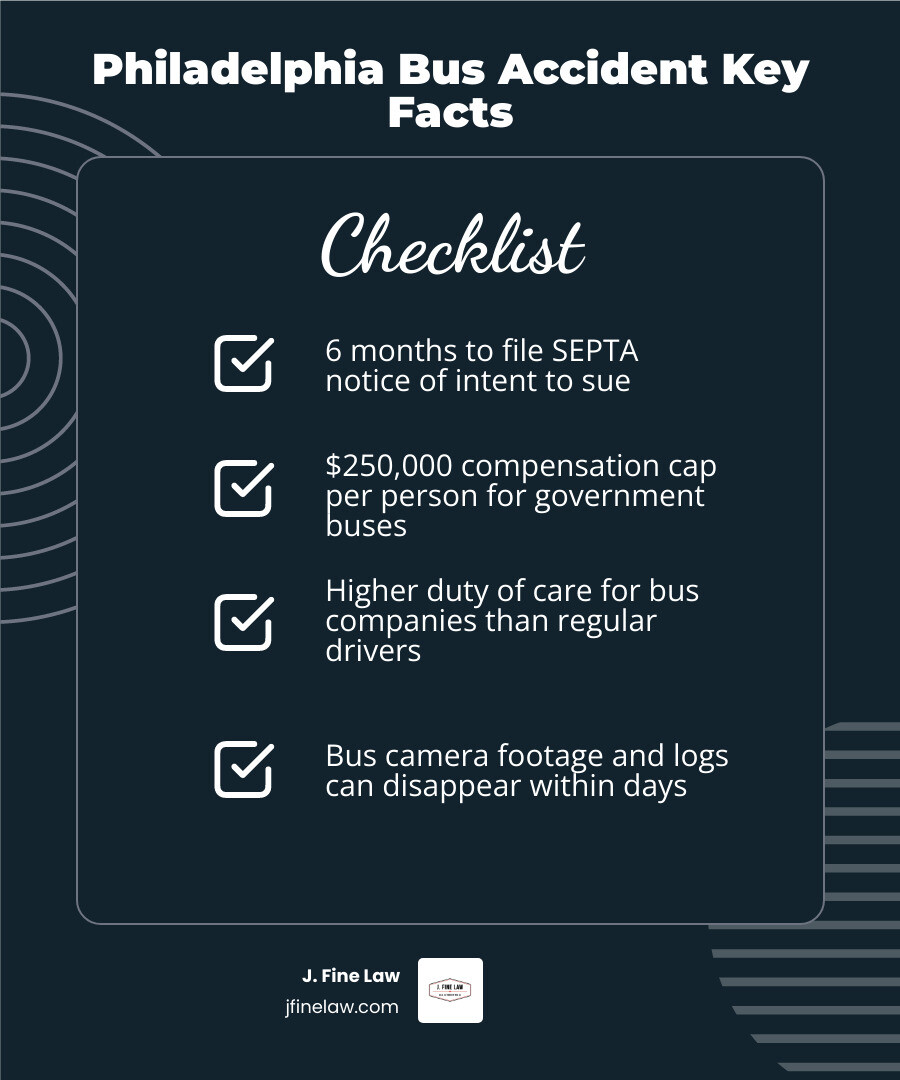
Easy bus accident attorneys philadelphia word list:
1. The Strict 6-Month Notice Requirement for SEPTA Claims
One of the most shocking things for victims to learn is that the clock starts ticking almost immediately. While a standard car accident in Pennsylvania usually gives you two years to file a lawsuit, SEPTA is a government entity. Under the Sovereign Immunity Act and the Political Subdivision Tort Claims Act, you must provide a formal “Notice of Claim” within just six months.
If you miss this window, your case is likely over before it begins. Our team at Philadelphia Bus Accident Attorneys – J. Fine Law understands that this deadline is non-negotiable. Whether you were hit by a bus near City Hall or injured while riding through North Philly, that six-month notice must include specific details about the time, location, and nature of your injuries. This is why acting quickly is the most important step you can take.
2. The $250,000 Sovereign Immunity Cap
Because SEPTA is a Commonwealth agency, Pennsylvania law protects it with a “Sovereign Immunity” cap. This means that no matter how severe your injuries are—even if they are life-altering—the maximum amount a single person can recover from a government-run bus entity is $250,000.
Furthermore, there is a $1 million aggregate limit. This means if twenty people are injured in a single crash on the Market-Frankford Line or a SEPTA bus, they all have to share that $1 million pot. This makes the legal strategy described in our Philadelphia Bus Accident Attorney Guide 2025 vital. We have to look for other liable parties, such as third-party maintenance contractors or manufacturers, who do not have these same statutory ceilings, to ensure you get the full compensation you deserve.
3. Understanding the ‘Jerk and Jolt’ Doctrine
Have you ever been thrown from your seat because a bus driver slammed on the brakes? In Philadelphia, these cases fall under the “jerk and jolt” doctrine. To win a claim as a passenger, you have to prove that the movement of the bus was so “extraordinary” and “unusual” that it went beyond the normal bumps of city travel.
Routine stops and starts don’t qualify for a claim. As a Bus Accident Injury Attorney, we look for evidence of extreme force—such as other passengers also being thrown or the driver’s reckless speed—to prove that the “jolt” was a result of negligence rather than standard operation.
4. The Heightened Duty of a Common Carrier
Buses are considered “common carriers.” Under Pennsylvania law, this means they owe a higher standard of care to their passengers than a regular driver owes to others on the road. While a normal driver must act with “reasonable care,” a bus company is often held liable for even the “slightest negligence.”
This heightened duty covers everything from the driver’s focus on the road to the safety of the steps when you are boarding or exiting near busy intersections like 15th and Chestnut. If a bus pulls too far from the curb and you fall, that could be a Bus Accident Compensation Claim based on this special legal status.
5. Why Immediate Access to Black Box Data is Vital
Modern buses are equipped with electronic logging devices (ELDs) and “black boxes” that record speed, braking patterns, and engine data. In an urban environment like Philadelphia, this data is the “silent witness” to your accident.
However, this data is often overwritten within days or weeks. When we hear about a SEPTA Bus Accident Today, our first move is often to send a “spoliation letter” to the transit authority. This legally requires them to preserve maintenance logs, driver hours-of-service records, and digital data. If you wait too long to hire an attorney, this evidence may be gone forever.
6. Navigating Federal FMCSA Regulations in Local Claims
Even though the accident happened on a local street, many bus companies must follow the Federal Motor Carrier Safety Administration (FMCSA) standards. These rules dictate how many hours a driver can be behind the wheel without a break and require strict drug and alcohol testing after a crash.
As a Bus Crash Attorney, we investigate whether the operator was fatigued or if the company skipped required background checks. Violating these federal mandates is a powerful way to prove negligence in a Philadelphia courtroom.
7. Infrastructure Risks and Narrow Philadelphia Streets
Philadelphia’s layout was designed long before 40-foot buses were a reality. Narrow corridors in South Philly and construction zones near University City create constant “blind spot” risks.
Bus drivers are trained to navigate these tight turns, but when they take a corner too fast or fail to account for a cyclist, the results are catastrophic. Understanding PA Public Transit logistics helps us identify if the route itself or the driver’s failure to adapt to local infrastructure caused the collision.
8. Liability in Multi-Party Commercial Accidents
Bus accidents are rarely simple. Liability can be spread across:
- The driver (for recklessness or distraction)
- The transit authority or private bus company (for poor training)
- The maintenance company (for brake or tire failure)
- A third-party driver who cut the bus off
Managing these multi-party claims requires a legal team that can handle aggressive insurance negotiation. We work to identify every possible insurance policy to maximize your recovery, especially when the $250,000 SEPTA cap is in play.
9. Vulnerable Passengers and Paratransit Safety
School buses and paratransit vehicles carry our most vulnerable neighbors. Every year, school bus-related incidents send 17,000 children to emergency rooms. These vehicles are often top-heavy and lack seatbelts, making them prone to rollovers.
| Bus Type | Annual Statistics (Avg) | Common Risks |
|---|---|---|
| School Bus | 17,000 ER visits; 20 deaths | Rollovers, boarding injuries |
| Commercial/SEPTA | 63,000 crashes | Sudden stops, blind spots |
Elderly passengers in Philadelphia also face unique risks, particularly during sudden stops or when paratransit drivers fail to properly secure wheelchairs. We take these cases personally because our seniors and children deserve the highest level of protection.
10. The Role of Surveillance Footage in Urban Accidents
Philadelphia is one of the most surveilled cities in the country. Between SEPTA’s onboard cameras and the city’s “Real Time Crime Center” feeds, there is almost always video evidence of a crash.
Video footage is the best way to overcome a “he-said, she-said” dispute. It can show if a driver was looking at their phone or if a pedestrian was already in the crosswalk when the bus turned. We move quickly to secure these feeds from local businesses and city agencies before they are deleted.
Frequently Asked Questions about Philadelphia Bus Accidents
What is the ‘jerk and jolt’ doctrine in Philadelphia?
It is a legal standard that requires a passenger to prove a bus movement was “unusually violent” or “extraordinary” to qualify for an injury claim. Normal stops and starts are considered a standard part of bus travel.
How long do I have to file a claim against SEPTA?
You must file a formal Notice of Claim within six months of the accident. The actual lawsuit must typically be filed within two years, but without that six-month notice, you lose your right to sue.
What is the maximum compensation for a government bus accident?
Under Pennsylvania’s Sovereign Immunity Act, the cap is $250,000 per person and $1 million per accident, regardless of how many people were hurt or how severe the injuries are.
Legal Help from J. Fine Law Firm
Navigating a bus accident claim in Philadelphia is a race against time and a battle against complex government regulations. At J. Fine Law, we take pride in our 98% success rate and our commitment to rapid attorney response. We have recovered over $50 million for our clients because we know how to push back against transit authorities and insurance companies.
If you or a loved one has been Contact a Philadelphia Bus Accident Attorney for help, do not wait. Whether you were injured in a transit crash or your loved one has suffered due to negligence in a care facility, our team is here to protect your rights. Contact our elder abuse attorney today for a comprehensive case review and let us fight for the justice you deserve.