 Skip to content
What Is Constructive Notice in a Philadelphia Retail Slip and Fall Case?
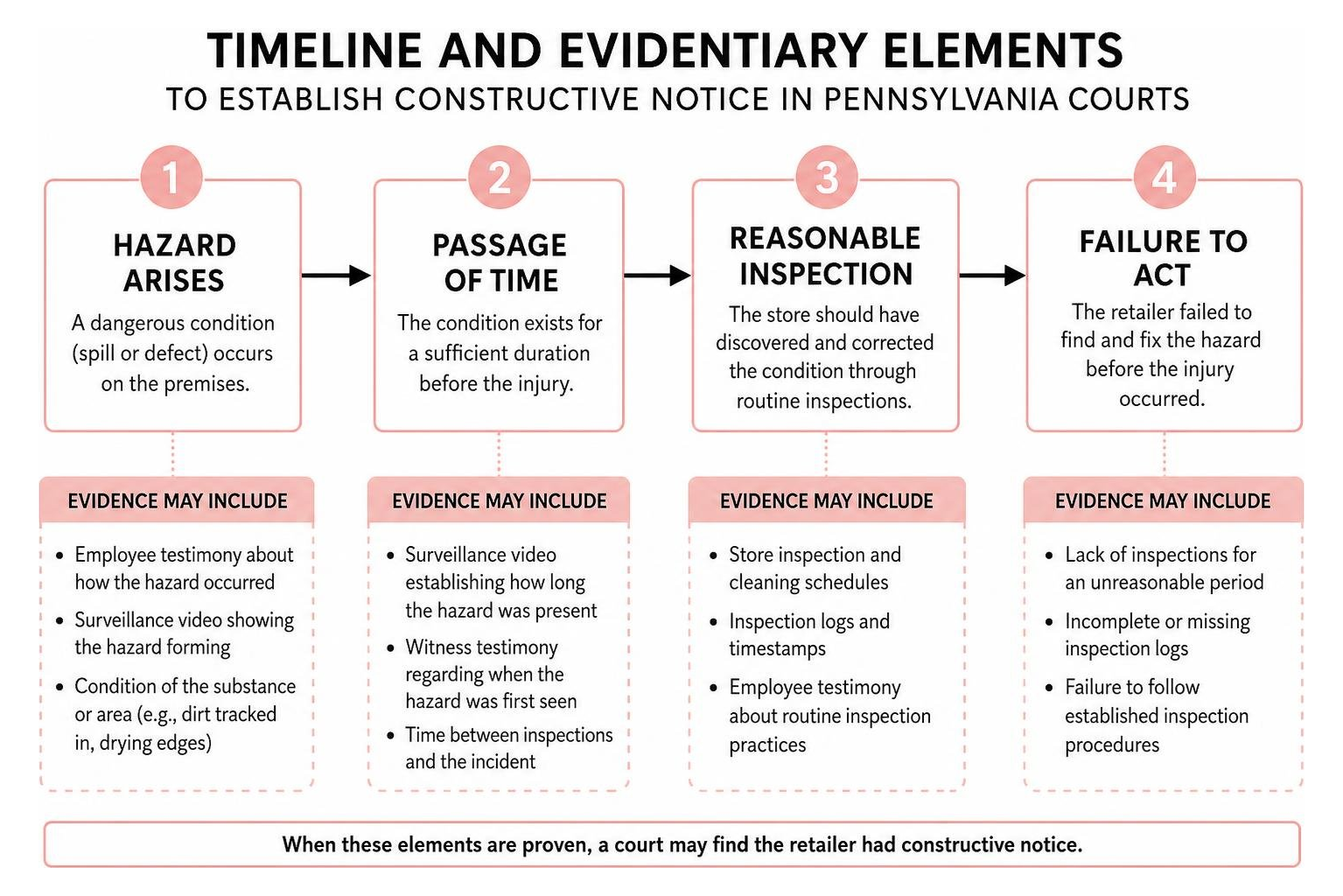
To prove constructive notice in a Pennsylvania retail slip and fall case, an injured shopper must demonstrate that a hazard existed long enough that store staff should have discovered and eliminated it through reasonable care. You establish this timeline through three primary types of evidence: securing time-stamped CCTV surveillance footage showing when the spill originated, documenting physical characteristics indicating the passage of time (such as cart tracks, footprint smudges, dirt accumulation, or drying puddle edges), and uncovering gaps or falsifications in store inspection logs.
Under Pennsylvania premises liability law, when you enter a retail store, supermarket, or department store along Market Street or Chestnut Street in Philadelphia, you hold the legal status of a business invitee. Under the Restatement (Second) of Torts § 343, which Pennsylvania courts strictly follow, commercial property owners owe business invitees the highest duty of care. A store possessor is subject to liability for physical harm caused by a condition on the land if, and only if, the possessor:
- Knows or by the exercise of reasonable care would discover the condition, and should realize that it involves an unreasonable risk of harm to invitees,
- Should expect that invitees will not discover or realize the danger, or will fail to protect themselves against it, and
- Fails to exercise reasonable care to protect them against the danger.
Establishing notice is often the single greatest hurdle an injured shopper faces. Pennsylvania law is clear: retailers and commercial property owners are not strictly liable insurers of customer safety. The mere fact that a spill occurred and an individual fell inside a store does not automatically create legal liability.
To hold a retailer accountable for injuries that require treatment at local trauma centers like Thomas Jefferson University Hospital or Penn Presbyterian Medical Center, an injured plaintiff must establish fault through one of three distinct pathways:
- Creation of the Hazard: Proving that store employees directly created the danger (such as an associate leaking fluid from a motorized floor scrubber or improperly stocking a display).
- Actual Notice: Proving that store management or employees had direct, literal knowledge of the spill or defect prior to the fall (such as an employee seeing the puddle or receiving a verbal complaint from another customer) and failed to take corrective action.
- Constructive Notice: Proving that the hazard was present for a sufficient duration that regular, reasonable inspections would have brought it to the retailer’s attention.
How Does Pennsylvania Case Law Define the Burden of Proof for Notice?
The cornerstone of modern Pennsylvania premises liability law regarding constructive notice is the landmark Superior Court decision in Moultrey v. Great A & P Tea Co.. In Moultrey, the plaintiff slipped on a cherry and water on the floor of a supermarket produce aisle. Because the plaintiff presented no evidence showing when the cherry fell, how long it remained on the floor, or when the store last inspected or cleaned the aisle, the trial court entered a compulsory non-suit in favor of the supermarket, which the Superior Court affirmed.
Moultrey built directly upon the Pennsylvania Supreme Court’s ruling in Martino v. Great Atl. & Pac. Tea Co. (1965). In Martino, a shopper stepped on a loose grape in a store aisle. The Supreme Court affirmed that stepping on stray produce without affirmative proof establishing the time of origin is fatal to a claim.
Pennsylvania appellate courts continually reinforce that juries cannot be left to guess, speculate, or draw inferences from thin air regarding how long a hazard existed. As of 2026, trial judges across the Philadelphia Court of Common Pleas routinely grant defense summary judgment motions when a plaintiff’s evidence demonstrates nothing more than the physical existence of a transient spill at the moment of impact.
| Notice Category | Legal Standard Required | Typical Evidentiary Proof | Difficulty to Prove |
|---|---|---|---|
| Actual Notice | Retailer had direct, conscious awareness of the specific hazard before the fall. | Incident logs, eyewitness testimony of warnings, employee radio transcripts. | High (requires direct documentation or admissions) |
| Constructive Notice | Hazard existed long enough that reasonable floor care would have revealed it. | Video timestamps, drying rings, dirty footprints, lapse in inspection logs. | Moderate to High (requires circumstantial timeline) |
| Recurring Condition | Store’s operating model creates continuous, foreseeable hazards in a specific area. | Prior incident reports, self-service station layout, chronic leak complaints. | Moderate (relies on business practice patterns) |
Overcoming these strict judicial standards requires building an evidentiary bridge between the moment the hazard originated and the moment of the accident. Working alongside a dedicated Philadelphia premises liability lawyer ensures that every available minute of store data is recovered and analyzed to survive retailer summary judgment motions under Pennsylvania law.
What Evidence Proves a Retail Hazard Existed Long Enough to Establish Liability?
Because commercial retail stores rarely admit they neglected a dangerous condition, proving constructive notice relies on hard physical and digital circumstantial evidence. We look for concrete indicators that establish the passage of time:
1. Physical Characteristics of the Dangerous Condition
The physical appearance of a spill or hazard often tells a compelling story about how long it sat on the sales floor:
- Drying Edges or Congealing: Liquids that exhibit perimeter evaporation rings, sticky crusts, or changes in viscosity indicate that the substance remained undisturbed for a substantial duration.
- Dirt, Dust, and Debris Accumulation: Clear fluids (such as water or melted ice) that have become murky, grayish, or laden with floor dust show extended exposure.
- Footprints, Smudges, and Cart Tracks: Wheel lines from shopping carts or dried shoe impressions cutting through a puddle prove that multiple patrons navigated through the spill long before the client arrived.
- Physical Deterioration: Bruised, flattened, browned, or stepped-on produce points to prolonged foot-traffic exposure rather than a recent drop.
2. Time-Stamped Digital Surveillance Footage
High-definition closed-circuit television (CCTV) is the gold standard for constructive notice claims in retail settings. Frame-by-frame analysis can pinpoint:
- The precise minute and second an item dropped or leaked onto the floor.
- The amount of time that elapsed between the spill’s creation and the client’s fall.
- Store associates walking past the unaddressed hazard without inspecting the floor or placing cautionary cones.
3. Maintenance Records and Inspection Logs
Retailers rely on standardized inspection schedules to argue they maintained reasonable care. Discovery demands often uncover severe gaps:
- “Sweep sheets” showing hours between required floor walkthroughs.
- Electronic maintenance records revealing missed inspection checkpoints.
- Falsified logs where an employee pre-signed inspection blocks for hours they had not yet worked.
Preserving this evidence requires decisive action. Commercial surveillance systems in high-traffic corridors like South Broad Street or Roosevelt Boulevard often overwrite video storage within 14 to 30 days. Partnering with a dedicated slip and fall lawyer in Philadelphia immediately allows for the service of formal spoliation letters, putting the store on legal notice that destroying or failing to preserve digital records will result in severe court sanctions.
Furthermore, any liability consultant testimony utilized to recreate the spill’s timeline must be grounded in verified floor coefficient measurements and concrete physical evidence to avoid being stricken by Pennsylvania judges as speculative.
Can Recurring Hazards or a Store’s “Mode of Operation” Establish Constructive Notice?
Under Pennsylvania law, when a retail store adopts a specific method of doing business that makes dangerous conditions reasonably foreseeable and continuous, the evidentiary burden on the injured plaintiff shifts.
This principle draws strength from cases such as McMillan v. Mountain Laurel Racing, which recognize that when a business operates in a manner that creates recurring, predictable hazards, the proprietor cannot claim ignorance simply because staff did not spot the specific puddle that caused the fall.
Common examples of high-risk retail setups include:
- Produce Misting Systems: Automated sprayers in grocery sections that periodically douse vegetables, causing continuous overspray onto smooth linoleum or polished concrete flooring.
- Self-Service Beverage and Ice Stations: Open fountain drink areas in convenience stores and fast-casual eateries where customer spills and dropped ice cubes melt into standing slip hazards.
- Self-Serve Bulk Bins and Salad Bars: Buffet and bulk food sections where patrons routinely drop loose items, oils, or dressings onto the floor.
- Entryway Ingress During Inclement Weather: Failure to maintain adequate floor runners, absorbent mats, and umbrella bags during heavy rain or melting snowstorms in Center City Philadelphia.
When handling big box store slip and fall cases, we depose department supervisors, floor managers, and third-party janitorial contractors. We examine prior work orders, customer incident reports from the preceding 36 months, and internal corporate communications.
Working with a seasoned supermarket accident lawyer helps connect past safety violations to your incident, establishing that the retailer had constructive knowledge of a chronic hazard that management chose to ignore.
What Defenses Do Pennsylvania Retailers Use to Defeat Constructive Notice Claims?
Corporate defense attorneys and insurance adjusters employ several standard legal defenses to defeat constructive notice claims and escape liability:
1. The “Open and Obvious” Doctrine
Retailers frequently argue that the hazard was so readily observable that a customer using ordinary perception should have seen and avoided it. Under Pennsylvania law, a possessor of land is generally not liable for injuries caused by conditions whose danger is known or obvious to invitees, unless the possessor should anticipate the harm despite such knowledge.
2. Proof of Reasonable Floor Inspection Protocols
Stores attempt to establish that they complied with reasonable retail practices by producing logs showing that an employee walked the aisle 10, 15, or 20 minutes before the accident occurred and observed no hazards. If a store proves that an unknown third party caused the spill only moments before the fall, constructive notice cannot legally attach.
3. Pennsylvania Modified Comparative Negligence (The 51% Bar Rule)
Under Pennsylvania’s Comparative Negligence Act (42 Pa.C.S. § 7102), an injured party can recover damages only if their own causal negligence does not exceed that of the defendant (50% or less). Retail defense teams routinely argue that the shopper was:
- Looking at high display shelves rather than the floor path ahead.
- Walking while distracted by a mobile phone or shopping list.
- Wearing improper or unstable footwear.
At J. Fine Law, we systematically counter these defense maneuvers. By pairing rapid attorney response with thorough discovery, our legal team exposes gaps in store records and secures pivotal physical evidence. Our proven track record—backed by a 98% success rate and more than $50 million recovered for injury victims across Pennsylvania—ensures our clients are positioned for maximum financial recovery.
Frequently Asked Questions About Proving Constructive Notice in Pennsylvania
How long must a spill be on the floor before a Pennsylvania store is considered negligent?
Pennsylvania law does not establish a universal, rigid minute-by-minute rule. Whether a timeframe is “sufficient” to establish constructive notice depends on the store’s size, customer volume, nature of the business, and the location of the spill. In a crowded Center City Philadelphia supermarket during evening peak hours, an unaddressed spill sitting for 20 to 30 minutes in a main checkout lane can easily support a finding of constructive notice. Conversely, a spill that occurred two or three minutes prior to an accident is rarely sufficient to establish negligence against the store.
What happens if the retail store deletes or overwrites security video of my fall?
If a retailer deletes or destroys digital surveillance footage after receiving formal notice of a claim or while litigation is reasonably foreseeable, it constitutes spoliation of evidence. Under Pennsylvania civil procedure, trial judges can penalize this misconduct by issuing an adverse inference instruction to the jury. This instruction permits jurors to presume that the destroyed video would have proved the store’s negligence and constructive notice. Consulting an experienced Pennsylvania slip and fall attorney right away guarantees that strict evidence-preservation demands are issued immediately.
Can I prove constructive notice if I did not see the liquid before I slipped?
Yes. Many injury victims do not spot clear liquids, transparent cleaning agents, or floor wax before falling. You can establish constructive notice through circumstantial evidence collected immediately after the fall. This includes damp or oil-soaked clothing, photos of cart tracks or footprint paths through the substance, witness accounts, and statements made by store staff (such as an employee remarking, “I told management to clean that up earlier”). Working with an experienced wet floor accident lawyer ensures this circumstantial evidence is properly developed to establish liability.
Stand Up for Your Rights After a Retail Injury in Philadelphia
A serious fall in a commercial store can alter your life in an instant, leading to costly medical bills, extensive physical therapy, and lost wages. Proving constructive notice requires swift, strategic legal action before store surveillance footage is erased, maintenance records are altered, or physical evidence disappears.
Whether you were injured in a retail store fall or need a dedicated elder abuse attorney to investigate a dangerous fall suffered by an elderly loved one due to facility neglect or hazardous property conditions, our team is ready to fight for you. We provide rapid attorney response, aggressive representation, and an unwavering commitment to holding negligent property owners accountable.
Explore our comprehensive legal resources on Pennsylvania slip and fall claims and commercial premises liability. Contact J. Fine Law today at our Philadelphia office for a free, confidential case evaluation, and let us help you secure the maximum compensation you deserve.