 Skip to content
Philadelphia Slip and Fall Lawsuit: Can You Seek Compensation?
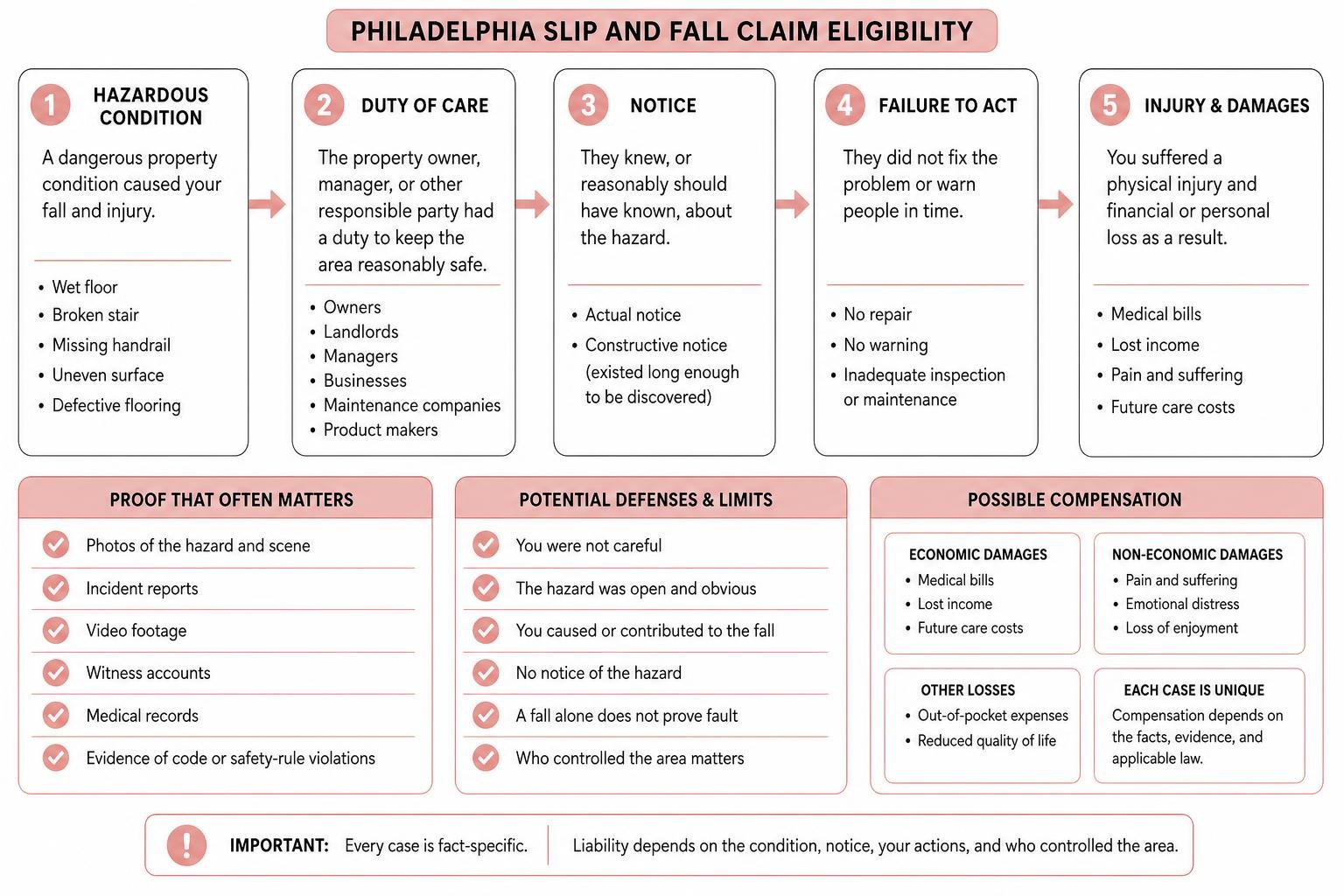
A Philadelphia slip and fall lawsuit may be an option when a dangerous property condition, such as a wet floor, broken stair, missing handrail, uneven sidewalk, or defective floor covering, caused your injury. In simple terms, you may have a claim if the person or company responsible for the property knew, or reasonably should have known, about the hazard and did not fix it or warn people in time.
- Potentially responsible parties: Property owners, landlords, managers, businesses, maintenance companies, and sometimes product makers.
- Proof that often matters: Photos, incident reports, video footage, witness accounts, medical records, and evidence of code or safety-rule violations.
- Possible compensation: Medical bills, lost income, future care costs, and pain and suffering.
- Important limits: A fall alone does not prove fault. The condition, notice, your own actions, and who controlled the area can all affect the case.
Recent Philadelphia verdicts show how serious these claims can become when unsafe conditions cause life-changing harm. One jury awarded $15 million in a stairway-fall case involving a missing handrail, while another major case involving a defective cable protector included claims for medical care, lost earnings, and noneconomic loss. Each case turns on its own facts, evidence, and legal rules.
I am Jason Fine, founder and senior trial attorney at J. Fine Law, with more than 25 years representing people hurt in accidents, including Philadelphia slip and fall lawsuit claims. The sections below explain the hazards, liability questions, defenses, damages, and court procedures that can shape your options.
Key terms for philadelphia slip and fall lawsuit:
- philadelphia slip and fall injury lawyer
- slip and fall accident lawyer philadelphia
- personal injury lawyer philadelphia
Common Causes of Slip and Fall Accidents in Philadelphia
Slip, trip, and fall incidents in Philadelphia occur across various settings, from retail centers along Aramingo Avenue to high-rise commercial structures near Market Street. Common structural defects include missing handrails on residential staircases, damaged stairs, and non-compliant stair tread dimensions that violate local municipal codes.
Surface hazards are equally frequent. Spills in commercial retail outlets can create slippery surfaces, especially when liquid hazards blend into floor tile patterns. In high-traffic transit areas like Philadelphia International Airport, smooth flooring materials such as untreated terrazzo become slippery when walked on without footwear during security checks. In corporate environments or event spaces, temporary floor coverings like heavy-duty cable protectors can cause tripping hazards if they defectively curl or misalign.
When dangerous floor conditions lead to severe harm, consulting a Wet Floor Accident Lawyer: Holding Negligent Parties Accountable helps clarify whether property maintenance standards were violated. For example, a landmark case detailed in Phila. Jury Awards $15M to Woman Who Slipped on Apartment Building Stairs | Law.com involved a tenant who fell on an apartment stairwell lacking a required handrail, resulting in severe surgical complications and a $15 million verdict.
Duty of Care in a Philadelphia Slip and Fall Lawsuit
In Pennsylvania premises liability law, your legal status determines the level of protection owed by a landowner or business. Most visitors entering retail stores, restaurants, or office spaces are classified as business invitees.
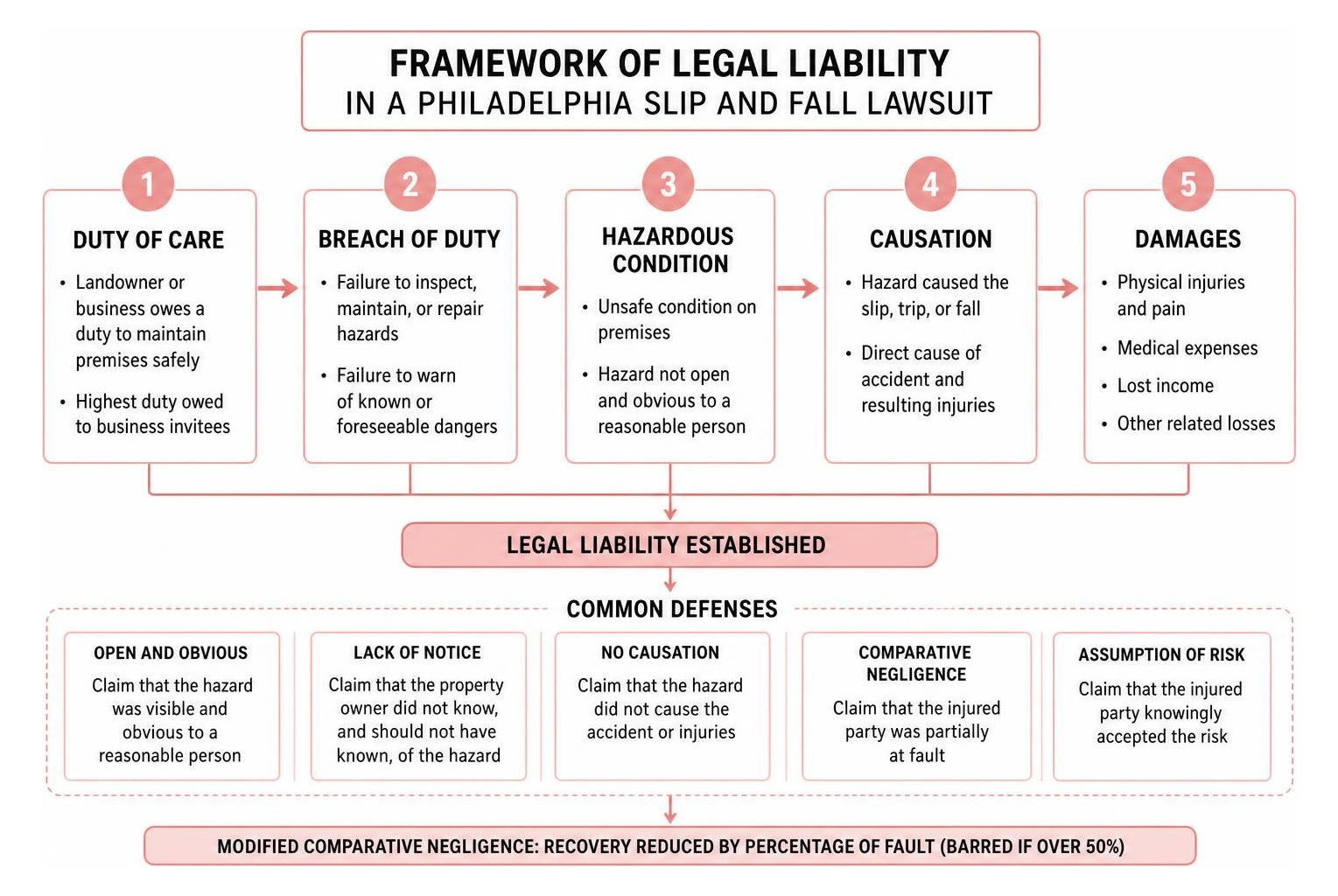
Property possessors owe business invitees the highest duty of care. They must maintain premises in a reasonably safe condition, perform regular inspections, and remedy or warn against foreseeable hazards. In JOHNSON v. PENNEY OPCO LLC (trial court document), District Court, E.D. Pennsylvania, 2025, the federal court affirmed that store owners are bound to protect invitees when store personnel receive notice of a hazard, even if management prioritizes other maintenance tasks like fixing ceiling leaks over cleaning spills. Working with a Philadelphia Indoor Slip and Fall Lawyer helps establish whether a property operator failed to address a known dangerous condition.
Premises Hazards Covered in a Philadelphia Slip and Fall Lawsuit
Defense teams frequently argue that a hazard was “open and obvious” to avoid liability. Under Pennsylvania law, a hazard is open and obvious only if both the condition and the associated risk would be apparent to a reasonable person exercising ordinary perception.
When liquid spills closely match tile colors or when un-coated terrazzo flooring becomes slick, courts recognize that hazards may be camouflaged. Furthermore, items like defective cable covers in hotel ballrooms can present hidden traps for visitors. Victims injured by structural or equipment hazards can consult a Philadelphia Trip Fall Lawyer to evaluate building safety violations.
Liability and Defenses in a Philadelphia Slip and Fall Lawsuit
Determining legal responsibility in a philadelphia slip and fall lawsuit often involves multiple parties, including property owners, commercial landlords, property managers, and equipment manufacturers. Pennsylvania follows a modified comparative negligence rule under 42 Pa.C.S. § 7102. An injured party can recover financial damages as long as their own fault does not exceed 50%, though any recovery is reduced by their assigned percentage of responsibility.
In complex apartment complex claims, juries frequently divide fault between property owners and property management firms. In the $15 million Philadelphia stairwell fall case, the jury allocated 75% fault to the property owner and 25% fault to the property management company due to systemic neglect of basic building maintenance codes.
When injuries stem from manufactured equipment placed on a property, complex product liability doctrines apply. In Burnley, D. v. Loews Hotel, Superior Court of Pennsylvania, 2026, a conference guest tripped on a defective cable cover in a Center City hotel ballroom, suffering permanent neurological injuries. The court applied the “product line exception” (the Dawejko standard) to hold a corporate successor strictly liable for manufacturing defects in equipment produced by an acquired entity. Injured tenants and guests facing severe property safety failures can seek guidance from a Landlord Negligence Lawyer Philadelphia.
Property Owner Defenses and Bankruptcy Stays
Property owners and corporate defendants rely on several legal defenses:
- Short Ownership Duration: Defendants often claim they recently purchased the building and lacked time to fix defects. However, pre-purchase due diligence periods give buyers ample opportunity to inspect structures and fix code violations prior to closing.
- Pre-Existing Conditions: Insurers frequently argue that injuries stem from prior health conditions rather than the fall itself. Clear medical causation testimony directly counters these defense claims.
- Automatic Bankruptcy Stays: When corporate property co-defendants file for bankruptcy protection under 11 U.S.C. § 362, an automatic stay pauses state litigation against that party.
In L. Tyson v. City of Philadelphia, et al. (majority), an individual injured on an unsafe sidewalk along Aramingo Avenue faced an administrative case dismissal while a commercial co-defendant was in bankruptcy. The Pennsylvania Commonwealth Court ruled that administrative terminations during an active bankruptcy stay are void ab initio, preserving the plaintiff’s right to pursue full compensation once the stay lifts. Pedestrians injured on public or private walkways can consult a Philly Sidewalk Fall Lawyer: Navigating Your Claim After a Pavement Mishap.
Calculating Damages and Procedural Evidence Standards
Victims of severe slip and fall accidents face significant financial and emotional burdens. In a philadelphia slip and fall lawsuit, recoverable damages fall into two primary categories: economic losses and noneconomic losses.
| Damage Category | Examples Included | How Claims Are Proven |
|---|---|---|
| Economic Damages | Past & future medical costs, lost wages, diminished earning capacity, mobility devices | Hospital records from Penn Presbyterian or Thomas Jefferson University Hospital, billing receipts, vocational assessment reports |
| Noneconomic Damages | Pain and suffering, emotional distress, loss of enjoyment of life, physical disfigurement | Personal testimony, family impact statements, severity of physical impairment |
In high-severity cases, damages can reach substantial figures. In Burnley v. Loews Hotel, the initial jury verdict totaled $18,111,250, including $2.7 million for future medical treatment, $2.4 million for loss of future earning capacity, and $10 million in noneconomic damages (later molded by the trial court to $7,354,716.83 including statutory delay damages). In another Philadelphia trial, a plaintiff who suffered an ankle fracture that developed a severe hardware infection requiring a below-the-knee amputation was awarded $15 million solely in noneconomic damages.
Evidentiary rules and procedure heavily influence trial outcomes:
- Surveillance Video Evidence: In Stipanovic, T. v. Ammons Supermarket LLC, Superior Court of Pennsylvania, 2020, store security video proved essential in establishing whether floor mats were flat or bunched up at the time of a fall.
- Post-Trial Procedural Strictness: Under Pa.R.C.P. 227.1, post-trial motions must explicitly detail where each legal objection was preserved during trial. Failure to list specific record locations results in automatic waiver of appellate rights.
- Governmental Immunity Exceptions: In ALLEN-FILLMORE v. TRANSPORTATION SECURITY ADMINISTRATION (trial court document), District Court, E.D. Pennsylvania, 2023, the federal court analyzed the real property exception to the Pennsylvania Political Subdivision Tort Claims Act (42 Pa. C.S.A. § 8542(b)(3)), ruling that municipal entities can be held accountable if dangerous real property conditions under their control cause injuries.
Individuals hurt on public property can learn more by contacting a Public Property Injury Attorney.
Frequently Asked Questions
Can I sue if the owner bought the building days before my fall?
Yes. Property buyers usually conduct formal pre-purchase inspections and due diligence during the acquisition process. Courts recognize that pre-closing inspection periods afford new owners sufficient opportunity to discover and correct obvious structural hazards, such as missing stair handrails or broken steps.
How does store video footage affect a slip and fall case?
Surveillance video provides objective evidence of the incident. It establishes how long a hazard existed on the floor, whether store employees walked past the hazard without cleaning it, and the precise physical mechanics of how the fall occurred.
How do pre-existing conditions affect noneconomic damages?
Pre-existing medical conditions do not prevent you from filing a lawsuit. Under Pennsylvania law, defendants are responsible for any aggravation of a pre-existing condition caused by their negligence. In cases where pre-existing medical causation is complex, focusing heavily on noneconomic damages for pain and diminished quality of life can be a highly effective trial strategy.
Protect Your Legal Rights with J. Fine Law
Navigating a philadelphia slip and fall lawsuit requires assertive legal advocacy and thorough factual investigation. Property owners and insurance corporations frequently attempt to minimize injuries or shift blame onto accident victims.
At J. Fine Law, our team brings decades of combined trial experience fighting for injured individuals across Philadelphia. We maintain a 98% success rate, provide rapid attorney responses to every inquiry, and have recovered over $50 million in financial settlements and verdicts for our clients.
Whether your injury occurred due to a commercial property defect, a slippery walkway, or neglect in a residential facility, our legal team moves quickly to preserve evidence and hold negligent parties accountable. If an elderly family member suffered a severe fall due to nursing home or care facility neglect, our team will guide you directly to a skilled elder abuse attorney to protect their rights and seek full justice. Contact our office today for a free case evaluation with a dedicated Philadelphia Premises Liability Lawyer.