 Skip to content
Can a Store Manager Claim Erased Security Footage After an Injury?
No, a store manager cannot escape legal liability simply by claiming security camera footage was erased after a fall in Cherry Hill. When you slip, trip, or fall inside a commercial property—whether along Route 70, inside the Cherry Hill Mall, or at a shopping plaza on Haddonfield Road—the digital surveillance recordings are often the most direct proof of what happened. Camera footage can establish exactly how long a liquid spill sat on the floor, whether staff walked past a hazard without addressing it, and how your injury occurred.
When a store manager casually remarks that the system “erased” or “overwrote” the video, many people assume their legal rights have vanished along with the file. That assumption is incorrect.
Commercial surveillance systems rely on digital recording loops that routinely recycle storage space every 24 hours to 30 days. However, retail operators are not permitted to hide behind standard automated overwrite cycles once they know an injury occurred. Under New Jersey law, businesses cannot simply discard or overwrite critical materials connected to an active injury claim.
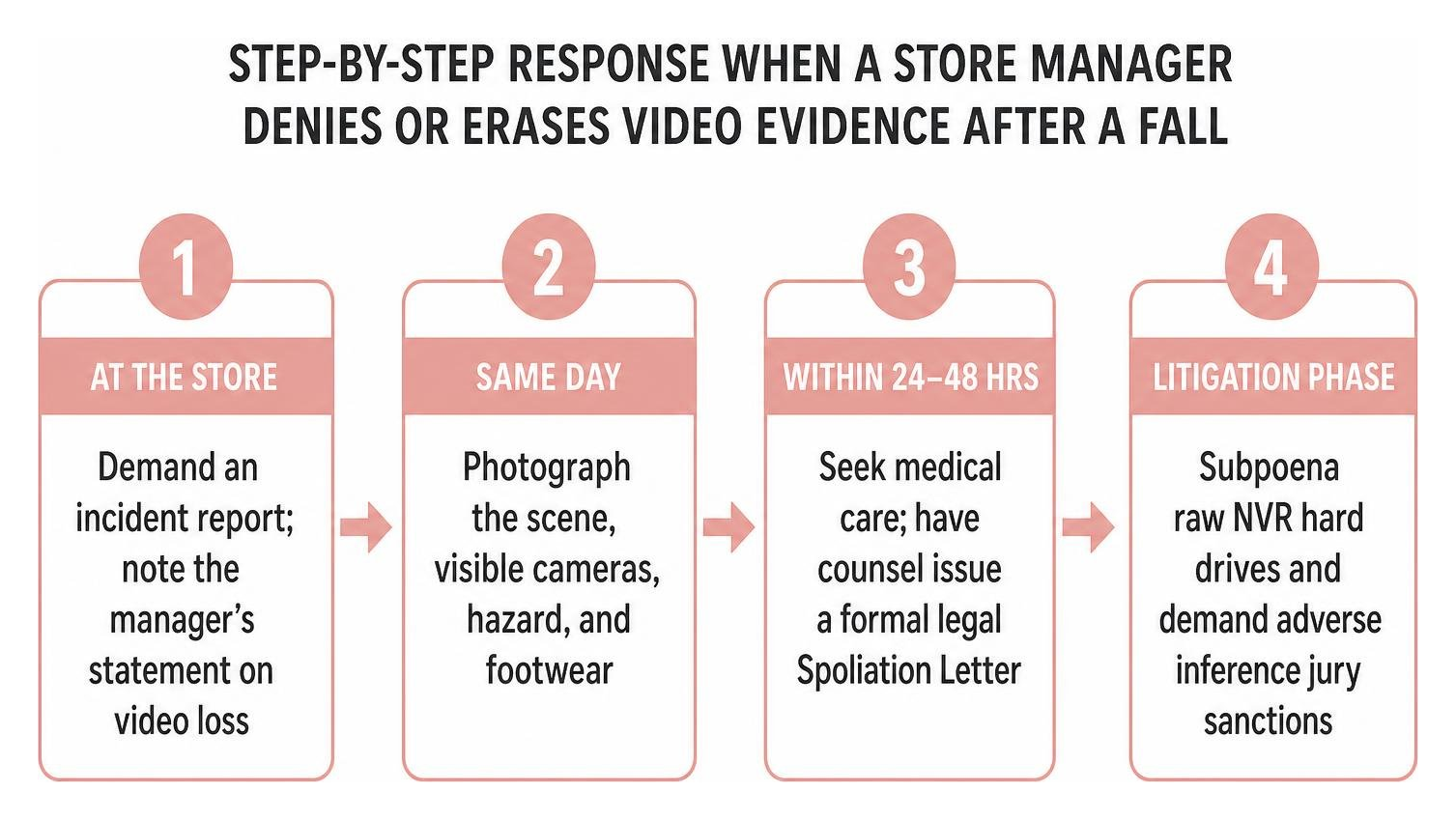
If a retail operator claims footage no longer exists, civil courts in Camden County have established remedies to protect injured patrons. Missing footage does not bar you from seeking compensation for medical bills, missed work, and physical pain.
Can a Store Legally Delete Video Footage After a Fall in Cherry Hill?
Commercial establishments open to the public owe visitors an affirmative duty of reasonable care. According to New Jersey premises liability laws, a property owner must maintain reasonably safe walkways, inspect the premises for latent hazards, and promptly repair or warn of dangerous conditions.
Once an accident occurs and is reported to staff, the legal landscape shifts. The business is placed on actual notice of a potential legal claim. From that moment forward, management has a legal duty to preserve all relevant evidence within its control—including digital video files showing the incident, the condition of the floor before the incident, and the actions of employees before and after the fall.
Intentionally deleting, altering, or neglecting to secure video footage after receiving notice of an injury is a violation of evidence preservation duties. Claiming that footage was “erased” can expose the retail establishment to severe procedural sanctions and expanded civil liability.
Standard Video Retention Cycles vs. Intentional Deletion
Digital Video Recorders (DVRs) and Network Video Recorders (NVRs) operate on continuous recording loops. As hard drive capacity fills up, the oldest recorded blocks are automatically rewritten with new data.
- Small shops and independent boutiques: May run on short loops of 24 to 48 hours.
- Regional grocery chains and retail outlets: Typically maintain 14- to 30-day retention windows.
- Large national department stores: Often maintain 30- to 90-day retention loops managed by central risk departments.
The moment you notify a manager, file an incident report, or seek emergency assistance at the store, the business must take active steps to freeze the system and safeguard the relevant video block. Permitting the automated system to overwrite files after being notified of a customer’s injury is treated under the law as a failure to preserve evidence, not a simple technical glitch.
How Does New Jersey Spoliation Law Protect Injured Customers?
In New Jersey tort litigation, the destruction, significant alteration, or failure to preserve evidence necessary to foreseeable litigation is known as spoliation of evidence.
When a commercial defendant destroys or fails to safeguard surveillance footage, New Jersey trial courts have wide discretion to impose sanctions against the business. Depending on whether the loss of evidence resulted from gross neglect or intentional concealment, remedies may include:
- Striking the business’s defenses: The court may bar the store from claiming it maintained clean floors or conducted routine inspections.
- Monetary sanctions: Requiring the business to pay the injured party’s attorney fees and forensic discovery costs.
- Separate tort claims: In situations involving deliberate concealment, plaintiffs may pursue separate claims for fraudulent concealment or intentional spoliation.
- Adverse inference jury instructions: A direct charge from the trial judge directing the jury to assume the missing evidence would have hurt the store’s defense.
Learning how courts handle holding property owners accountable for evidence destruction provides valuable insight into how evidence disputes unfold during litigation.
The Power of an Adverse Inference Instruction in Court
An adverse inference instruction is one of the most effective tools available to an injured plaintiff in a New Jersey courtroom. Under New Jersey Model Civil Jury Charges, when a business fails to produce relevant evidence within its custody without a valid explanation, the trial judge can instruct jurors that they may infer the missing video would have revealed facts unfavorable to the store.
This instruction alters the dynamics of a case. Rather than the injured person needing to prove every second of the spill’s duration through direct video playback, the jury is permitted to presume the store was negligent. Confronted with this instruction, commercial insurance carriers frequently choose to negotiate settlements rather than defend the missing evidence before a jury.
What Steps Should You Take Immediately If the Store Manager Claims Video Is Gone?
If an employee or store manager claims the camera footage was deleted or unavailable, take immediate steps to protect your claim:
- Insist on an Incident Report: Ensure management creates a written record of your fall. If the manager states the cameras are broken or footage was erased, ensure that exact statement is documented on the incident report or write down their direct words immediately.
- Photograph the Scene and Cameras: Use your smartphone to capture wide shots and close-ups of the hazardous condition, the surrounding aisle, the lighting, any lack of warning signs, and every visible camera bubble or dome mounted on the ceiling nearby.
- Gather Witness Information: Obtain the names, phone numbers, and addresses of other shoppers and retail clerks who saw you fall or witnessed store employees discussing the cleanup.
- Preserve Your Footwear and Clothing: Seal the shoes and clothing you were wearing in a clean bag. Do not wash or alter them; their condition can serve as physical evidence regarding slip resistance and foreign substances.
- Seek Prompt Medical Care: Go directly to a nearby healthcare provider, such as the emergency department at Jefferson Cherry Hill Hospital on Chapel Avenue or an urgent care clinic on Route 38, to document the physical injuries resulting from the incident.
How Can an Attorney Force a Retailer to Preserve and Recover Evidence?
Informal requests to view or save surveillance recordings are almost always dismissed by store personnel. Commercial operators routinely inform injured individuals that security footage is “private company property” or that “it was already erased.”
A seasoned Cherry Hill slip and fall lawyer overrides these stall tactics through formal legal channels:
- Formal Spoliation Demand Letter: Counsel immediately issues an evidence preservation notice via certified mail. This legal notice demands the preservation of all raw video files, camera server hard drives, inspection logs, and employee records for a window spanning at least 24 hours prior to the fall and several hours afterward.
- Forensic Recovery Protocols: If a retailer claims data was overwritten, digital forensic investigators can examine the physical NVR units. Because automated overwriting often leaves residual magnetic traces or unallocated digital sectors, deleted files can frequently be recovered if the hardware is preserved promptly.
- Formal Subpoenas: During litigation filed in Camden County Superior Court, formal discovery rules compel the production of video archives, internal risk management communications, and records from third-party security vendors.
At J. Fine Law, our legal team responds rapidly to ensure that commercial defendants do not destroy critical digital proof.
How Do You Prove Store Negligence If Surveillance Footage Is Truly Gone?
Even if digital surveillance files are permanently unrecoverable, premises liability claims can still be established through alternative forms of evidence. Under New Jersey law, plaintiffs can demonstrate actual or constructive notice by establishing that a hazard existed for a sufficient length of time that the store should have discovered and corrected it.
| Evidence Category | With Video Footage Available | When Video Footage Has Been Erased |
|---|---|---|
| Hazard Duration | Direct time-stamped video showing spill occurrence | Electronic sweep logs, vendor delivery records, and witness testimony |
| Store Notice | Video recording of employees walking past the hazard | Maintenance records, employee timecards, and shift inspection logs |
| The Fall Event | Visual confirmation of mechanics and impact | Medical injury documentation, paramedic records, and 911 dispatch audio |
| Hazard Condition | Visual playback of puddle size and floor state | Photographs of wet clothing, soiled shoes, and physical scene photos |
| Legal Posture | Direct evaluation of visual evidence | Adverse inference instruction directing jury to presume store fault |
To construct a compelling case without video:
- Sweep Sheets and Maintenance Logs: Stores maintain written or digital records detailing when aisles were inspected. Gaps in these logs demonstrate that the store failed to follow its own maintenance procedures.
- Depositions of Store Staff: Questioning floor workers and managers under oath often reveals inconsistent cleaning routines, inadequate staffing, or prior knowledge of leaks.
- Point-of-Sale Data and Register Records: Register transaction timestamps can establish customer traffic patterns and prove that no employee monitored an aisle for an extended period.
Our team works with clients across South Jersey, whether building a case with a grocery store injury attorney after a supermarket spill or working with a wet floor accident lawyer to address dangerous retail walkways. Our investigative approach has helped us maintain a 98% success rate and recover over $50 million for injured clients.
Frequently Asked Questions About Erased Fall Footage in Cherry Hill
Can I file a separate claim if a Cherry Hill store intentionally destroyed camera footage?
Yes. Under New Jersey law, if an entity intentionally conceals, alters, or destroys evidence to disrupt prospective or pending litigation, you may have grounds for an independent tort claim for fraudulent concealment or intentional spoliation. This claim allows an injured individual to seek separate compensatory and potentially punitive damages against the business for its bad-faith conduct.
How long do New Jersey retail stores keep security camera footage?
Video retention cycles vary by company size and hardware configuration. Smaller retail shops along Haddonfield Road or Kings Highway may operate on 24- to 72-hour recording loops, while larger supermarkets and department stores typically retain files for 30 to 90 days. Because these automated systems overwrite data on regular cycles, sending a formal preservation demand immediately after an accident is essential.
Will missing camera footage ruin my slip and fall claim?
No. Many premises liability claims resolve successfully without video recordings. By presenting scene photographs, witness statements, maintenance records, and medical documentation—combined with an adverse inference charge that penalizes the defendant for missing evidence—a strong case can be made against the responsible property owner.
Securing Your Legal Rights After a Retail Fall in South Jersey
When a store manager claims security camera footage has been erased, treat that statement as an urgent reason to take action rather than a defeat. Commercial retailers and their insurance adjusters often use missing evidence as a tactic to discourage injured customers from asserting their rights.
New Jersey law provides distinct protections against evidence destruction. The critical factor is acting quickly: digital files must be preserved before hardware cycles permanently overwrite the data, maintenance records must be secured, and formal spoliation notices must be served on corporate risk departments.
When older adults or vulnerable family members suffer serious falls due to dangerous retail hazards or facility negligence, consulting a qualified elder abuse attorney and premises liability advocate ensures crucial evidence is preserved immediately. Our firm combines rapid response times with a proven settlement record to hold negligent property managers and retail corporations accountable. Contact our office today for a free case evaluation, and let us protect your rights from day one.