 Skip to content
When a Workplace Accident in Philadelphia Leaves You Unable to Work
A work injury lawyer can be the difference between getting the full compensation you deserve and walking away with far less than you need to recover.
Here is what you need to know right away:
- You have rights. Pennsylvania law protects injured workers, even if your employer or their insurer says otherwise.
- Workers’ compensation covers medical bills, a portion of lost wages, and disability benefits — regardless of who was at fault.
- You may also have a third-party claim if someone other than your employer caused or contributed to your injury.
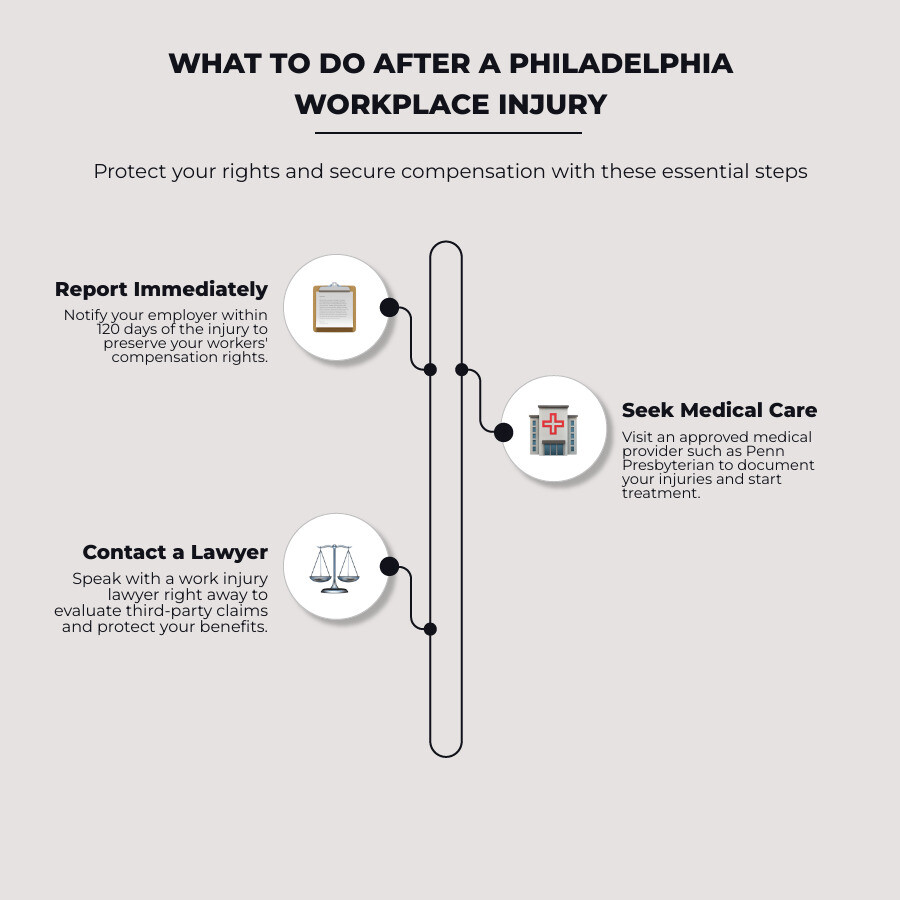
- Deadlines matter. In Pennsylvania, you must report your injury within 120 days and file a formal claim petition within three years.
- A lawyer costs you nothing upfront. Work injury attorneys typically work on contingency — no fee unless you win.
Getting hurt on the job in Philadelphia is stressful enough. You should not have to fight an insurance company alone while you are dealing with medical treatment and lost paychecks. Whether you were injured on a construction site near Broad Street, in a warehouse, or at a healthcare facility, the process of securing compensation can feel overwhelming — especially when bills start piling up fast.
I’m Jason Fine, senior trial attorney and founding member of J. Fine Law Group, with over 25 years of experience representing injured workers across Pennsylvania and New Jersey as a work injury lawyer — including being named a Pennsylvania Super Lawyer ten consecutive times. I know exactly how insurance companies operate, and I know how to push back.
Basic Work injury lawyer vocab:
What Does a Philadelphia Work Injury Lawyer Do for Your Claim?
When you are injured on the job, your primary focus should be on healing, not deciphering complex legal jargon or arguing with insurance adjusters. That is where a work injury lawyer comes in. Our primary job is to handle the legal and administrative heavy lifting so you can focus on your recovery.
First, we help you secure the medical benefits you are entitled to. This includes coordinating your care and ensuring you can see qualified medical professionals at local facilities like Temple University Hospital without having to pay out of pocket. If the insurance company tries to send you to a doctor who seems more interested in saving the insurer money than getting you well, we step in to protect your medical rights.
We also gather the necessary evidence to support your claim. This involves collecting medical records, securing witness statements, and obtaining accident reports from the job site. If you want to know what to expect during your first meeting with us, you can read our work injury consultation complete guide to see how we build a rock-solid case from day one.
Additionally, we handle all communications and negotiations with the insurance company. Insurers often try to offer lowball settlements or deny claims altogether, hoping you will simply give up. We know their tactics, and we do not let them take advantage of you. Having a dedicated legal advocate on your side ensures that your rights are fully protected under Pennsylvania law throughout the entire process.

Understanding Your Rights Under Pennsylvania Work Injury Laws
Every worker in Philadelphia is protected by strong legal frameworks designed to ensure they are not left destitute after an on-the-job accident. Knowing your injury at work rights is the first step toward securing your future. Under the Pennsylvania Workers’ Compensation Act, almost every employee is covered from their very first day on the job.
If you sustain a Pennsylvania work injury, you have the right to receive medical treatment for your injuries, and these bills should be paid entirely by your employer’s workers’ compensation insurance. If you are taken to an emergency trauma center like Penn Presbyterian Medical Center, those urgent care costs are covered.
However, these rights come with strict timelines. If you fail to act quickly, you could lose your right to benefits entirely. The work injury statute of limitations dictates that you must report your injury to your employer within 120 days of the accident, and you have up to three years to file a formal claim petition if your benefits are denied or stopped prematurely.
To help you understand how these claims function, it is helpful to look at how standard workers’ compensation differs from a third-party personal injury claim:
| Benefit Feature | Workers’ Compensation Claim | Third-Party Personal Injury Claim |
|---|---|---|
| Fault Requirement | No-fault system (you do not need to prove your employer did anything wrong). | Negligence-based (you must prove another party was at fault). |
| Who You Can Sue | Your employer (limited to workers’ comp benefits only). | Subcontractors, equipment manufacturers, or negligent property owners. |
| Medical Expenses | Covered 100% for reasonable and necessary treatment. | Recoverable as part of overall financial damages. |
| Pain and Suffering | Not available under workers’ compensation. | Fully recoverable in a civil lawsuit. |
| Wage Replacement | Typically covers about two-thirds of your average weekly wage. | Allows you to recover 100% of your past and future lost earnings. |
Understanding these distinctions is crucial for maximizing your recovery and ensuring all your medical bills and lost wages are fully covered.
When to Hire a Work Injury Lawyer After an Accident
While some minor injuries with straightforward claims can be handled directly, there are several critical scenarios where hiring a work injury lawyer is absolutely essential. You should contact an attorney immediately if:
- Your claim is denied: Insurance companies frequently deny valid claims, hoping you will not appeal. We can help you file an appeal and represent you before a workers’ compensation judge.
- Your employer retaliates: It is illegal for an employer to fire, demote, or harass you for filing a workers’ compensation claim. If this happens, we will fight to protect your job and your rights.
- You have a pre-existing condition: Insurers love to blame your workplace injury on an old injury. We know how to prove that your job duties directly caused or worsened your current condition.
- Your injuries are severe: If you have suffered a life-altering injury, the long-term costs of your care must be calculated correctly so you do not run out of funds later.
For a deeper dive into how to handle these disputes and protect yourself, check out our workplace accident law ultimate guide.
How a Work Injury Lawyer Maximizes Your Financial Recovery
Insurance companies are businesses, and their main goal is to pay out as little as possible. A work injury lawyer level the playing field by fighting for the maximum compensation available to you. We do this by ensuring your average weekly wage is calculated correctly, which directly impacts the amount of your weekly disability checks.
We also look beyond the standard workers’ compensation system. If a third party—such as a reckless driver who hit your delivery truck, or a manufacturer who built a defective piece of machinery—contributed to your accident, we can file a separate personal injury lawsuit. This allows you to recover damages that workers’ comp does not cover, such as pain, suffering, and emotional distress.
To learn more about how we negotiate these payouts to cover your family’s future, read our guide on securing a fair work injury settlement.
Workplace Injuries in Philadelphia Healthcare and Nursing Homes
When we think of workplace accidents, we often picture construction sites or industrial factories. However, healthcare workers in Philadelphia face some of the highest injury rates of any industry. Nurses, certified nursing assistants (CNAs), and support staff at local hospitals and nursing homes routinely suffer debilitating injuries from heavy lifting, patient transfers, and slip and falls on slick hospital floors.
A slip on a wet surface can lead to a serious slip at work claim, resulting in severe back, neck, or joint injuries. In the most tragic situations, defective medical machinery or severe industrial accidents can even cause a catastrophic amputation work injury.
Furthermore, there is a deep connection between the safety of healthcare workers and the safety of the patients they care for. When nursing homes are understaffed, employees are forced to rush, leading to a spike in employee slip and falls. At the same time, this lack of staff leads directly to nursing home neglect and patient injuries. If you are a healthcare worker who was hurt due to dangerous conditions, or if you have a family member suffering from neglect in a local facility, we are here to help you hold the owners accountable.
Frequently Asked Questions About Philadelphia Workplace Accidents
Can I sue my employer directly for a workplace injury?
Under the Pennsylvania Workers’ Compensation Act, you generally cannot sue your employer directly in civil court for a workplace injury. The system is designed as a trade-off: you receive medical and wage benefits without needing to prove your employer was at fault, but you give up the right to sue them for pain and suffering.
However, you can file a third-party lawsuit if a negligent manufacturer, subcontractor, or property owner caused your injury. For a complete breakdown of how these parallel claims work, see our workplace accident law firm complete guide.
How long do I have to file a claim in Pennsylvania?
You must report your injury to your employer within 120 days of the accident. If you do not report it within 21 days, you might not receive retroactive benefits back to the date of the injury, but you still have up to 120 days to secure future benefits. The formal claim petition must be filed within the three-year statute of limitations. For immediate assistance on what to do right after an accident, read our guide on work accident help.
What happens when I am cleared to return to work?
If you are cleared for light duty, your employer must offer a suitable position that fits your specific medical restrictions. If they cannot accommodate your restrictions, you will continue to receive your total disability benefits. If you take a light-duty job that pays less than your pre-injury wage, you may be eligible for partial disability benefits to make up the difference. You can learn more about transitioning back to your job in our guide on the return to work process.
Secure Your Recovery with Trusted Philadelphia Legal Advocates
At J. Fine Law, we believe that no hardworking person should have to suffer financially because they were hurt on the job. We are proud of our 98% success rate, our rapid response times, and the fact that we have recovered over $50 million in settlements for our clients. We handle all the paperwork, negotiate with the insurance adjusters, and fight to get you every dollar you deserve.
If you have been hurt at work, do not wait for the insurance company to make the first move. Contact us today to schedule your free consultation. We also provide dedicated support across our other practice areas, including workplace accident representation and compassionate elder abuse attorney services for families dealing with nursing home neglect. If you suspect a loved one is suffering from mistreatment in a care facility, consulting an elder abuse attorney is the most effective way to protect their rights and secure justice. Let us stand up for you so you can focus on getting back on your feet.