 Skip to content
When a Nursing Home Fails Your Loved One in Feasterville-Trevose
Nursing home negligence happens when a facility fails to meet a resident’s basic needs — things like food, water, hygiene, shelter, and essential medical care — causing real harm.
Here is a quick breakdown of what that means:
| Term | What It Means |
|---|---|
| Negligence | Failing to provide proper care (often unintentional) |
| Abuse | Deliberate actions intended to cause harm |
| Neglect | A type of negligence — not giving a resident what they need to stay safe |
Key facts to know right away:
- Nursing home negligence covers both actions and inactions by staff
- Residents in Bucks County facilities have legal rights to dignity, safety, and adequate care
- Neglect is one of the most underreported forms of elder abuse — for every case reported, an estimated 57 go unreported
- 1 in 20 nursing home residents is believed to be a victim of negligence or injury
If your loved one is in a Feasterville-Trevose or Bucks County facility and something feels wrong, you are right to pay attention. Nursing homes have a legal duty of care. When they break it, families have options.
I’m Jason Fine, senior trial attorney at J. Fine Law Group and a ten-time consecutive nominee to Pennsylvania Super Lawyers. With over 25 years of handling personal injury cases — including nursing home negligence cases such as bedsores and falls — I know how hard it is to spot this kind of harm before serious damage is done.
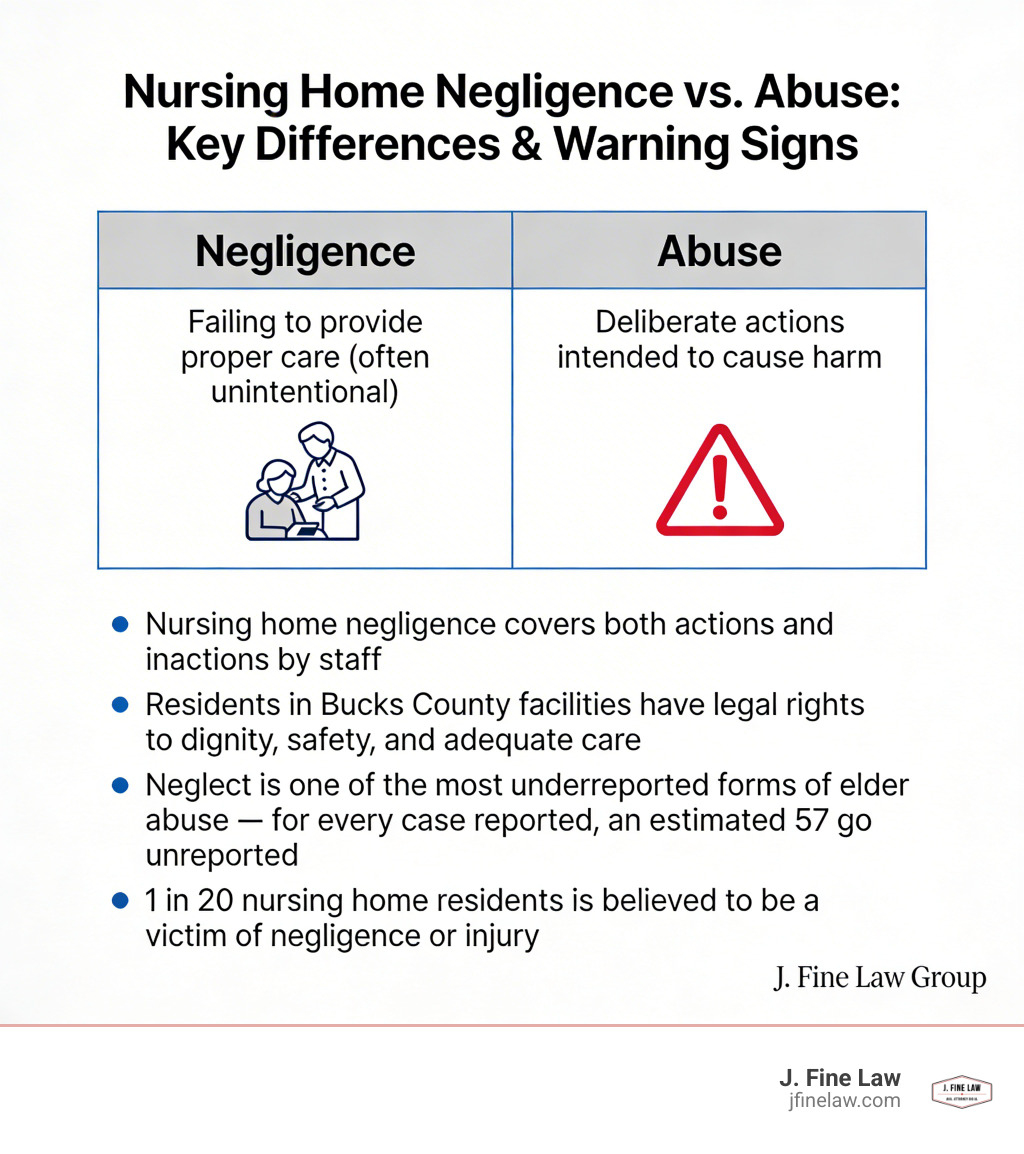
Nursing home negligence vocab explained:
Identifying the Warning Signs of Nursing Home Negligence

Spotting nursing home negligence in Feasterville isn’t always as easy as seeing a bruise. Often, it starts with subtle changes that are easy to dismiss as “just getting older.” However, the Centers for Disease Control and Prevention (CDC) defines neglect as the failure to meet basic needs, which can be just as deadly as active abuse.
In many Bucks County facilities, the root cause of these issues is chronic understaffing. When there aren’t enough nurses or aides to go around, tasks like turning residents to prevent sores or ensuring they finish their meals get skipped. According to industry data, 12% of nursing home employees have actually admitted to neglecting residents because they were overwhelmed or undertrained.
Common Red Flags to Watch For:
- Sudden Weight Loss: This often points to malnutrition or dehydration.
- Poor Hygiene: Unwashed hair, long fingernails, or the smell of urine suggests staff aren’t assisting with basic grooming.
- Frequent Falls: While seniors are at higher risk for falls, a pattern of “unexplained” falls often means the facility isn’t providing the required supervision or mobility assistance.
- Changes in Behavior: If your normally cheerful parent becomes withdrawn, angry, or fearful, it may be a reaction to their environment.
- Unsanitary Conditions: Look at the room. Are the floors sticky? Is the bedding soiled? These are clear signs of facility-wide nursing home negligence.
Scientific research confirms that neglect is a failure of “omission”—it’s what the staff doesn’t do that causes the injury. Whether it’s forgetting to refill a water pitcher or failing to check on a resident for hours, these small lapses add up to a breach of the standard of care.
Common Types of Physical Nursing Home Negligence
Physical neglect is the most visible form of nursing home negligence in Feasterville. When we visit clients in facilities near Street Road or Bustleton Pike, we often see the devastating results of a facility’s failure to provide basic physical maintenance.
1. Bedsores (Pressure Ulcers) Bedsores are perhaps the most “preventable” injury in a care setting. They occur when a resident is left in the same position for too long, cutting off blood flow to the skin. If your loved one is immobile, the staff has a legal duty to “turn and position” them every two hours. A Stage 4 pressure sore can lead to sepsis and death. If you see a sore developing, you need to act fast. Learn more about what to do if your loved one has bedsores.
2. Malnutrition and Dehydration It isn’t enough to just put a tray of food in front of a resident. Many seniors need help cutting their food or being encouraged to eat and drink. In a negligent facility, staff might just whisk the tray away 20 minutes later, even if it hasn’t been touched. This leads to “papery” skin, extreme fatigue, and a weakened immune system.
3. Medication Errors Statistics show that 75% of nursing home patients have been given at least one inappropriate medication. Whether it’s the wrong dose, the wrong time, or a “chemical restraint” used to make a resident easier to manage, medication mismanagement is a severe form of nursing home negligence.
Recognizing Medical and Emotional Nursing Home Negligence
Not all harm leaves a mark on the skin. Medical and emotional neglect can be even more insidious. According to the World Health Organization (WHO), nursing home neglect can occur regarding both physical needs and emotional security.
Medical Neglect This happens when a facility fails to provide necessary medical treatment for existing conditions. Examples include:
- Failing to notify a doctor when a resident shows signs of an infection (like a UTI).
- Ignoring symptoms of a serious event, like a stroke or heart attack.
- Failing to provide specialized care for residents with diabetes or respiratory issues.
If your loved one is rushed to St. Mary Medical Center or Jefferson Bucks Hospital with a condition that should have been caught days earlier, you are likely looking at medical nursing home negligence.
Emotional and Social Neglect Humans are social creatures. When staff ignore a resident’s calls for help, leave them isolated in a room for days, or prevent them from seeing family, the psychological harm is immense. Emotional neglect can accelerate cognitive decline in residents with dementia or Alzheimer’s. The National Institute on Aging (NIA) notes that this isolation can lead to deep depression and a “failure to thrive” that shortens a resident’s life.
Proving Liability and Duty of Care
To win a nursing home negligence lawsuit in Pennsylvania, we have to prove four specific legal elements:
- Duty of Care: The facility had a legal obligation to provide a certain standard of care (usually defined by state and federal laws like the Nursing Home Reform Act).
- Breach of Duty: The facility failed to meet that standard (e.g., they didn’t have enough staff to monitor residents).
- Causation: This failure directly caused the injury (e.g., the lack of monitoring led to a fall and a broken hip).
- Damages: The resident suffered actual losses, such as medical bills, pain, or suffering.
One important concept is vicarious liability. This means the nursing home as a business is responsible for the actions of its employees. If a nurse at a Feasterville facility makes a mistake, you don’t just sue the nurse—you sue the corporation that hired, trained, and supervised them. For a deeper dive into these concepts, check out our Nursing Home Malpractice Lawyer Complete Guide.
Legal Steps and Compensation for Families in Feasterville
If you suspect nursing home negligence in Feasterville, the process can feel overwhelming. You’re dealing with a loved one’s failing health while trying to fight a large corporation. Here is how the legal process typically unfolds:
- Investigation: We gather medical records, staff logs, and facility inspection reports.
- Evidence Gathering: We look for “deficiencies” cited by state inspectors. Did you know that 95% of nursing homes have been cited for at least one safety deficiency?
- Filing the Complaint: This is the formal document that starts the lawsuit.
- Discovery: Both sides exchange information. This is where we often find “the smoking gun,” like understaffing reports or internal memos about budget cuts that affected care.
- Settlement or Trial: Most cases settle out of court, but we prepare every case as if it’s going to a jury.
Understanding Your Potential Compensation
When we hold a facility accountable for nursing home negligence, we seek “damages” to make things right.
| Type of Damage | Examples |
|---|---|
| Economic | Medical bills, hospital stays, physical therapy, and funeral costs. |
| Non-Economic | Pain and suffering, emotional distress, and loss of enjoyment of life. |
| Punitive | Extra money meant to punish the facility for especially bad behavior. |
The average nursing home abuse settlement is around $406,000, though cases involving wrongful death or permanent disability can result in much higher amounts.
Reporting Neglect to Pennsylvania Authorities
If your loved one is in immediate danger, call 911. For ongoing concerns that don’t require an ambulance, you should report the nursing home negligence to the following Pennsylvania authorities:
- Adult Protective Services (APS): They investigate reports of abuse and neglect for adults with disabilities.
- The Long-Term Care Ombudsman: This is a free advocate for nursing home residents. They can help resolve complaints and investigate the quality of care.
- Pennsylvania Department of Health: They handle the licensing of facilities and can perform surprise inspections based on your complaint.
Reporting is vital because it creates a paper trail. If you suspect something is wrong, don’t wait for the facility to “investigate themselves.” Find out more about what to do if you suspect abuse in the Philadelphia area.
Understanding Statutes of Limitations and Damages
Time is not on your side in nursing home negligence cases. Pennsylvania has a Statute of Limitations, which is a strict deadline for filing a lawsuit.
- Personal Injury: Generally, you have two years from the date the injury occurred or was discovered.
- Medical Malpractice: This can sometimes have shorter or more complex deadlines depending on the specific circumstances.
- Wrongful Death: If your loved one passed away due to neglect, the two-year clock usually starts on the date of death.
Missing these deadlines means you lose your right to sue forever. This is why it is critical to contact a lawyer as soon as you notice a problem. Even if you aren’t 100% sure it’s negligence, an investigation can uncover the truth before the clock runs out. Learn more about finding a wrongful death attorney.
Seeking Justice with a Feasterville Attorney
At J. Fine Law, we believe that our elders deserve more than just a bed—they deserve dignity and respect. When a facility chooses profits over people by cutting staff or ignoring safety protocols, they must be held accountable.
Why choose us for your nursing home negligence case?
- 98% Success Rate: We know how to win these complex cases.
- Local Knowledge: We are active in Feasterville, Philadelphia, and Cherry Hill, NJ. We know the local hospitals and the reputations of the facilities in Bucks County.
- Over $50 Million Recovered: We have the resources to take on big nursing home corporations and their insurance companies.
- Rapid Response: When you call us, you talk to an attorney who can give you real answers.
If you’ve seen the warning signs—the bedsores, the weight loss, the confusion, or the dirty rooms—don’t wait until it’s too late. The facility has a team of lawyers working to protect their interests; you need a team working to protect yours.
For more information on how we can help your family, visit our Feasterville-Bucks County personal injury law office or call us today for a free, no-obligation consultation. We don’t get paid unless we win your case.
Additional Resources: