 Skip to content
Can I Sue for Pain and Suffering in Philadelphia, PA If I Have Limited Tort Insurance?

Yes, you can sue for pain and suffering in Philadelphia, PA if you have limited tort insurance, but only if your injury meets the statutory “serious injury” standard under 75 Pa.C.S. § 1702 or if a specific legal exception under 75 Pa.C.S. § 1705(d) applies—such as a DUI, an out-of-state at-fault vehicle, or an uninsured driver. Without meeting that threshold or exception, limited tort still allows recovery of economic damages like medical bills and lost wages, but bars non-economic damages for pain and suffering.
When you purchase auto insurance in Pennsylvania, the Pennsylvania Motor Vehicle Financial Responsibility Law (MVFRL) requires you to make a choice: full tort or limited tort. This election dictates your legal rights if an accident occurs on local roadways like the Schuylkill Expressway or Roosevelt Boulevard.
To understand the core distinction, it helps to understand the two legal categories of damages:
- Economic damages: Measurable monetary losses such as hospital bills, rehabilitation costs, physical therapy, diagnostic testing, past and future lost wages, and vehicle repair costs.
- Non-economic damages: Subjective, non-monetary harm including physical pain, emotional distress, mental anguish, physical impairment, and the loss of life’s pleasures.
Under the Pennsylvania car accident legal framework, both tort options provide access to mandatory first-party medical benefits (PIP) to cover initial medical bills. However, your ability to recover non-economic damages from an at-fault driver depends heavily on your tort status.
| Feature | Full Tort Coverage | Limited Tort Coverage |
|---|---|---|
| Right to Sue for Economic Losses | Full right (medical bills, lost wages, vehicle repair) | Full right (medical bills, lost wages, vehicle repair) |
| Right to Sue for Pain and Suffering | Unrestricted right for any injury, minor or severe | Restricted; requires meeting “serious injury” standard or statutory exception |
| Medical Proof Required for Lawsuit | Standard medical causation | Heightened burden: must prove serious impairment or permanent disfigurement |
| Average Policy Cost | Higher annual premium (approx. 15%–20% higher) | Lower premium savings |
| First-Party PIP Medical Benefits | Mandatory minimum $5,000 | Mandatory minimum $5,000 |
What Qualifies as a “Serious Injury” Under Pennsylvania Law?
If you elected limited tort, you can pierce the limited tort threshold and sue for pain and suffering if your condition satisfies the legal definition of a “serious injury.”
Under 75 Pa.C.S. § 1702, Pennsylvania law defines a serious injury as:
- Death
- Permanent serious disfigurement (such as visible, extensive facial scarring or severe burns)
- Serious impairment of a body function
How Philadelphia Courts Evaluate “Serious Impairment of Body Function”
Pennsylvania courts rely on the landmark Pennsylvania Supreme Court standard established in Washington v. Baxter. Evaluating whether an injury crosses the threshold requires examining two key factors:
- What body function was impaired? (e.g., spinal movement, cognitive ability, weight-bearing function of a joint)
- How serious was the impairment? The court evaluates the injury’s medical severity, the extent and duration of treatment, and the degree to which it interferes with the victim’s normal activities and ability to earn a living.
Examples of Qualifying vs. Non-Qualifying Injuries
Injuries Likely to Meet the Threshold:
- Traumatic brain injuries (TBIs) resulting in ongoing cognitive deficits
- Spinal cord injuries, herniated discs causing nerve root impingement (radiculopathy), or injuries requiring spinal fusion
- Compound fractures requiring surgical placement of hardware (plates, pins, screws)
- Torn ligaments (such as an ACL, MCL, or rotator cuff) requiring reconstructive surgery and prolonged physical therapy
- Loss of limb or chronic, medically documented mobility impairment
Injuries Typically Challenged by Insurance Carriers:
- Minor soft-tissue sprains and strains
- Mild whiplash resolving within weeks
- Minor bruising or contusions
- Temporary soreness without objective findings on MRIs, CT scans, or EMGs
Because insurance adjusters dispute limited tort claims, working with a personal injury car accident attorney in Philadelphia PA helps ensure your medical records from facilities like Thomas Jefferson University Hospital or Penn Presbyterian Medical Center properly document functional limitations. We know how to apply effective legal approaches to turn severe anguish into full compensation.
What Are the Statutory Exceptions That Allow Limited Tort Drivers to Sue for Pain and Suffering?
Even if your injuries do not meet the “serious injury” threshold, you may still recover pain and suffering damages. Under 75 Pa.C.S. § 1705(d), Pennsylvania law outlines specific statutory exceptions where limited tort restrictions are completely waived, granting you full tort rights.
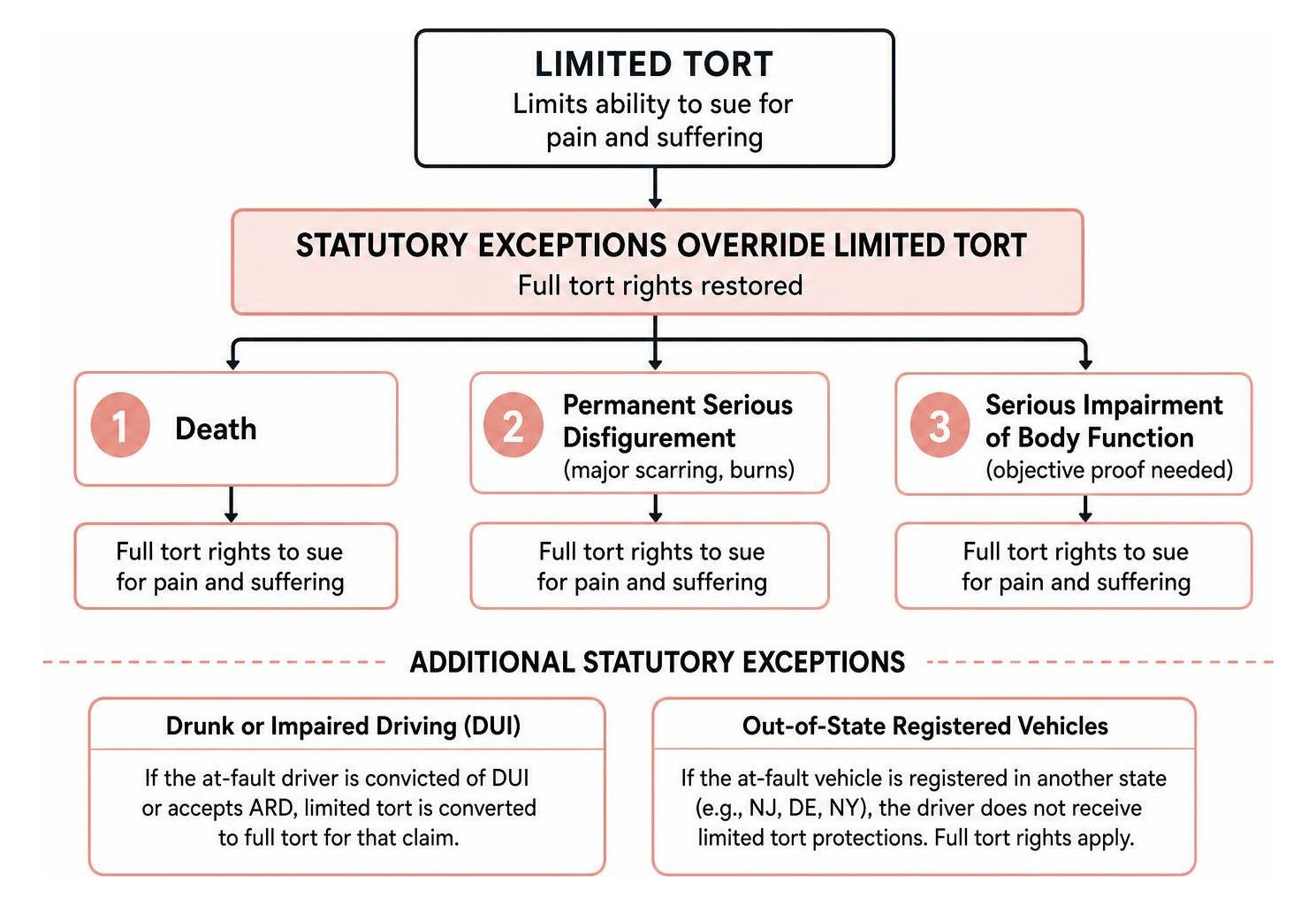
Drunk or Impaired Driving (DUI)
If the driver who caused your crash is convicted of driving under the influence of drugs or alcohol, or accepts Accelerated Rehabilitative Disposition (ARD), your limited tort selection is automatically converted to full tort for that accident claim.
Out-of-State Registered Vehicles
If the at-fault vehicle was registered in another state (such as New Jersey, Delaware, or New York), the driver does not receive the protections of Pennsylvania’s limited tort system. You have unrestricted full tort rights to sue for non-economic damages.
Uninsured Drivers and Hit-and-Run Crashes
When you are hit by a driver who failed to maintain auto insurance, the limited tort restriction does not shield them. You can pursue pain and suffering directly from the uninsured motorist or through your own policy by reviewing our uninsured motorist lawyer guide.
Commercial Vehicles, Taxis, Rideshares, and Pedestrian Accidents
You are exempt from limited tort restrictions if:
- You were a pedestrian or bicyclist struck by a motor vehicle.
- You were an occupant of a commercial passenger vehicle, such as a SEPTA bus, taxi, or airport shuttle.
- The at-fault party intended to injure you (intentional torts).
- Your injury was caused by a defective auto part, allowing for a product liability claim against a manufacturer or repair facility.
What Damages Can You Recover If You Do Not Meet the Serious Injury Threshold?
If your injuries do not meet the serious injury threshold and no statutory exception applies, you are still entitled to recover 100% of your economic losses from the at-fault driver’s insurance carrier.
Recoverable economic damages include:
- Excess Medical Expenses: Medical bills exceeding the $5,000 PIP minimum (or higher limits chosen on your policy), including surgeries, physical therapy, chiropractic treatments, and prescriptions.
- Lost Wages: Actual income lost due to missed work during recovery.
- Diminished Earning Capacity: Compensation for future income losses if your injury forces you to take a lower-paying job or reduces your working hours.
- Out-of-Pocket Expenses: Travel costs to medical appointments, home modifications, medical equipment (crutches, braces, wheelchairs), and domestic services for household chores you cannot perform.
- Property Damage: Repair or fair market value replacement of your vehicle and damaged personal property.
To learn more about the differences between financial reimbursement and general damages, read our comprehensive overview on demystifying damages and personal injury compensation.
How Do Pennsylvania Negligence Laws and Deadlines Affect Your Claim?
Securing compensation after a car accident involves more than proving your tort status; you must also navigate Pennsylvania’s negligence laws and statutory deadlines.
Pennsylvania Modified Comparative Negligence (42 Pa.C.S. § 7102)
Pennsylvania follows a 51% modified comparative fault rule:
- You can recover damages as long as your fault is 50% or less.
- If you are found 51% or more at fault, you are legally barred from recovering any damages.
- If you share partial responsibility (50% or less), your total financial award is reduced by your percentage of fault. For example, if a jury awards $100,000 but finds you 20% responsible for the collision on Broad Street, your net recovery is $80,000.
Statute of Limitations (42 Pa.C.S. § 5524)
Under Pennsylvania law, you have two years from the exact date of the collision to file a personal injury or property damage lawsuit. Failing to file within this two-year window almost always results in a complete forfeiture of your right to compensation.
Overcoming Pennsylvania’s Low Minimum Insurance Limits
Pennsylvania requires minimum liability coverage of only $15,000 per person / $30,000 per accident / $5,000 property damage (15/30/5). In serious crashes, this minimal coverage is quickly exhausted. In these cases, we evaluate your policy to identify Underinsured Motorist (UIM) coverage, helping our clients secure substantial Pennsylvania accident settlements even when the at-fault driver carried inadequate coverage.
What Steps Should You Take After a Philadelphia Car Accident to Protect Your Rights?
To protect your right to pain and suffering compensation after a crash, follow these essential steps:
- Call 911 and Obtain a Police Report: Ensure the Philadelphia Police Department documents the scene, vehicle positions, witness statements, and citations issued to the other motorist.
- Seek Immediate Medical Evaluation: Visit an emergency room, such as Temple University Hospital or Penn Presbyterian, within 24 to 48 hours. Medical records created immediately after the crash provide the objective evidence required to prove a serious injury.
- Document Everything: Photograph vehicle damage, road conditions, skid marks, traffic signals, and visible physical injuries (bruises, cuts, swelling).
- Locate Your Insurance Declarations Page: Review your policy paperwork to confirm whether you have full tort or limited tort, and verify your PIP and UM/UIM limits.
- Do Not Give Recorded Statements: Insurance adjusters frequently ask questions designed to minimize the severity of your injuries or elicit statements that can be used against your tort threshold claim.
- Obtain Legal Guidance Early: Get dependable car accident settlement help before discussing settlements or signing releases with insurance carriers.
Frequently Asked Questions About Limited Tort Claims in Pennsylvania
How do I find out if I have full tort or limited tort on my policy?
Check the Declarations Page (Dec Page) of your auto insurance policy, which lists your selected coverages, tort option, and premiums. Under 75 Pa.C.S. § 1705(a)(3), if your insurer cannot produce a valid, signed tort election form proving you chose limited tort, Pennsylvania law automatically treats you as having full tort status.
Can my children or passengers sue for pain and suffering if I have limited tort?
Your limited tort selection generally applies to resident family members (spouses and minor children) who do not own their own vehicles. However, non-resident passengers, roommates, and passengers who own their own insured vehicle with full tort coverage are governed by their own policy’s tort election, not yours.
What happens if the at-fault driver has only minimum 15/30/5 insurance limits?
If the at-fault driver carries Pennsylvania’s minimum liability limits of $15,000, that amount may not cover severe injuries. If you purchased Underinsured Motorist (UIM) coverage, you can file a claim against your own insurance policy to recover the remaining value of your pain, suffering, and economic losses.
Protect Your Legal Rights with Proven Philadelphia Injury Representation
Holding a limited tort auto insurance policy does not mean you are out of options after a serious collision. Insurance companies routinely use limited tort status to discourage injured victims from pursuing the full compensation they deserve. At J. Fine Law, our attorneys review insurance election forms for technical defects, uncover statutory exceptions, and assemble medical evidence to prove serious bodily impairment.
With a 98% success rate, rapid attorney response, and over $50 million recovered for injury victims across Philadelphia and surrounding communities, our legal team is prepared to protect your rights. We represent all personal injury clients on a contingency fee basis—meaning you pay no upfront legal fees unless we successfully resolve your claim.
Whether you need assistance overcoming limited tort barriers after a crash or require representation from a dedicated attorney for complex claims, we are here to help. Contact us today for a free, confidential case evaluation.