 Skip to content

Does my Car Insurance Cover Me in an Uber in Philadelphia?
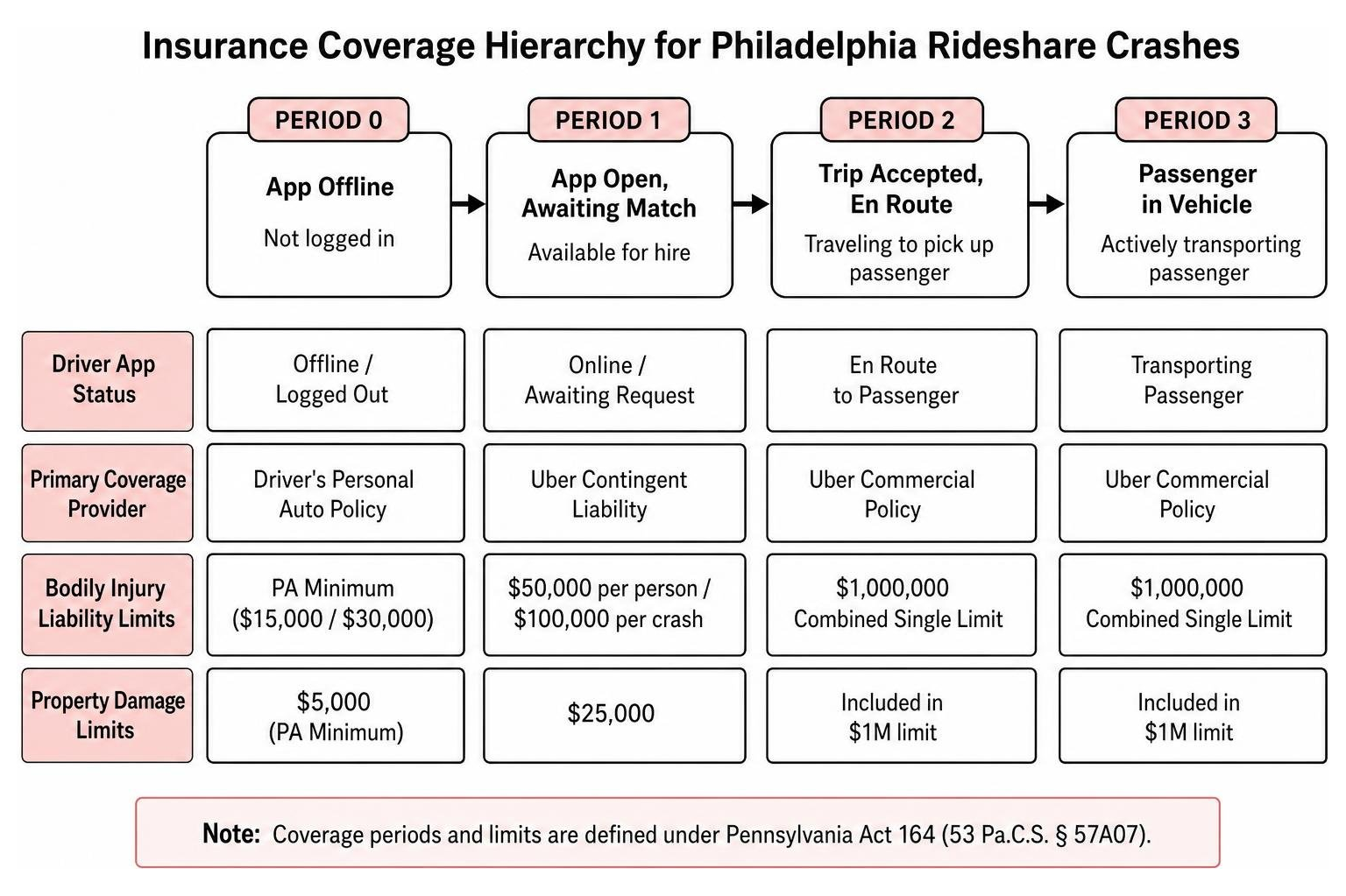
The answer depends on the driver’s app status at the moment of the crash. Uber’s coverage operates across four distinct phases defined under Pennsylvania Act 164 (53 Pa.C.S. § 57A07), and each phase determines which policy responds first and how much money is available to injured riders, drivers, or third parties.
When the driver app is offline, only personal auto insurance applies. Once online awaiting a ride, Uber provides limited liability coverage. When dispatching to or transporting passengers, full commercial liability coverage up to $1,000,000 takes over.
Pennsylvania law divides rideshare activity into distinct operational windows. Each window determines which insurance policy responds first and sets the maximum payout limits available.
- Period 0 (App Offline): The driver is not logged into the app. Only the driver’s personal automobile insurance policy applies, with zero coverage from the rideshare platform.
- Period 1 (App Open, Awaiting Match): The driver is available for hire in Center City or on I-76 but has not accepted a dispatch. Uber provides contingent third-party liability coverage of $50,000 per person for bodily injury, $100,000 per accident for bodily injury, and $25,000 for property damage.
- Period 2 (Trip Accepted, En Route): The driver is traveling to pick up a passenger on Market Street or Broad Street. Commercial coverage expands to at least $1,000,000 for third-party bodily injury and property damage.
- Period 3 (Passenger in Vehicle): A passenger is actively riding in the vehicle. The full $1,000,000 commercial liability policy remains active alongside applicable first-party benefits.
Uber’s insurance materials explain that coverage changes with the driver’s app status. The table is a quick reference, but coverage depends on the trip stage and crash facts.
| Rideshare Phase | Driver App Status | Primary Coverage Provider | Bodily Injury Liability Limits | Property Damage Limits |
|---|---|---|---|---|
| Period 0 | Offline / Logged Out | Driver’s Personal Auto Policy | PA Minimum ($15,000 / $30,000) | $5,000 (PA Minimum) |
| Period 1 | Online / Awaiting Request | Uber Contingent Liability | $50,000 per person / $100,000 per crash | $25,000 |
| Period 2 | En Route to Passenger | Uber Commercial Policy | $1,000,000 Combined Single Limit | Included in $1M limit |
| Period 3 | Transporting Passenger | Uber Commercial Policy | $1,000,000 Combined Single Limit | Included in $1M limit |
What Is the Difference Between Standard TNC Drivers and Commercial Uber Black Chauffeurs?
Standard UberX drivers operate as peer operators under Transportation Network Company (TNC) statutes. Uber maintains commercial policies on their behalf during active dispatch periods.
Uber Black and luxury livery drivers operate under completely different legal requirements. In Philadelphia, commercial livery drivers must hold valid commercial registrations and maintain their own dedicated commercial auto insurance policies.
Standard platform TNC insurance policies do not cover trips driven under commercial livery accounts. Commercial fleet operators must maintain separate liability documentation to preserve active platform privileges and protect passengers.
Why Does Personal Auto Insurance Deny Claims for Uber Accidents?
Personal auto policies routinely deny rideshare claims under standard business-use or livery conveyance exclusions. Because personal policies are priced solely for private driving, insurers will not cover commercial transportation of people for a fee. Operating without commercial coverage or a rideshare endorsement risks claim denials, personal liability, and immediate policy cancellation.
Standard personal car insurance policies explicitly exclude commercial activities like carrying passengers or goods for compensation. As noted in legal analyses by Your Uber is here: Which auto insurance goes along for the ride?, private auto policies exclude liabilities that arise while driving for hire.
When an accident happens on Market Street or near University City, personal insurance carriers investigate the driver’s app activity and trip records. If the insurer discovers that the driver was logged into a rideshare app, they will issue a formal reservation of rights or deny the claim outright.
Failing to disclose ridesharing activities to an insurer can trigger policy cancellation or accusations of insurance misrepresentation. Injured drivers or passengers facing claim denials should consult a rideshare accident lawyer to protect their rights.
How Does a Rideshare Endorsement Protect Drivers in Pennsylvania?
A rideshare endorsement bridges the dangerous coverage gap during Period 1 when the app is running without an active match. Adding this endorsement extends your personal policy’s collision, comprehensive, and liability protections into your gig driving hours.
According to research from Rideshare Insurance: What To Know – State Farm®, adding rideshare driver protection typically adds roughly 15 to 20 percent to a personal auto premium. This endorsement helps bridge the gap between your personal collision deductible and Uber’s $2,500 physical damage deductible.
Without this endorsement, a driver involved in a crash while waiting for a fare could face thousands of dollars in out-of-pocket repair bills. An endorsement keeps personal coverage valid and prevents policy cancellation.
Does Uber Insurance Cover Vehicle Damage and Physical Injuries?
Uber covers physical vehicle damage only if the driver maintains personal collision and comprehensive policies, subject to a $2,500 deductible during active trips. For injuries, Pennsylvania law governs medical payment priority through personal injury protection, while third-party liability and uninsured motorist coverage protect injured riders and drivers.
Uber’s collision and comprehensive protection is strictly contingent. If you carry only liability on your personal vehicle, Uber will not pay to repair your car after a crash.
When contingent coverage applies during Periods 2 and 3, drivers must pay a substantial $2,500 deductible before repairs begin. Uber also does not reimburse rental vehicle costs while your car is in the repair shop.
Medical expenses follow Pennsylvania’s Motor Vehicle Financial Responsibility Law (75 Pa.C.S. § 1711). Under Pennsylvania’s no-fault framework, an injured person’s own auto policy provides primary first-party medical benefits.
If a negligent third party causes the crash, injured victims can pursue third-party liability claims against the at-fault driver’s carrier. Understanding limited tort rules after an Uber crash in Philadelphia is critical when seeking compensation for pain and suffering.
How Does Delivery Driver Coverage Differ from Rideshare Trips?
Uber maintains separate commercial liability insurance policies for food delivery couriers. Delivery drivers receive third-party liability protection while en route to pick up food or deliver orders.
However, Uber’s delivery insurance does not cover physical damage to the courier’s own vehicle during any delivery phase. Couriers must rely on personal auto policies that specifically permit commercial delivery work.
Food delivery couriers navigating South Philadelphia or Center City can purchase optional injury protection to cover medical bills and lost wages. Standard rideshare passenger policies do not apply during food delivery dispatches.
What Steps Should You Take Immediately After a Philadelphia Uber Crash?
Immediately protect your health and legal rights by calling 911 for an official police report and seeking medical care. Take photos of vehicle positions, damage, and trip receipts before notifying rideshare support. Avoid giving recorded statements to insurance adjusters until you consult a dedicated attorney about your claim.
Physical safety is your top priority following any collision on Roosevelt Boulevard or the Vine Street Expressway. Contact emergency personnel immediately so the Philadelphia Police Department can create an official accident report.
Seek a comprehensive medical evaluation right away at a local trauma center like Penn Presbyterian Medical Center or Thomas Jefferson University Hospital. Prompt medical documentation establishes a clear link between the crash and your physical injuries.
Collect evidence before leaving the scene by photographing property damage, road signs, and active app screens. Exchange insurance details with all involved motorists and obtain contact information from independent witnesses.
Report the collision through the Uber app safety toolkit, but do not discuss fault or sign settlements with claims adjusters. Contact J. Fine Law to ensure your claim is handled properly from day one.
Our rapid-response legal team has secured over $50 million in settlements for injured clients across Pennsylvania. We examine every insurance policy to ensure our clients recover maximum compensation under the law.
Contact Jason Fine After an Uber Accident in Philadelphia
Rideshare accident claims involve complex layers of personal insurance policies, commercial TNC coverage, and strict state statutes. Insurance carriers frequently attempt to shift liability or issue coverage denials to avoid paying injured victims.
Our team brings a proven 98% success rate and over $50 million in recovered settlements to every case we handle. We respond rapidly to investigate collisions, handle aggressive claims adjusters, and pursue maximum financial compensation.
If you suffered injuries as a driver or passenger, contact J. Fine Law’s Uber and Lyft accident team today. We provide confidential, no-obligation case evaluations to protect your financial recovery under Pennsylvania law. Get your free consultation 24/7.
Frequently Asked Questions About Uber Car Insurance in Philadelphia
Does my personal car insurance cover medical bills if I am an injured Uber passenger?
Under Pennsylvania law (75 Pa.C.S. § 1713), medical bills follow a strict statutory priority order. If you or a resident family member owns an insured vehicle, your personal auto policy pays first-party medical benefits first. If you do not own a vehicle, the driver’s policy or Uber’s commercial carrier may be responsible for covering your medical bills instead.
Can an Uber passenger sue the at-fault driver for pain and suffering in Philadelphia?
Yes, injured rideshare passengers have the legal right to pursue compensation from the at-fault driver. Pennsylvania tort rules allow claims against negligent rideshare drivers or third-party motorists who cause collisions, and passengers often qualify for exceptions to limited tort restrictions when pursuing pain and suffering damages.
Does Uber provide a rental car while my vehicle is being repaired after a crash?
Uber does not cover rental vehicle expenses after an accident. Drivers must rely on personal auto endorsements or pay out of pocket through platform vehicle rental partners while repairs are completed.