 Skip to content
Man Killed in Overnight Crash as Philadelphia Police Investigate What Led to It
A man died early Saturday morning, August 22, 2026, after being struck near 20th Street and Belfield Avenue in Philadelphia’s Logan section. The driver, a 41-year-old man in a Jeep, stayed at the scene and was not injured. Police have not yet said what led to the crash. When a driver remains at the scene and the cause isn’t yet clear, a Philadelphia pedestrian accident attorney has to look carefully at how Pennsylvania law weighs fault between drivers and pedestrians, rather than assuming either side is automatically responsible.
What Happened
According to 6abc / WPVI-TV, the crash happened around 1:50 a.m. Saturday near 20th Street and Belfield Avenue in Logan. Police found a man, believed to be in his 30s or 40s, unresponsive in the roadway. He was taken to Jefferson Einstein Medical Center, where he was pronounced dead. The 41-year-old driver of the Jeep stayed at the scene and was not injured. Officials said they are still working to determine what led to the crash.
How Pennsylvania Law Looks at Fault Between Drivers and Pedestrians
Because this crash happened overnight and the cause hasn’t been determined, it’s worth understanding how Pennsylvania actually assigns responsibility in pedestrian cases, rather than assuming the driver — or the pedestrian — was automatically at fault.
Pennsylvania law gives pedestrians the right-of-way in certain situations and imposes duties on them in others. Under 75 Pa. C.S. § 3542, when traffic-control signals aren’t in place or aren’t operating, a driver must yield to a pedestrian crossing within a marked crosswalk or an unmarked crosswalk at an intersection — but that same law also says a pedestrian can’t suddenly leave a curb or place of safety and walk into the path of a vehicle so close it creates a hazard. Separately, 75 Pa. C.S. § 3543 addresses pedestrians crossing somewhere other than a crosswalk: in that situation, the pedestrian generally must yield the right-of-way to vehicles on the roadway, and in urban areas with signalized intersections nearby, pedestrians typically aren’t permitted to cross mid-block outside a marked crosswalk at all.
In practice, this means the details that haven’t yet been released, like exactly where in the roadway the man was and whether he was in a crosswalk, will matter enormously to how a claim would ultimately be evaluated. If it turns out the driver failed to see a pedestrian who had the right-of-way, or was speeding, distracted, or otherwise negligent, that points toward driver liability. If the man was crossing outside a crosswalk in a way the statute doesn’t favor, that changes the analysis. This is exactly the kind of case where Pennsylvania’s comparative negligence rule, under 42 Pa. C.S. § 7102 (the “51% bar rule”), often ends up mattering: even if a pedestrian bears some responsibility, a claim can still succeed as long as the pedestrian’s own fault is found to be 50% or less, with damages reduced proportionally.
Why the Driver Staying at the Scene Matters, Legally and Practically
Unlike several of the incidents we’ve covered recently, this was not a hit-and-run. The driver remained, cooperated, and was not injured. That’s a meaningful difference: rather than an investigation built around identifying an unknown driver, this one will likely turn on physical evidence, any available surveillance footage, and witness accounts to reconstruct exactly what happened in the moments before impact. For a family considering their options, that generally means a faster and more straightforward path to gathering the facts than in an unidentified-driver case, even though what those facts ultimately show is still unknown.
Logan and the 20th and Belfield Corridor
Logan is a North Philadelphia neighborhood bordered roughly by Broad Street, Roosevelt Boulevard, and Fern Rock, with a mix of residential blocks and commercial corridors. Belfield Avenue runs through the neighborhood as a secondary north-south route, intersecting numerous residential cross streets, including 20th Street, in an area with a mix of streetlighting and residential parking that can make overnight visibility conditions vary block to block.
Frequently Asked Questions
Has a cause been determined for this crash?
Not according to available reporting. Police said they were still working to determine what led to the crash as of publication.
Was the driver charged or cited?
The source doesn’t indicate any charges. The driver stayed at the scene and was not injured; the investigation was ongoing.
If a pedestrian wasn’t in a crosswalk, does that mean the driver isn’t responsible?
Not automatically. Pennsylvania law does place added responsibility on a pedestrian crossing outside a crosswalk, but drivers still owe a general duty of care, and comparative negligence rules mean fault can be shared between both parties depending on the facts.
What is Pennsylvania’s comparative negligence rule?
Under 42 Pa. C.S. § 7102, an injured person (or their estate) can recover damages as long as they’re found 50% or less at fault; if their fault is 51% or more, recovery is barred, and otherwise, damages are reduced by their share of fault.
How long does a family have to file a wrongful death claim in Pennsylvania?
Generally two years from the date of death, under 42 Pa. C.S. § 5524.
Does it matter that the driver stayed at the scene instead of fleeing?
Practically, yes. A driver remaining at the scene typically means police have direct access to that driver’s account and any physical evidence right away, which can make the investigative process more straightforward than an unidentified-driver case, even though it doesn’t by itself determine fault.
What should a family do while an investigation like this is ongoing?
Consider speaking with an attorney early to help preserve evidence such as surveillance footage, which can be time-limited, even before the police investigation concludes.
About J. Fine Law Firm, P.C.
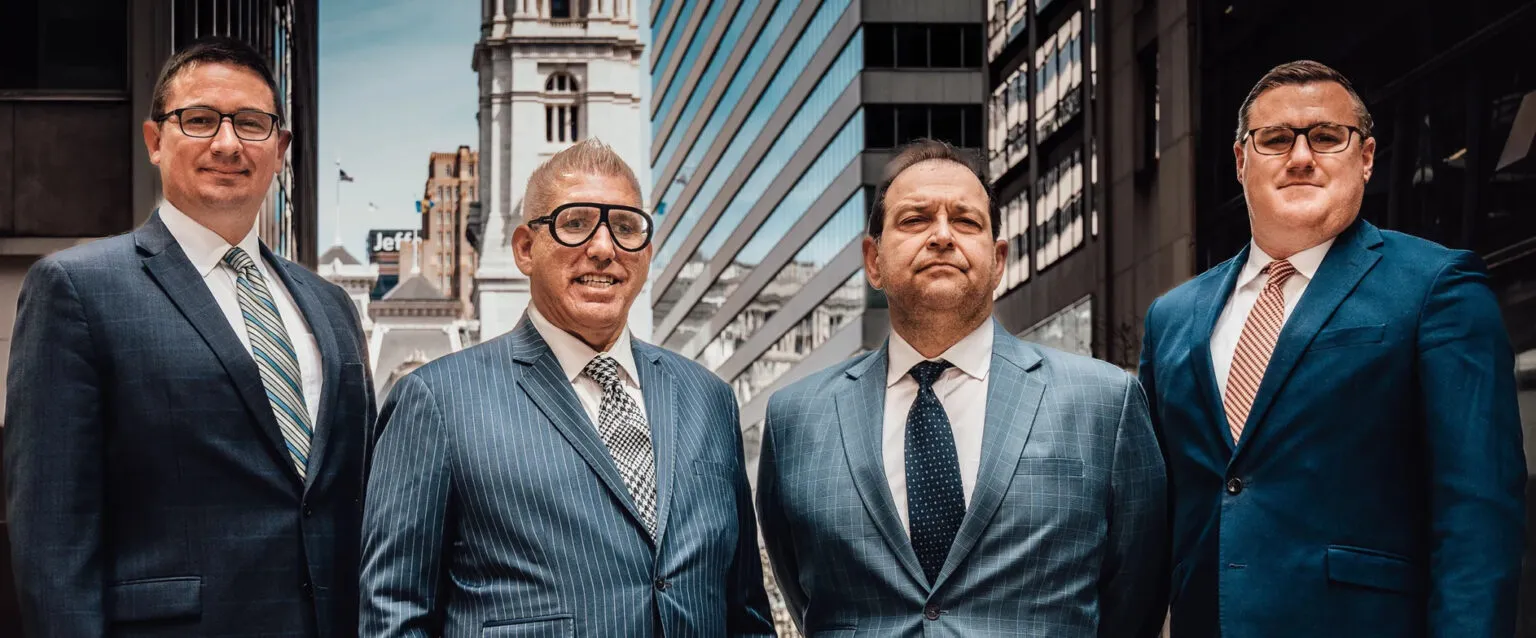
J. Fine Law Firm, P.C. represents injured people and families across Philadelphia in pedestrian accident cases, including situations where fault isn’t yet clear and an investigation is still underway. Attorney Joe LaRosa handles Pennsylvania matters for the firm, working alongside founding attorney Jason Fine to evaluate pedestrian cases based on Pennsylvania’s specific right-of-way and comparative negligence rules, rather than assuming fault in either direction. The firm’s past results reflect experience across a range of Pennsylvania personal injury matters, including pedestrian cases.
If You or a Loved One Has Been Hurt or Lost Someone in a Pedestrian Accident
Losing a family member in an overnight crash, with no clear explanation yet for how it happened, is an especially difficult place to be. If you or a loved one has been injured, or if your family has lost someone, in a pedestrian accident in Philadelphia, J. Fine Law Firm, P.C. — your Philadelphia personal injury lawyer resource — can help you understand your options once more facts are known. Call 1-888-913-3899 or request a free consultation to talk through your situation. There’s no cost to have that conversation, and no assumption on our part about how the facts will turn out.
Our thoughts are with the man who lost his life in this crash and with his family. J. Fine Law Firm, P.C. has represented Philadelphia families in pedestrian accident cases, and we’re here if you’re facing something similar.