 Skip to content
When Can You File a Premises Liability Lawsuit in Philadelphia?
You may have a premises liability claim if you were hurt by a dangerous condition on someone else’s property and the person responsible failed to take reasonable care. In Philadelphia, a claim generally depends on showing what caused the injury, why the property owner should have addressed it, and how it led to your losses. Take photos, get medical care, and save witness names and incident reports before evidence disappears.
I’m Jason Fine, founding attorney of J. Fine Law. For over 25 years, I’ve represented people injured in falls and other accidents, and I help Philadelphia clients understand what it takes to bring a premises liability lawsuit.
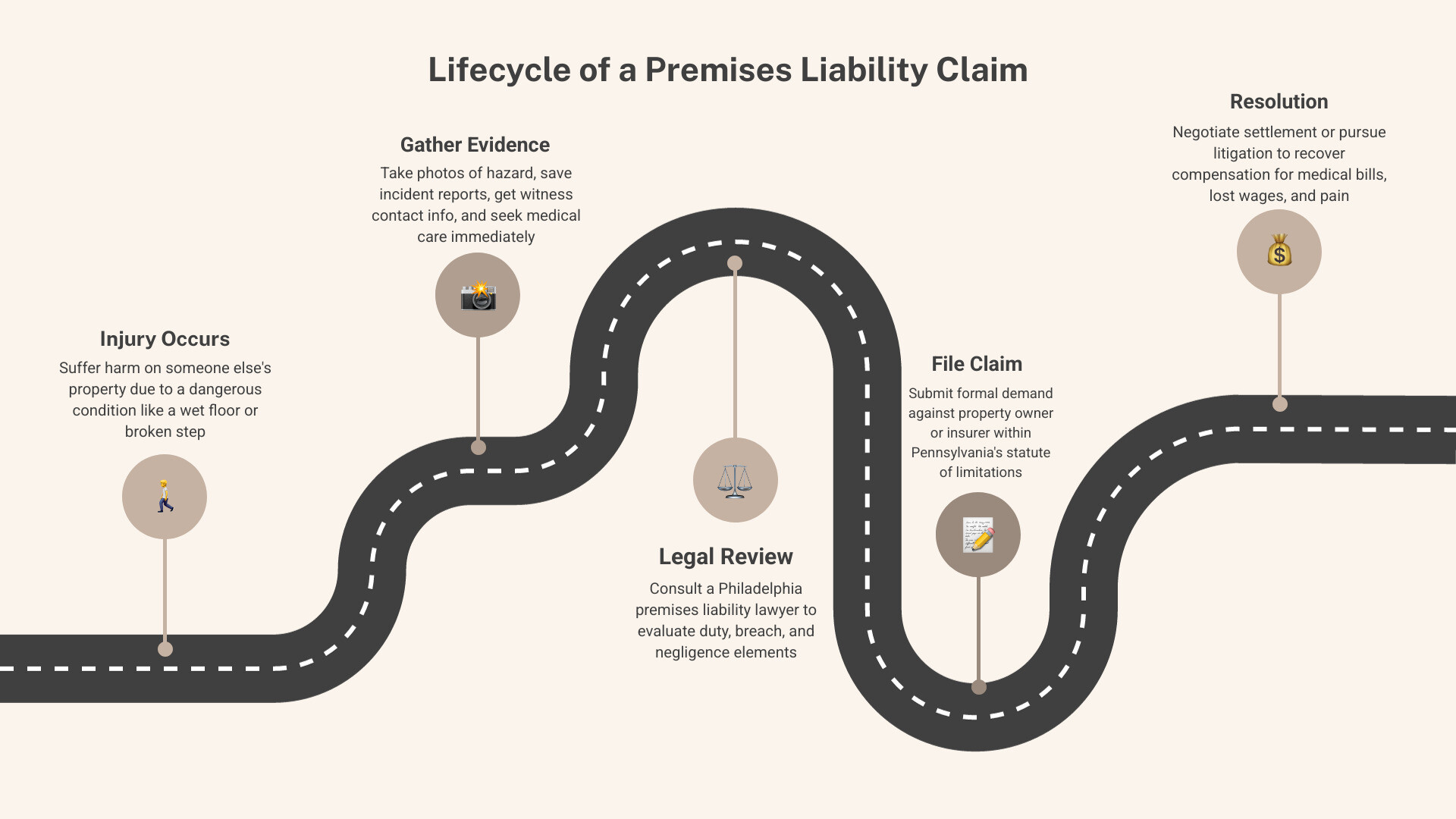
Premises liability lawsuit terms at a glance:
- Philadelphia premises liability lawyer
- premises injury lawyer
- landlord negligence lawyer Philadelphia
Understanding Property Owner Duty of Care and Visitor Status in Philadelphia

When an individual steps onto commercial real estate, a private residence, or a public facility in Philadelphia, the legal responsibility of the property owner depends heavily on the visitor’s status. Pennsylvania courts apply the Restatement (Second) of Torts § 343 to determine how much care a property owner, landlord, or business manager must exercise.
Whether you are navigating a bustling retail store along Market Street or entering an apartment complex near Center City, a Philadelphia premises liability lawyer evaluates whether the property controller breached their legal duty to maintain a reasonably safe environment.
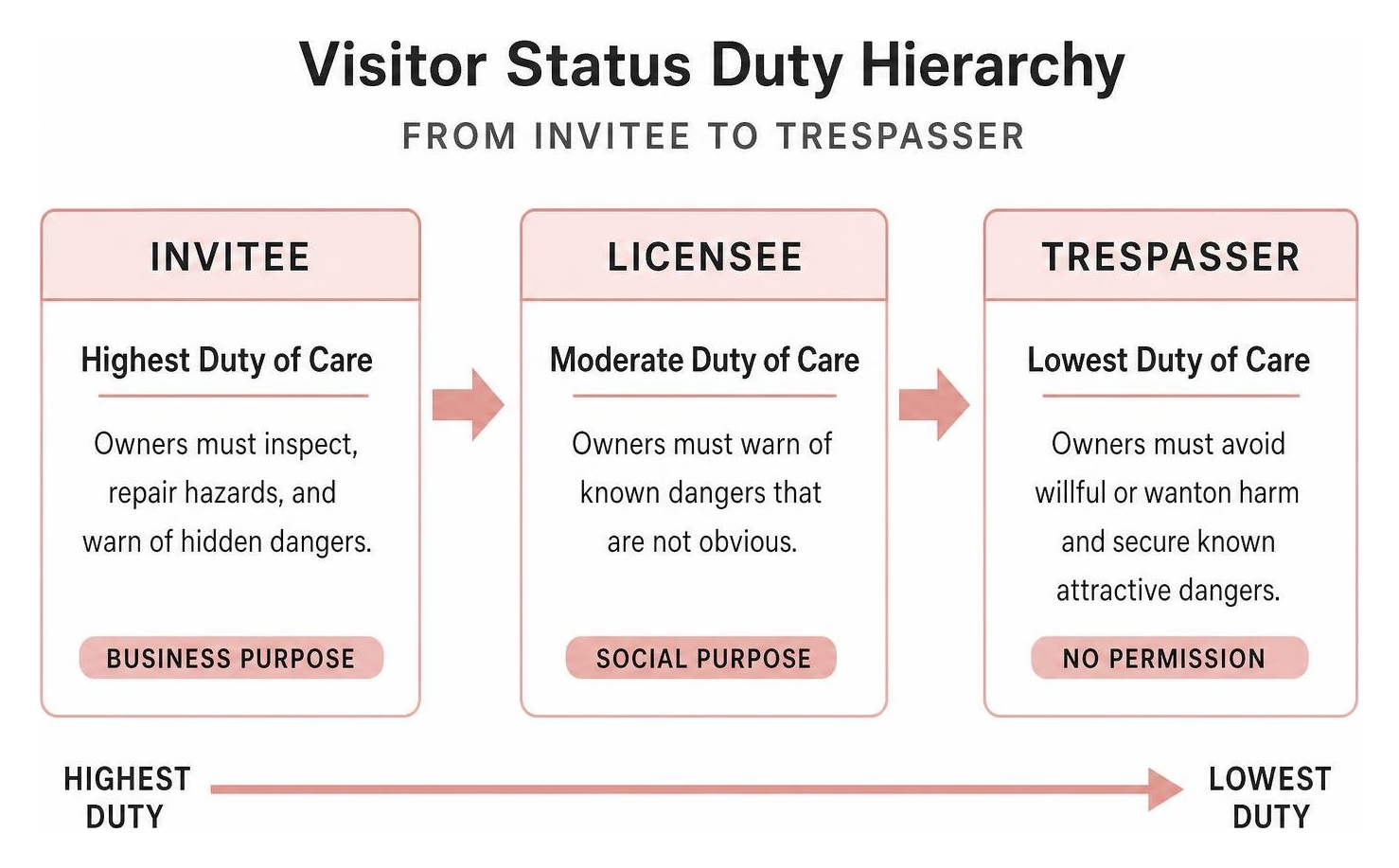
Legal Duties Owed to Business Invitees vs. Licensees
Pennsylvania premises liability law categorizes visitors into three primary groups:
- Business Invitees: Customers and patrons entering a business for commercial purposes receive the highest level of protection. Owners must proactively inspect the grounds, repair hazardous defects, and post clear warnings about hidden dangers.
- Licensees: Social guests entering with permission are owed a duty of reasonable care. Property possessors must warn them of known, concealed dangers that the guest is unlikely to discover.
- Trespassers: Individuals entering without permission are generally owed only a duty to refrain from willful or wanton misconduct, with distinct protections reserved for child trespassers under the attractive nuisance doctrine.
Understanding these distinctions helps determine fault in common slip and fall accident types across commercial and residential properties.
Heightened Precautions for Vulnerable and Disabled Populations
Commercial establishments must anticipate patrons with diverse physical capabilities. Property owners must ensure compliance with accessibility standards, ensuring clear walkway transitions, secure handrails on stairwells, and sufficient illumination in parking garages and corridors.
When businesses cater to older adults or individuals using mobility aids near local hubs like Penn Presbyterian Medical Center or Thomas Jefferson University Hospital, failing to address uneven thresholds or slippery ramps creates foreseeable dangers that violate basic safety duties.
Core Legal Standards for Proving a Premises Liability Lawsuit
Proving liability in an injury claim requires establishing four foundational elements: the defendant owed a duty of care, they breached that duty by allowing a hazardous condition, the breach directly caused your injuries, and you suffered measurable physical and financial damages. Obtaining clear premises liability legal advice early ensures your claim addresses these core standards with solid documentation.
Actual vs. Constructive Notice and Employee-Created Hazards
To hold a property owner accountable for a slip-and-fall hazard created by a third party, the injured party typically must show that the owner had notice of the condition:
- Actual Notice: The property owner or staff knew about the danger (e.g., an employee saw a spill or received a complaint).
- Constructive Notice: The hazard existed long enough that regular inspections should have caught and remedied it.
However, notice requirements shift dramatically when a business’s own staff creates the hazard. Courts across jurisdictions, including modern appellate rulings such as the Supreme Court of MD decision on employee-created hazards, hold that when an employee creates a hazard during their routine tasks—such as mopping a walkway without immediately displaying warning cones—the knowledge element is met, and whether the business took reasonable steps to warn patrons is a question for the jury.
Mode of Operation vs. Traditional Notice in a Premises Liability Lawsuit
In standard retail litigation, proving how long a spill sat on a floor presents a heavy evidentiary hurdle. To address this, modern jurisprudence recognizes the “mode of operation” approach for self-service businesses like buffets, grocery aisles, and self-service fueling stations.
Under this theory, as analyzed in the Moore v. Primadonna Co. appellate decision, an injured plaintiff does not need to prove actual or constructive notice if the business’s chosen operational method makes customer spills and resulting hazards reasonably foreseeable.
| Legal Approach | Notice Requirement | Primary Burden of Proof | Typical Application |
|---|---|---|---|
| Traditional Notice | Actual or constructive notice required | Plaintiff must prove hazard existed long enough for staff discovery | Sit-down restaurants, private offices, standard walkways |
| Mode of Operation | Notice requirement is satisfied by business model | Plaintiff proves the self-service model created foreseeable risks | Self-service grocery aisles, gas station pumps, food courts |
Overcoming the Open and Obvious Hazard Defense
Defendants frequently attempt to dismiss claims by arguing that the hazard was “open and obvious,” asserting that an attentive customer should have avoided it. However, courts increasingly reject this defense when hidden factors amplify the danger.
For instance, the Lewis v. Circle K Stores Inc. Fourth Circuit ruling demonstrated that while wet concrete post-rainfall might seem ordinary, the use of chemical cleaning agents on painted walkways can create an invisible, severe slipping hazard that a customer cannot reasonably anticipate, invalidating the property owner’s open-and-obvious defense.
Navigating Evidence, Causation, and Spoliation in Property Injury Claims
Building a winning claim requires rapid action to secure objective evidence before property managers alter the scene. Partnering with a dedicated slip and fall lawyer in Philadelphia ensures that critical evidence is preserved immediately through formal preservation demands.
Gathering Critical Evidence to Support a Premises Liability Lawsuit
- Surveillance Camera Footage: Video proving how long the hazard existed, foot traffic volume, and the exact fall mechanics.
- Floor-Walk Inspection Sheets: Maintenance logs documenting when staff performed required sweep and mop intervals.
- Incident and Police Reports: Official records filed immediately after the injury detailing surface conditions.
- High-Resolution Scene Photos: Detailed images capturing liquid dimensions, lighting levels, missing signage, or structural cracks.
- Eyewitness Statements: Unbiased observations from patrons or nearby employees regarding the condition.
Proving Injury Causation and Handling Pre-Existing Conditions
Premises accidents regularly inflict severe physical trauma, ranging from concussions to patellar tendon ruptures requiring extensive orthopedic reconstruction and physical therapy. In major injury claims, medical bills can climb past $400,000, accompanied by permanent physical impairment ratings.
Under Pennsylvania’s “eggshell plaintiff” doctrine, a negligent property owner is fully responsible for all damages resulting from their negligence, even if the victim had a pre-existing medical issue or prior injury that made them more susceptible to severe harm. While lay witness testimony can establish obvious injury mechanics within common everyday experience, complex joint ruptures and surgical recovery demands clear medical records and physician testimony to connect the fall directly to the losses.
The Consequences of Evidence Spoliation
When a property owner destroys surveillance footage, repaints a slippery ramp, or discards inspection logs after an accident, they may face legal penalties for the spoliation of evidence. Courts can impose severe sanctions, including monetary fines or instructing the jury to apply an “adverse inference”—presuming that the destroyed evidence would have proven the business was negligent.
Frequently Asked Questions About Philadelphia Property Accident Claims
What constitutes reasonable precautions for a business to prevent slip and fall accidents?
Reasonable precautions include conducting scheduled floor inspections, placing bright warning cones before mopping, providing anti-slip mats at entryways during wet weather, requiring employees to wear high-visibility gear during maintenance, and promptly barricading known structural hazards.
When is professional witness testimony required to prove causation in a property injury case?
Lay testimony is often sufficient when the injury mechanism is straightforward (such as immediate bruising or simple fractures from a fall). However, qualified medical causation and engineering testimony are necessary when assessing complex joint trauma, long-term degenerative aggravation, or technical friction-coefficient testing of floor surfaces.
How does evidence spoliation affect the outcome of a premises liability lawsuit?
Spoliation severely harms the defense. If a property owner deliberately deletes surveillance video or fails to preserve maintenance logs after receiving a formal legal hold, the court may issue adverse inference jury instructions, which substantially increases the likelihood of a plaintiff verdict.
Holding Negligent Property Owners Accountable for Your Recovery
When property owners, senior living facilities, or commercial establishments in Philadelphia fail to maintain safe premises, vulnerable older adults and innocent visitors suffer life-altering physical and financial harm. At J. Fine Law, our legal team brings a 98% success rate, rapid response times, and over $50 million recovered for injury victims across our communities. If you or an aging loved one suffered severe harm from hazardous facility conditions, facility neglect, or fall hazards, connecting with an elder abuse attorney and a dedicated Pennsylvania premises liability lawyer ensures your rights are protected. Contact us today for a free case evaluation so we can investigate the scene, preserve critical evidence, and fight for the full compensation your family deserves.