 Skip to content
No, a “wet floor” sign does not automatically clear a grocery store of liability under Pennsylvania premises liability law—a warning cone is merely one piece of evidence rather than an absolute liability shield.
Grocery stores operating along Market Street, Broad Street, or anywhere across Philadelphia owe a strict legal duty of care to their customers. When you enter a supermarket to buy groceries, the law classifies you as a business invitee. That status affords you the highest level of legal protection under state property law.
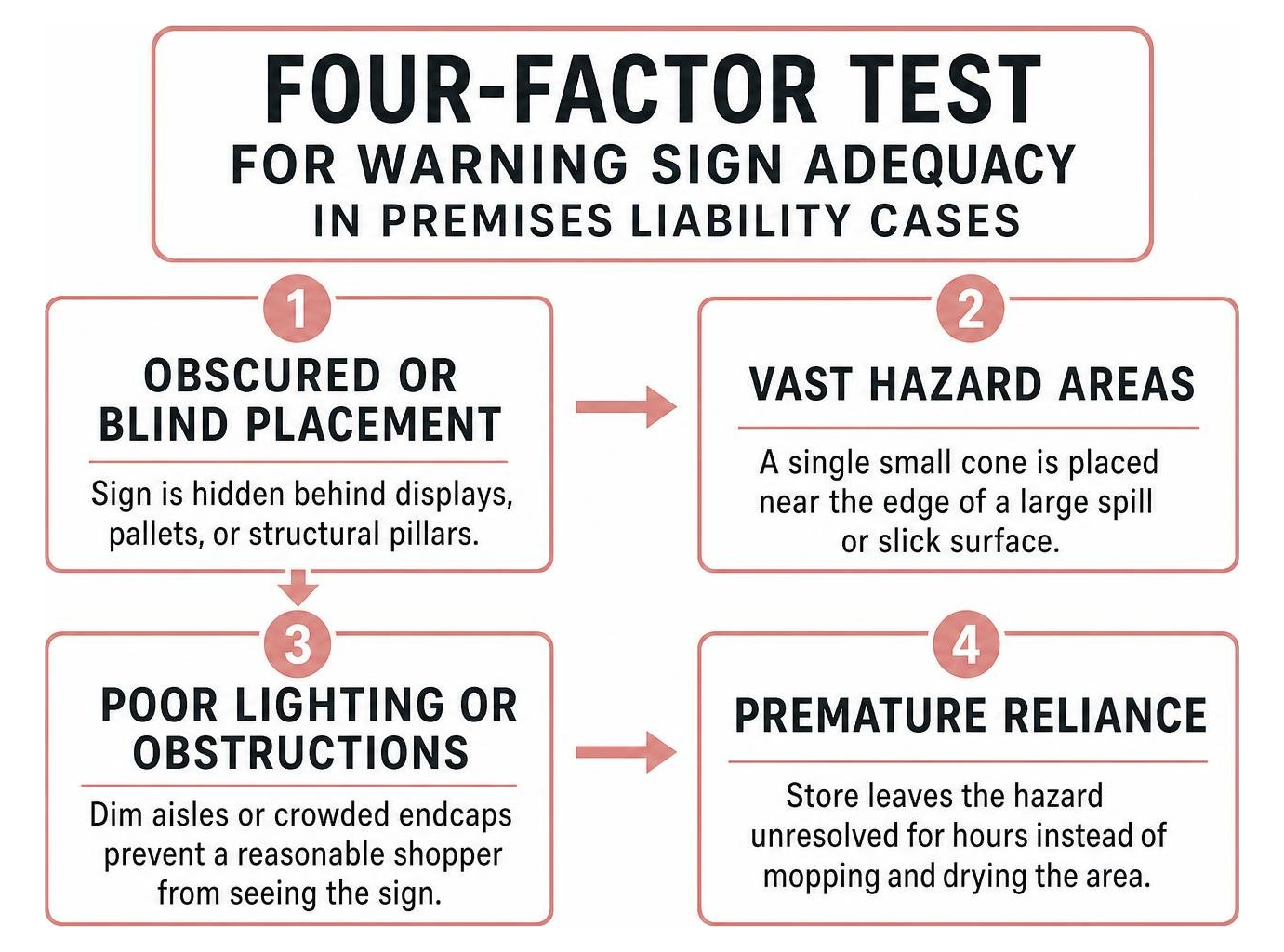
Commercial grocers cannot simply toss a plastic sign onto a polished floor and ignore ongoing hazards. Warning signs routinely fail legal adequacy standards under several common conditions:
- Obscured or Blind Placement: The sign is tucked behind a promotional cardboard display, pallet, or structural pillar.
- Vast Hazard Areas: A single ten-inch cone is dropped near the perimeter of a thirty-foot trail of spilled liquid or melting ice.
- Poor Lighting or Obstructions: Dim aisle lighting or crowded endcaps prevent a reasonable shopper from noticing the cone before stepping onto the slick surface.
- Premature Reliance: The store leaves standing liquid on the floor for hours instead of actually mopping and drying the aisle.
The physical consequences of supermarket falls are severe. According to federal public health data, one out of five falls results in serious injuries, such as broken bones or traumatic brain injuries. Furthermore, nearly one million older adults are hospitalized every year across the country because of a fall, most commonly suffering debilitating hip fractures or head trauma. In fact, falls remain the leading cause of injury-related deaths among seniors.
Core Duty of Care in Pennsylvania Supermarkets
Supermarket operators must actively maintain reasonably safe aisles and walkways. Placing a temporary warning does not replace the business’s primary obligation to remediate dangerous conditions promptly.
If a store manager knows an aisle floor is slick from cleaning or leaking refrigeration lines, posting a cone is only a short-term precaution while staff actively clear the puddle. Leaving a hazardous condition untouched under the assumption that a sign transfers all legal fault onto injured shoppers violates basic premises liability rules. Working with a dedicated Philadelphia slip and fall accident attorney ensures that the store’s maintenance timeline and cleanup failures are thoroughly investigated.
What Evidence Proves the Store’s Warning Sign Was Ineffective or Inadequate?
Courts analyze warning signs under a totality-of-the-circumstances test rather than accepting a simple defense claim that a sign existed. In retail premises liability claims, judges and juries assess the validity of a warning through four core factors:
- Placement: Was the cone positioned directly at the entry point of the danger zone, or was it set several feet away where approaching shoppers could not see it?
- Timing: Was the warning present before you approached, or did an employee set it down during the chaos after your fall?
- Visibility: Was the sign upright, brightly lit, and clearly contrasting with the surrounding store environment?
- Scope: Did the physical warning adequately communicate the entire footprint of the slippery area?
Judicial opinions, such as the analysis in Flor Reyes v. Brookshire Grocery Company, examine the exact proximity and visibility of warning markers relative to where a patron actually stepped. When a store claims it provided fair warning, evidence must demonstrate that a typical customer exercising ordinary attention would have seen and understood the warning before encountering the hazard.
| Warning Characteristic | Legally Adequate Warning | Legally Defective Warning Attempt |
|---|---|---|
| Positioning | Placed directly in front of the wet perimeter at eye-level line of sight | Tucked behind an endcap display or placed in an adjacent aisle |
| Timing | Deployed immediately upon discovering the puddle | Rushed out by an employee after the customer hits the floor |
| Physical Condition | Standing upright, clean, and clearly legible from several yards away | Knocked flat, obscured by shopping carts, or faded text |
| Coverage Area | Multiple cones or caution tape cordoning off large liquid spills | A single small cone set in the center of an expansive liquid slick |
Physical Sign Inadequacy and Post-Fall Deployment
One of the most frequent defense tactics involves employees claiming a sign was present when surveillance video reveals otherwise. Store staff members frequently retrieve a caution cone from a storage closet and place it right beside an injured customer while waiting for emergency medical responders to arrive from Thomas Jefferson University Hospital or Penn Presbyterian Medical Center.
We also uncover incidents where signs were knocked over by shopping carts minutes before the fall, leaving flat plastic that blends into the floor pattern. When business operators try to evade accountability through deceptive sign placement, partnering with a wet floor accident lawyer to hold negligent parties accountable provides the investigative tools needed to expose the truth.
How Do Actual and Constructive Notice Differ in Supermarket Spill Claims?
To succeed in a slip and fall injury claim against a grocery chain in Philadelphia, you must establish that the business had notice of the dangerous condition before the accident occurred. Pennsylvania law recognizes two primary forms of legal notice:
- Actual Notice: The store created the puddle itself (e.g., an employee mopped the aisle or dropped a jar of liquid) or an employee was directly told about the spill before your fall.
- Constructive Notice: The dangerous liquid remained on the floor for such a duration that store personnel exercising reasonable care should have discovered and eliminated it.
When an employee argues that a wet floor sign was nearby, that very statement often establishes actual notice. If store staff had time to place a cone near a leaking freezer or a broken container, management was already aware of the dangerous puddle.
The legal distinction regarding circumstantial evidence and customer flow patterns was detailed in Isaac v. Wal-Mart, where courts examined how long liquid remained on a retail floor and whether foot traffic patterns indicated the business neglected routine inspections. Electronic sweep logs, maintenance time stamps, and employee shift schedules often reveal substantial inspection gaps where spills sat unnoticed across busy shopping hours. A detailed review of these standards is available in our supermarket accident guide.
Mode of Operation and Employee-Created Hazards
Not all grocery store spills originate from customer accidents. Many dangerous floor conditions stem directly from store operations:
- Automated produce misters that overspray onto smooth aisle linoleum
- Cracked commercial freezer seals leaking condensation onto tile
- Melting ice around open seafood and poultry display cases
- Routine floor scrubbing or mopping during peak shopping hours without blocking off aisle access
When store equipment creates the condition, the injured party does not need to prove how long the liquid sat on the floor—the business generated the danger through its own operating methods. You can evaluate the merits of an equipment-related claim with a grocery store injury attorney.
How Does Comparative Negligence Affect Your Claim If You Walked Near a Warning Cone?
Insurance carriers routinely argue that if any warning marker existed in the building, the injured patron is entirely at fault for failing to look down. Pennsylvania law rejects this extreme position under the state’s modified comparative fault statute (42 Pa.C.S. § 7102).
Under Pennsylvania’s 51% rule:
- You can recover financial compensation as long as your share of responsibility is 50% or less.
- Your total recovery is reduced proportionally by your percentage of fault.
- If a court determines your damages total $100,000 and finds you were 15% responsible for not seeing an obscure cone, your final recovery award is $85,000.
Senior citizens are particularly vulnerable to these aggressive insurance defense tactics. With falls serving as the leading cause of fatal injuries for older adults and driving nearly one million emergency hospitalizations annually, adjusters frequently exploit mobility issues or eyeglasses to shift the blame onto senior victims.
To determine what your case may be worth after accounting for insurance defenses, review our guide to Philadelphia slip and fall lawsuit eligibility.
Rebutting Adjuster Accusations of Distracted Walking
Supermarkets are intentionally engineered to capture your gaze at eye level. Brightly colored shelf displays, promotional hanging banners, price tags, and endcap promotions are carefully positioned to pull your eyes away from the floor.
Checking prices, searching for items on a shelf, or holding a grocery list does not make you negligent under Pennsylvania law. Insurers cannot design a visual retail environment that distracts shoppers and then claim customers are legally barred from recovery because they failed to stare continuously at their feet. Our legal team implements proven premises liability strategies for holding property owners accountable to counter these adjuster tactics.
What Immediate Steps Should You Take in Philadelphia to Counter False Store Defense Claims?
Taking decisive action immediately after a grocery store slip preserves crucial evidence before store personnel can alter the scene or overwrite recording devices:
- Take Photos and Video Immediately: Use your smartphone to capture the wet area, the puddle’s boundaries, your clothing and shoes, and the exact distance to any signs or cones.
- Identify Nearby Cameras: Look up at ceiling rafters and aisle corners to note the locations of security cameras that recorded the fall and employee actions.
- Demand an Official Incident Report: Notify the manager on duty, insist that an official report be drafted, and take a photo of the completed document before leaving.
- Collect Independent Witness Details: Obtain names, phone numbers, and brief notes from fellow shoppers who saw the puddle before store staff wiped it clean.
- Seek Urgent Medical Care: Visit a nearby facility such as Pennsylvania Hospital or Temple University Hospital immediately to establish a documented record linking your injuries directly to the fall.
- Send a Formal Evidence Preservation Letter: Work with legal counsel to issue an immediate spoliation letter preventing the supermarket from destroying digital surveillance footage.
Under Pennsylvania law, you generally have two years from the date of the injury to file a premises liability lawsuit against a private commercial store. However, if your fall occurred in a municipal or publicly operated facility, formal written notice must be submitted within six months. Review the types of slip and fall accidents in Philadelphia to understand how specific fall scenarios impact these legal timelines.
Preserving Critical Physical Evidence
Store the exact shoes and clothing you wore during the accident inside a clean plastic bag. Do not wash the garments or scrub the soles of your shoes, as residual liquids, grease, or floor wax can be tested in litigation to confirm floor slickness.
Once your physical evidence is secure, consult a premises liability lawyer to plan your next legal steps.
Frequently Asked Questions About Grocery Store Slip and Fall Liability
What should I do if an employee places a wet floor sign only after I fell?
If you are physically able, take immediate timestamped photographs of the scene showing where the cone was eventually placed. Point out the delayed placement to nearby shoppers and store employees. When our firm steps in, we issue an immediate legal hold demand for all store surveillance footage, which exposes the exact minute the sign was brought onto the floor.
Can I still receive compensation if I saw the warning sign from a distance?
Yes. If the puddle extended far past the sign, if the cone was placed inside an adjacent aisle, or if the store failed to leave a reasonably safe, dry pathway to navigate around the hazard, the property owner remains liable under Pennsylvania comparative fault rules.
How long do I have to file a slip and fall claim in Philadelphia?
For private grocery stores and retail supermarkets, Pennsylvania’s statute of limitations gives you two years from the exact date of your fall to file a lawsuit. If the injury occurred on property operated by a government or municipal agency, you must provide formal written notice of the claim within six months.
Take Decisive Action to Protect Your Grocery Store Slip Injury Claim in Philadelphia
When a grocery store accident leaves you facing mounting medical bills, lost wages, and severe physical pain, do not let an insurance adjuster dismiss your claim with false assertions about a caution sign.
At J. Fine Law, our legal team has secured over $50 million in settlements and verdicts for injured victims across Philadelphia, PA, maintaining an exceptional 98% success rate. We understand how major grocery chains and their claims administrators attempt to avoid responsibility, and our rapid response team acts immediately to secure store video surveillance, sweep records, and maintenance logs before evidence disappears.
Whether your injury occurred in Center City, South Philadelphia, or Northeast Philly, we handle every aspect of your case under a contingency fee arrangement—meaning you pay zero upfront costs and owe no attorney fees unless we recover compensation for you. If a loved one suffered a catastrophic fall, or if you require representation from an elder abuse attorney for an injury sustained in a commercial or residential setting, we are prepared to fight for the justice you deserve.
Contact our Philadelphia office today for a free, comprehensive case evaluation.