 Skip to content
If an insurance adjuster calls immediately after a fall at a Philadelphia business, do not give a recorded statement, do not describe how you feel, and do not discuss fault. Provide only your name, address, and phone number, then politely direct all other questions to a lawyer. This protects you while your injuries are still being evaluated.
When you suffer an injury at a commercial property—whether slipping on ice outside a Center City restaurant on Walnut Street or losing your footing on a wet floor in a South Philadelphia supermarket—the property owner’s commercial liability insurer moves fast. In most cases, an insurance adjuster will contact you within 24 to 48 hours following the incident.
This rapid outreach is not motivated by customer service or concern for your health. Insurance companies understand the psychology of post-accident shock. Right after a fall, your body is flooded with adrenaline, masking severe soft-tissue damage, herniated discs, or concussions. You might genuinely believe you are unhurt, only to wake up forty-eight hours later unable to turn your neck or put weight on your knee.
Adjusters reach out early to capitalize on this window of uncertainty. Their primary objectives include:
- Securing early recorded admissions: Getting you on record saying “I’m okay” or “I didn’t see the spill” before you have had a complete medical assessment at facilities like Penn Presbyterian Medical Center or Thomas Jefferson University Hospital.
- Locking in unrepresented testimony: Taking advantage of the fact that you do not yet have legal representation to explain your rights under Pennsylvania law.
- Shifting fault early: Asking subtle, leading questions to make it sound as though your choice of footwear, distraction with a mobile phone, or rushing contributed to the fall.
- Closing the file cheaply: Offering a small nuisance payment to settle the matter before the true financial and medical cost of your injury becomes clear.
Casual conversational politeness can quickly turn into a legal admission of fault. Answering “I’m fine, thank you” to an opening pleasantry can later be presented as evidence that your injuries were minor or non-existent at the time of the event.

What Should You Say (and Never Say) When the Insurance Adjuster Calls?

When an adjuster calls, you must control the narrative by saying as little as possible. Insurance adjusters are trained negotiators who know how to extract damaging admissions during seemingly informal chats.
Traps Behind Seemingly Harmless Questions
- “How are you feeling today?”
- The Trap: Answering “I’m doing okay” or “A little sore, but hanging in there.”
- How It Is Used: The insurer argues your injuries were minor and that later treatments for severe pain are fabricated or unrelated.
- “Can you tell me what happened in your own words?”
- The Trap: Providing an unscripted recap while you are still disoriented.
- How It Is Used: Any slight omission or misstatement about where you looked or what you stepped on will be used to argue you were careless.
- “We just need a quick recorded statement to process your medical bills.”
- The Trap: Believing this is a mandatory step for them to cover your emergency room visit.
- How It Is Used: They search the recording for contradictions to deny coverage entirely.
Exact Scripts to Use When the Adjuster Calls
You can remain polite and professional while firmly protecting your legal rights:
Adjuster: “I just need to take a quick recorded statement about what happened at the store.”
You: “I am not providing any recorded statements. Please send all written communications to my address, and I will have my attorney review them.”
Adjuster: “How are you feeling after the fall?”
You: “I am currently under medical care, and my injuries are still being evaluated by my physicians. I will not discuss my medical condition over the phone.”
Adjuster: “If you don’t give a statement today, we can’t open a claim to help with your bills.”
You: “You may open the claim with my basic contact information. All further questions regarding liability and damages must go through my legal representative.”
Before engaging in any conversation, take the essential protective steps following an incident in a store to ensure you do not inadvertently compromise your position. Limit your responses strictly to your legal name, current address, and phone number. Decline to answer substantive questions regarding the mechanics of your fall or your ongoing medical prognosis.
What Tactics Do Insurance Adjusters Use to Devalue Your Philadelphia Slip and Fall Claim?
Commercial insurers handle claims using proven playbooks designed to minimize settlement payouts. Understanding their methods allows you to avoid costly mistakes.
| Adjuster Tactic | Insurer’s Hidden Objective | Your Rights Under Pennsylvania Law |
|---|---|---|
| Pushing Early Lowball Settlements | Settle your claim for pennies before diagnostic MRIs reveal disc tears, fractures, or nerve damage. | You have the right to complete all medical diagnostics and treatment before discussing settlement values. |
| Exploiting Comparative Negligence | Blame your shoes, phone use, or failure to watch your step to reach the 51% fault bar. | Under Pennsylvania’s modified comparative negligence rule, you can recover damages as long as your fault is under 51%. |
| Requesting Blanket Medical Releases | Dig into decades of past medical records to claim your current pain is a “pre-existing condition.” | You are only required to provide medical documentation directly relevant to the specific injuries caused by this incident. |
| Delaying Until Evidence Disappears | Stall direct communication until store security cameras overwrite footage of the spill or hazard. | Commercial surveillance is often erased within 24 to 72 hours; you have the right to issue legal preservation demands immediately. |
| Discouraging Legal Counsel | Tell you that hiring an attorney will simply reduce your take-home payout through legal fees. | Represented claimants statistically recover significantly higher net settlements, even after fees are accounted for. |
Insurance representatives frequently attempt to misuse Pennsylvania’s modified comparative negligence statute. If an adjuster can convince a jury or arbitration panel that you were 51% or more responsible for not spotting an open puddle on Market Street or an unlit stairway on Broad Street, the business pays zero dollars.
To build a solid claim, working alongside an experienced Philadelphia premises liability lawyer ensures that vital surveillance video is preserved before the business erases it under standard recording overwrite cycles.
What Can You Do If You Already Gave a Recorded Statement to the Adjuster?
If you already gave a recorded statement before reading this guide, do not panic. While giving an early statement creates hurdles, there are clear legal steps to limit any potential damage to your claim.
Immediate Action Plan
- Request the Full Audio Recording and Transcript: Under standard discovery rules, you have the right to request a complete copy of any statement you provided to an adverse party’s insurer.
- Consult Legal Counsel Immediately: Have a seasoned slip and fall accident lawyer in Philadelphia review the transcript line by line. An attorney can spot leading questions, clarify statements taken out of context, and draft supplemental declarations that correct misinterpretations.
- Anchor Your Case with Objective Medical Data: Adjusters rely on early recorded remarks such as “I just bumped my knee” to downplay claims. Objective diagnostic imaging—such as X-rays, CT scans, and MRIs from facilities like Temple University Hospital—provides concrete medical proof that supersedes initial unrepresented statements made during physical shock.
- Collect Independent Witness Accounts and Incident Reports: If your statement contained minor factual inconsistencies regarding the precise layout or timing, securing formal statements from third-party witnesses and obtaining the official store incident report will verify the real conditions of the property.
How Does Working with J. Fine Law Protect Your Financial Recovery?
Navigating insurance calls while recovering from painful injuries can feel overwhelming. At J. Fine Law Group, our legal team takes over all communication with adverse insurers from day one, insulating you from aggressive adjusters and high-pressure settlement tactics.
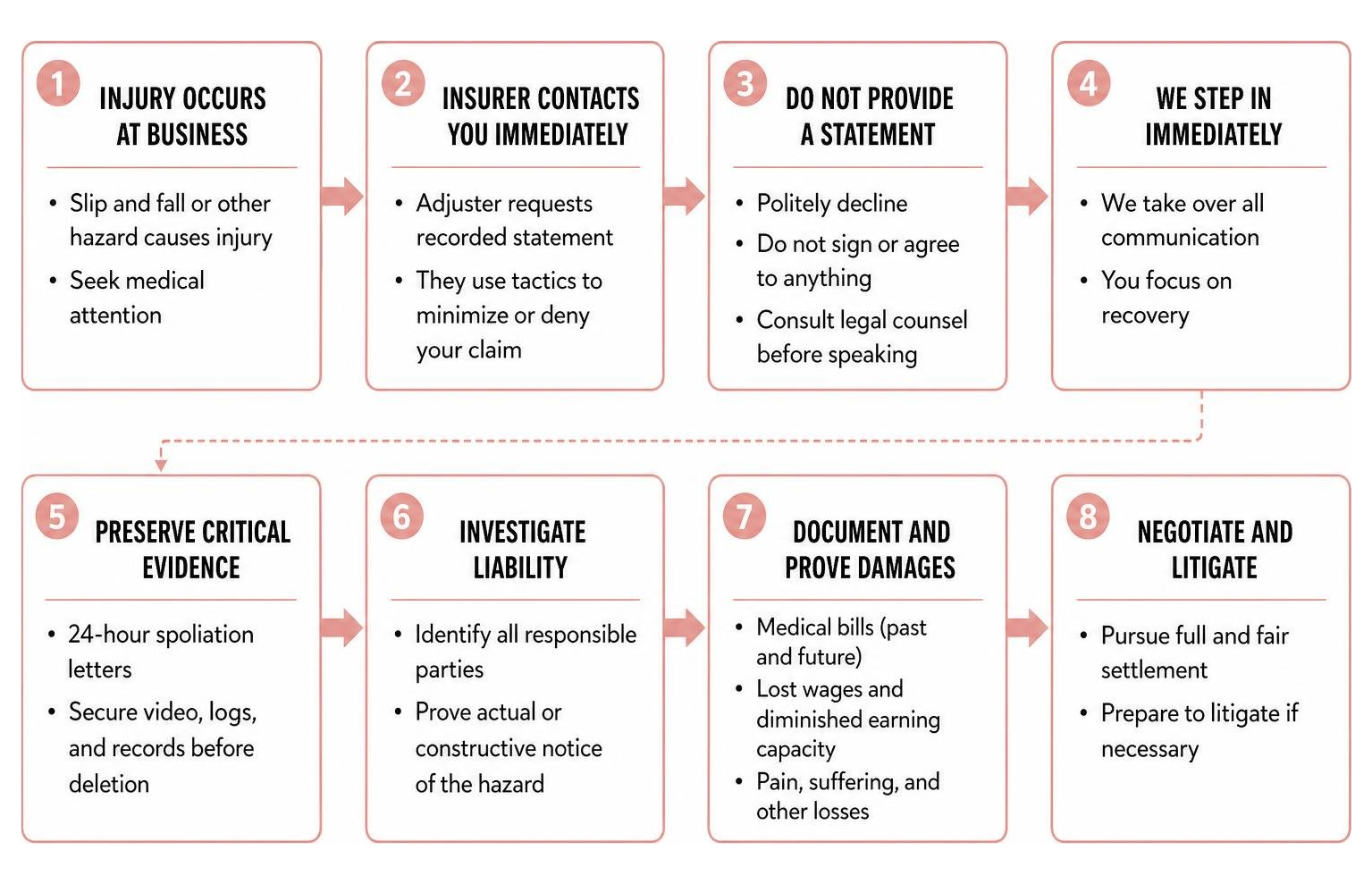
When you retain our firm, we initiate immediate steps to protect your claim:
- 24-Hour Evidence Preservation: We issue formal spoliation letters within 24 hours of retention to compel businesses to preserve store security video, employee shift logs, cleaning records, and maintenance logs before routine deletions occur.
- Comprehensive Liability Investigation: We establish that commercial property owners, landlords, or business operators had actual or constructive notice of a dangerous condition and failed to address it.
- Accurate Damage Calculations: We account for all past and future medical bills, lost wages, diminished earning capacity, rehabilitation costs, and non-economic pain and suffering.
- Strict Adherence to Filing Deadlines: While private property claims in Pennsylvania carry a two-year statute of limitations, claims involving municipal or government properties in Philadelphia require a formal notice of claim filed within six months. We ensure every statutory deadline is strictly met.
With a 98% success rate and over $50 million recovered for injury victims throughout the region, our rapid response team provides the assertive representation needed to hold negligent business owners accountable. We invite you to schedule a free consultation to discuss your case with us.
What Are the Most Frequently Asked Questions About Insurance Calls After a Fall?
Can an insurance adjuster legally force me to provide a recorded statement?
No. Under Pennsylvania law, you are under no legal obligation to provide a recorded statement to a third-party commercial property owner’s insurance company. While your own insurance policy might require cooperation for certain first-party claims, an adverse business’s insurer has no legal authority to compel your testimony outside of a formal deposition during active litigation.
What deadlines apply if the fall occurred on municipal or government-managed property in Philly?
If your fall occurred on a surface owned, operated, or maintained by a government agency—such as a sidewalk abutting a municipal building, a public transit concourse, or a city park—you must serve a formal written notice of claim within six months of the accident date under the Pennsylvania Political Subdivision Tort Claims Act. Failing to file this notice within six months can permanently bar your claim, regardless of the two-year general personal injury deadline.
When is the best time to hire a lawyer after an accident in a business?
You should consult an attorney within the first 24 to 48 hours following an incident. Retaining a dedicated slip and fall lawyer in Philadelphia, PA right away stops direct insurer calls, protects your rights, and ensures time-sensitive evidence—like commercial security footage—is formally preserved before it is deleted.
Protect Your Legal Rights After a Philadelphia Slip and Fall
Dealing with an uninvited phone call from an insurance adjuster while dealing with medical appointments and painful injuries can put your legal claim at risk. This is especially critical when a fall involves an older adult at a business or care facility, where adjusters often attempt to blame age-related frailty or pre-existing conditions rather than hazardous property maintenance—making guidance from an elder abuse attorney or injury advocate vital to protecting their recovery.
To keep your claim on track:
- Prioritize a comprehensive medical evaluation at a local hospital or clinic, following all treatment instructions carefully.
- Decline any recorded interview requests from commercial insurance representatives.
- Preserve physical evidence, including the unwashed clothing and footwear you wore during the fall.
- Avoid posting about your fall, daily activities, or recovery progress on social media platforms.
- Let an experienced legal team handle all insurer correspondence and settlement discussions on your behalf.
Whether your case involves dangerous store conditions or requires the dedicated advocacy of an elder abuse attorney to protect a vulnerable senior from insurer exploitation, swift action makes all the difference. Before you take that next call or sign any insurance documents, protect your rights and get the compensation you deserve by requesting your Philadelphia injury attorney free consultation with our team today.