 Skip to content
What Are Pain and Suffering Damages in a Philadelphia Personal Injury Case?
Philadelphia personal injury lawyers calculate pain and suffering settlement amounts primarily through two methods: the Multiplier Method, which multiplies total economic damages by a factor between 1.5 and 5+ based on injury severity, and the Per Diem Method, which assigns a daily dollar rate for each day of recovery until Maximum Medical Improvement. Under Pennsylvania civil law, pain and suffering damages fall under the category of non-economic damages. When you suffer an injury due to someone else’s negligence—whether in a collision on the Schuylkill Expressway or a slip and fall on Market Street—the law allows you to seek compensation for both your financial losses and your personal suffering.
Non-economic damages address the intangible, human impact of an injury:
- Physical Pain: The ongoing physical distress, aching, acute agony, and discomfort caused by bodily trauma and subsequent medical procedures.
- Mental Anguish: Psychological consequences including anxiety, post-traumatic stress disorder (PTSD), severe depression, sleep disturbances, and fear.
- Physical Impairment and Disability: The inability to move freely, complete routine tasks, or return to physical independence.
- Disfigurement and Scarring: Visible physical changes, surgical scars, or amputations that affect self-image and lifestyle.
- Loss of Life’s Pleasures: The inability to participate in hobbies, play with your children, enjoy family outings in Fairmount Park, or engage in social activities you once loved.
Non-economic damages frequently account for 50% to 80% of total personal injury recoveries.
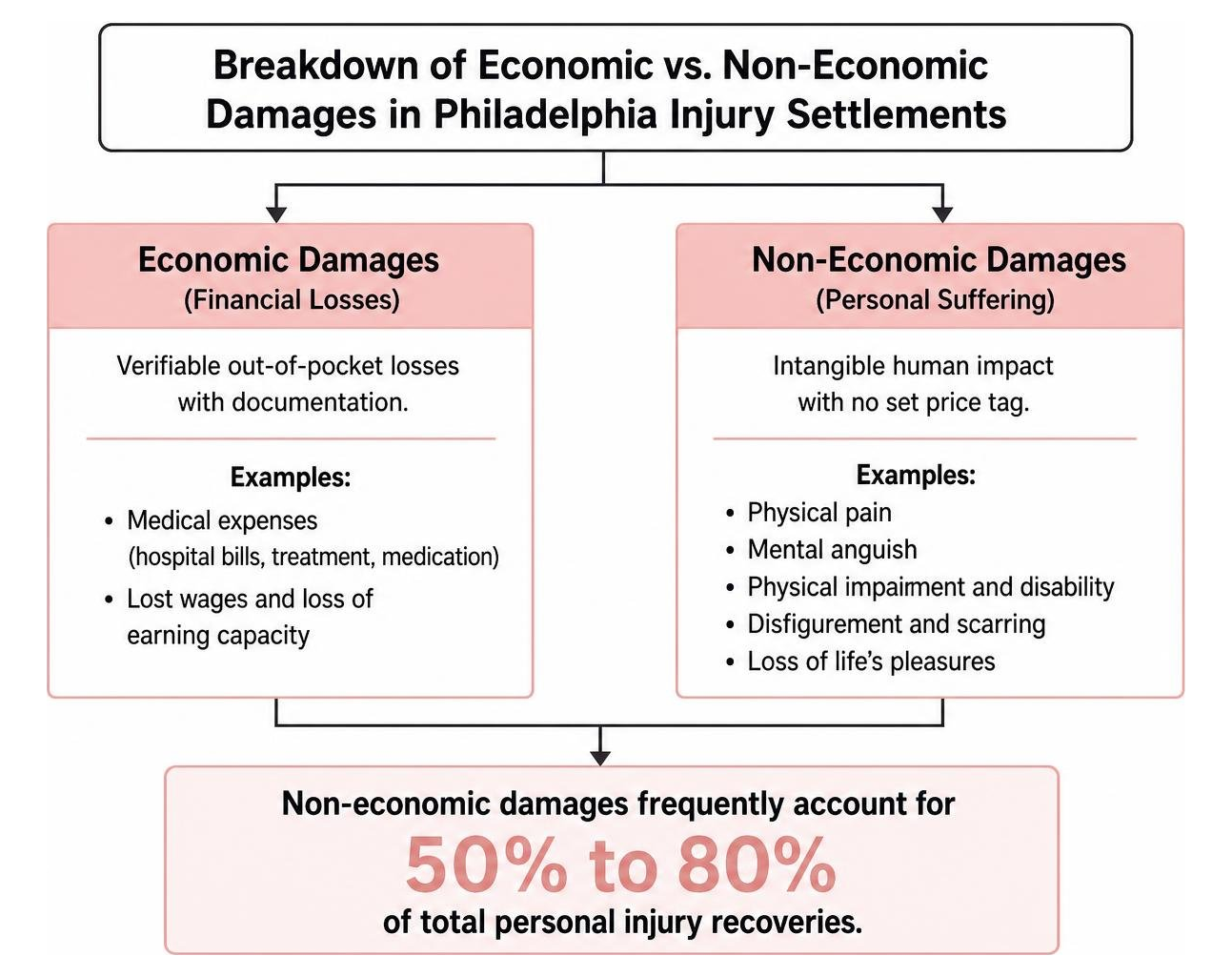
While economic damages are verified with hospital invoices from facilities like Penn Presbyterian Medical Center or Thomas Jefferson University Hospital and pay stubs showing lost wages, non-economic damages carry no set price tag. Our role when representing you is to quantify these subjective experiences into a compelling, evidence-backed monetary figure that insurers and civil juries must take seriously.
How Do Philadelphia Lawyers Calculate Pain and Suffering Amounts?
Calculating non-economic damages requires an understanding of trial valuation, local verdict histories, and negotiation math. We primarily use two foundational approaches: the Multiplier Method and the Per Diem Method.
1. The Multiplier Method
The Multiplier Method is the most widely utilized formula in personal injury claims. We calculate your total economic damages (accumulated medical expenses, future medical projections, and lost wages) and multiply that sum by a figure ranging between 1.5 and 5+, depending on the severity and permanence of your injury.
- Minor Injuries (1.5x – 2x multiplier): Soft tissue sprains, minor whiplash, or brief contusions that resolve completely within a few weeks without surgery.
- Moderate Injuries (2x – 3x multiplier): Non-displaced fractures, moderate concussions, or joint sprains requiring months of physical therapy.
- Significant Injuries (3x – 4x multiplier): Herniated discs requiring epidural steroid injections or surgical intervention, complex bone fractures requiring hardware, or injuries leaving lasting limitations.
- Severe to Catastrophic Injuries (4x – 5x+ multiplier): Traumatic brain injuries (TBIs), spinal cord damage, severe burns, or permanent nerve damage that fundamentally alters your quality of life.
2. The Per Diem (Daily Rate) Method
The Per Diem method assigns a specific dollar amount to every day you experience pain from the date of the incident until you reach Maximum Medical Improvement (MMI).
To justify a per diem rate to an insurance adjuster or jury, we often align the daily figure with your actual daily earnings (e.g., $200 to $500 per day), arguing that enduring severe physical pain for 24 hours is worth at least what you would earn during a standard workday. If an injured worker endures 180 days of intense recovery before returning to baseline health at a daily rate of $250, the pain and suffering demand equals $45,000 ($250 × 180 days).
Choosing the Right Method
We analyze the trajectory of your medical recovery to determine which formula maximizes your recovery. If you have an injury with a clear, predictable recovery timeline, a per diem calculation can produce a strong outcome. If you face permanent impairment, ongoing surgical care, or lifelong limitations, the multiplier method properly captures the scale of future suffering.
Victims often utilize an interactive pain and suffering calculator to gauge baseline financial expectations before entering legal negotiations.
Real-World Philadelphia Benchmark Calculations
To understand how these numbers function in practice, consider two common injury scenarios in our local courts:
- Surgical Herniated Disc: A driver struck near Roosevelt Boulevard incurs $85,000 in economic losses (spinal surgery, post-operative therapy, and four months of lost earnings). Applying a standard 3.5x multiplier yields $297,500 in pain and suffering, bringing the total settlement estimate to $382,500.
- Mild Traumatic Brain Injury with Cognitive Deficits: A worker injured by falling equipment sustains $200,000 in medical and long-term vocational losses. Applying a 4.0x multiplier reflects lasting memory issues and headaches, generating $800,000 in pain and suffering for a total recovery valuation of $1,000,000.
Understanding the baseline formulas is essential for demystifying personal injury damages as you prepare your claim.
| Injury Type | Typical Severity Level | Multiplier Range | Estimated Pain & Suffering Value |
|---|---|---|---|
| Soft Tissue Sprain / Whiplash | Minor | 1.5x – 2.0x | $10,000 – $50,000 |
| Simple Bone Fracture | Moderate | 2.0x – 3.0x | $25,000 – $100,000 |
| Herniated Disc (with Surgery) | Significant | 3.5x – 4.5x | $100,000 – $350,000 |
| Compound / Multiple Fractures | Significant / Severe | 3.0x – 4.5x | $75,000 – $250,000 |
| Mild-to-Moderate TBI | Severe | 4.0x – 5.0x | $200,000 – $800,000 |
| Spinal Cord Injury / Paralysis | Catastrophic | 5.0x+ | $1,000,000 – $5,000,000+ |
Why Do Philadelphia Juries and Venues Award Higher Pain and Suffering Settlements?
Venue plays a decisive role in the ultimate value of any personal injury claim in Pennsylvania. Cases filed in the Philadelphia County Court of Common Pleas historically resolve for higher amounts than identical claims filed in rural Pennsylvania counties.
Several factors drive this difference:
- Urban Jury Demographics: Philadelphia jurors generally demonstrate greater empathy toward injured plaintiffs facing institutional defendants and large insurance carriers. They recognize the high cost of living, medical expenses in major metropolitan health systems, and the profound disruption severe injuries cause in a urban environment.
- Absence of Statutory Damage Caps: Pennsylvania law imposes no statutory financial cap on pain and suffering damages for motor vehicle collisions, premises liability, and general negligence claims against private entities. Unlike states that arbitrarily limit non-economic recoveries to fixed amounts, Philadelphia juries are free to award amounts that fully reflect the plaintiff’s true anguish.
- Comparative Fault Rules (42 Pa.C.S. § 7102): Pennsylvania operates under a modified comparative fault standard with a strict 51% bar. You can recover damages as long as your share of responsibility is 50% or less, though your recovery is reduced by your percentage of fault. If a jury awards $500,000 for pain and suffering but finds you 10% responsible for the crash on Broad Street, your net payout is $450,000.
Navigating these jurisdictional strengths requires insight into local court rules, which you can review further in our Philadelphia personal injury guide.
How Do Insurance Companies Attempt to Minimize Pain and Suffering Payouts?
Insurance companies do not calculate pain and suffering based on empathy; they rely on computer software designed to protect their profit margins. Carriers such as State Farm, Allstate, and Liberty Mutual frequently use algorithmic evaluation programs like Colossus.
These software systems convert your medical records, injury codes, and physician notes into numerical points. The software deliberately excludes the human elements of your case—such as missing your daughter’s graduation or being unable to sleep due to chronic back spasms. Because of these automated valuation tools, initial settlement offers from insurance adjusters are routinely 30% to 50% below fair market value.
Common tactics insurers use against Philadelphia victims include:
- Exploiting Treatment Gaps: If you delayed seeking care after a crash or missed physical therapy sessions due to work or childcare, adjusters claim your pain was minimal.
- Blaming Degenerative Changes: For spinal disc injuries, insurers routinely argue that MRI findings represent “normal age-related wear” rather than trauma from the collision.
- Discounting Subjective Symptoms: Insurers dismiss reports of headaches, radiating nerve pain, depression, and anxiety because they cannot be seen on an X-ray.
Overcoming these tactics requires aggressive advocacy. As an established personal injury lawyer in Philadelphia, PA, our team counters computer models with comprehensive medical narratives, sworn witness statements, and detailed documentation of your daily limitations. With over $50 million recovered for our clients and a 98% success rate, our firm knows how to dismantle insurer software assessments and demand fair compensation.
What Crucial Evidence Increases the Value of Your Philadelphia Settlement?
To secure a settlement near the top of the multiplier scale, you must provide objective, consistent proof of your non-economic losses. We advise clients to assemble several critical evidentiary records:
- Detailed Pain and Recovery Journals: Document your daily pain levels on a 1-to-10 scale, record missed family events, describe interrupted sleep, and note specific tasks you could not perform without assistance.
- Consistent Medical and Therapy Documentation: Attend all scheduled physical therapy, chiropractic, and medical appointments. Detailed therapy notes provide a continuous written record of your physical struggle and gradual recovery.
- Psychological and Psychiatric Evaluations: If you experience accident-related trauma, counseling records from mental health providers establish documented proof of mental anguish, anxiety, or depression.
- Before-and-After Evidence: Photographs of your injuries, surgical scarring, and recovery milestones, combined with statements from coworkers, friends, and neighbors detailing how your demeanor and abilities changed after the incident.
- AMA Impairment Ratings: Once you reach Maximum Medical Improvement, an evaluation assessing your permanent functional loss under American Medical Association guidelines provides strong support for higher multipliers.
Securing maximum value requires transforming clinical records into a compelling human story. Discover how a lawyer turns your anguish into a settlement to ensure your voice is heard during negotiations.
If you are unsure of the potential value of your claim, contact J. Fine Law to evaluate what your case is worth through a no-obligation free consultation.
What Are the Most Common Questions About Philadelphia Pain and Suffering Settlements?
How does Pennsylvania’s 51% comparative negligence rule affect my pain and suffering award?
Under Pennsylvania’s comparative negligence statute (42 Pa.C.S. § 7102), your pain and suffering compensation is reduced in proportion to your percentage of fault. For example, if your total non-economic damages are valued at $200,000 and you are found to be 20% at fault for an accident at an intersection along Vine Street, your recovery is reduced by 20% ($40,000), leaving you with $160,000. However, if your share of liability is determined to be 51% or greater, you are completely barred from receiving any financial recovery under state law.
Is there a legal cap on pain and suffering damages for car accident claims in Philadelphia?
No. Pennsylvania statutory law places no maximum financial limit or statutory cap on non-economic damages in personal injury claims arising from motor vehicle crashes, commercial truck collisions, premises liability, or general negligence involving private individuals and corporations. The amount of compensation you can receive is determined entirely by the evidence, the skill of your legal counsel, and the judgment of the jury or insurance carrier.
When should a lawyer use the per diem method instead of the multiplier method?
The per diem approach is generally most effective when an injured person suffers an acute, highly painful injury with a defined, predictable recovery timeline—such as a broken arm or soft tissue injury that heals completely within six to nine months. In contrast, for permanent disabilities, traumatic head injuries, or conditions requiring lifelong medical care, the multiplier method is preferred because it accounts for ongoing future suffering across the remainder of the victim’s life.
Maximize Your Pain and Suffering Recovery with J. Fine Law
Suffering a serious injury or watching a vulnerable family member endure mistreatment disrupts every facet of your life. Insurance carriers and care facilities routinely attempt to reduce these lived experiences to line items in automated valuation software, offering settlements that fall far short of covering long-term pain and suffering.
Whether your case involves a vehicle collision, a fall, or severe nursing home neglect and elder abuse, partnering with a seasoned elder abuse attorney and personal injury advocate ensures your family’s rights remain protected. Our team at J. Fine Law delivers rapid attorney response, individualized attention, and assertive representation. We have recovered over $50 million in verdicts and settlements across Pennsylvania, maintaining a 98% success rate.
We operate on a contingency fee basis, meaning you pay zero legal fees unless we successfully resolve your claim. Contact an elder abuse attorney and injury litigator at our firm today to schedule your free consultation and demand the full compensation your family deserves.