 Skip to content
A Quick Start Guide to Construction Site Injury Legal Rights in Philadelphia, PA
A construction site injury can leave a worker facing medical bills, missed paychecks, and pressure from insurers while they are still trying to heal.
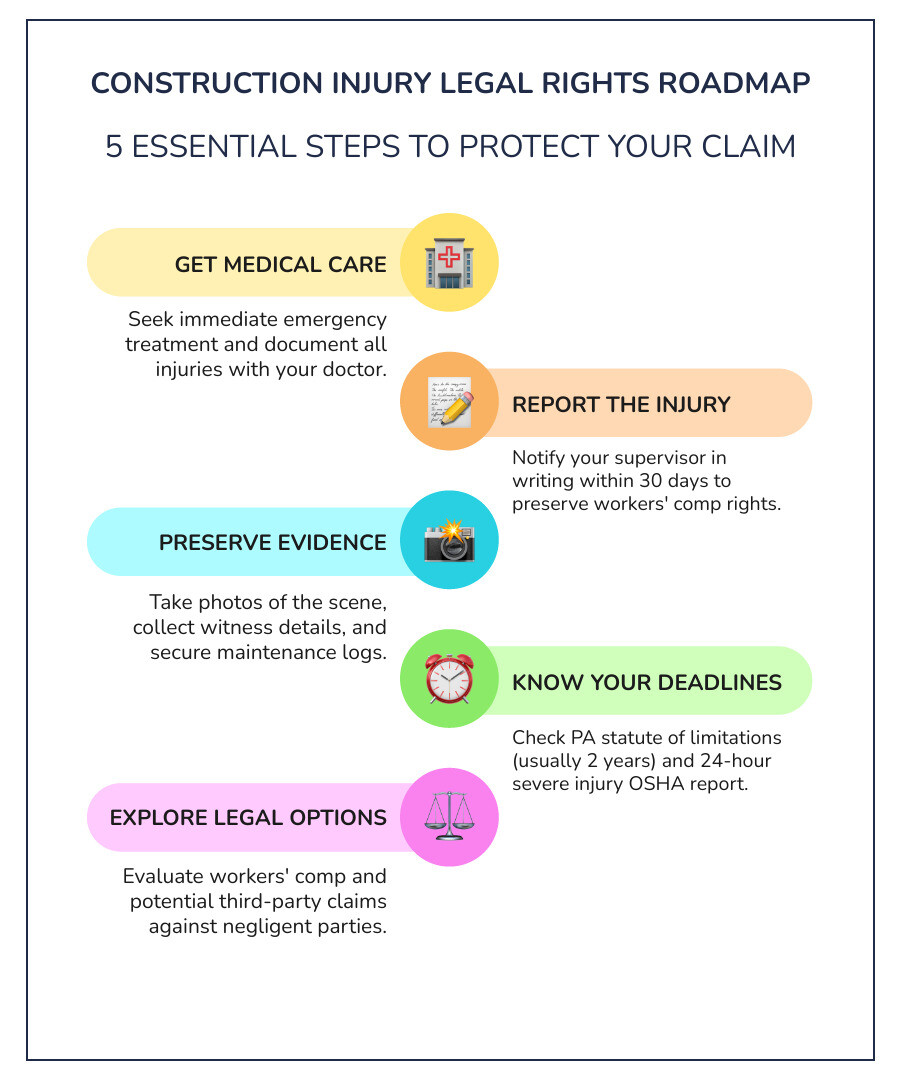
An injured construction worker may have the right to workers’ compensation benefits and, in some cases, a separate claim against a negligent party other than their employer. Important early steps include getting medical care, reporting the injury, preserving evidence, and learning the deadlines that apply to the claim.
Construction work has serious risks. Falls, falling objects, electrical contact, and machinery or trench accidents are among OSHA’s Fatal Four hazards. Falls alone caused 37% of construction deaths in 2021. When a preventable incident happens, responsibility may extend beyond the direct employer to a general contractor, property owner, subcontractor, equipment maker, or another party.
I am Jason Fine, a trial attorney with more than 25 years of experience representing people harmed in a construction site injury and other serious accident claims. The sections below explain the rights, evidence, and legal paths that may matter after a job-site accident.
Simple construction site injury glossary:
- Philadelphia premises liability lawyer
- building code violations
- personal injury attorney Philadelphia
Understanding Common Workplace Hazards and OSHA’s Fatal Four
Every year, U.S. construction workers sustain more than 200,000 work-related injuries, with roughly 1,000 resulting in fatalities and another 80,000 requiring job restrictions or days away from work. According to federal safety data from the Bureau of Labor Statistics, construction accounts for nearly 20% of all fatal workplace incidents across the country.

Occupational Safety and Health Administration (OSHA) standards highlight four major hazard categories responsible for the vast majority of severe construction accidents:
- Falls from Heights: Falling from roofs, scaffolding, ladders, or unprotected edges remains the single leading cause of death, accounting for 37% of construction fatalities.
- Struck-by Incidents: Objects dropping from upper floors, swinging crane loads, or rolling vehicles account for about 8% of fatalities. A two-pound wrench dropped ten stories hits with destructive force.
- Electrocution: Contact with overhead power lines, energized circuits, or ungrounded tools causes roughly 8% of construction deaths.
- Caught-in or -Between: Trench wall collapses (where soil weighs roughly 3,000 pounds per cubic yard) or heavy equipment entanglements account for about 5% of deaths.
Structural collapses and machinery entanglements demonstrate how fast a routine shift can become life-threatening. Reports of scaffolding or formwork failures, such as a major structural collapse like the Worker dies in scaffolding collapse at Jurong Port construction site | The Straits Times incident, show the devastation that occurs when safety protocols are bypassed. To learn more about standard protections across industrial worksites, consult our Workplace Accident Law Ultimate Guide.
Preventing Fatal Four Accidents on Job Sites
Preventing life-threatening hazards requires strict compliance with established job-site rules. OSHA standards dictate that fall protection must be provided whenever a worker operates at heights of six feet or greater (or ten feet on scaffolding).
Key prevention measures include:
- Mandatory 100% tie-off rules using double-lanyard personal fall arrest systems.
- Thorough pre-shift inspections of ladders, elevated platforms, and heavy equipment.
- Strict Lockout/Tagout (LOTO) procedures during machinery maintenance and electrical work.
- Proper excavation box installation and trench sloping for deep digging.
Real-world legal outcomes highlight the importance of safety compliance. For example, severe fall incidents demonstrate how improper training and hardware setup can lead to catastrophic losses, as seen when an Injured Ironworker Settles Construction Fall Case at Fermilab for $40M | Engineering News-Record.
Long-Term Impacts of a Severe Construction Site Injury
Severe construction accidents often cause permanent, life-altering physical and financial consequences. Between 2015 and 2021, construction accounted for over 18% of all severe workplace injury reports submitted to OSHA, including amputations, eye losses, and emergency hospitalizations.
Common long-term consequences include:
- Traumatic Brain Injuries (TBIs): Caused by falls or heavy head impacts, leading to cognitive impairment, memory loss, and personality changes.
- Spinal Cord Damage: Partial or total paralysis requiring lifelong personal care assistance and modified living arrangements.
- Traumatic Amputations: Loss of limbs from unguarded saws or heavy machinery entrapping limbs, detailed further in our guide to Amputation Work Injury.
- Diminished Earning Capacity: Inability to return to physical labor, drastically reducing a worker’s lifelong earning potential.
Step-by-Step Actions Immediately After a Construction Site Injury

What you do in the hours immediately following a job-site injury impacts both your health recovery and your legal rights.
- Seek Immediate Emergency Medical Care: Get evaluated right away at an emergency facility such as Thomas Jefferson University Hospital or Penn Presbyterian Medical Center in Philadelphia. Inform the treating doctor that your injury occurred on a construction site.
- Report the Incident to Your Direct Supervisor: Give written notification of the accident to your employer or site manager as soon as possible.
- Preserve physical evidence: Retain your damaged hardhat, torn workwear, safety harness, boots, or broken tools exactly as they were during the incident.
- Take Scene Photographs and Videos: If physically able, capture photos of the hazard, machinery, lack of guardrails, weather conditions, and warning signs before the site is cleaned up.
- Get Legal Assistance: Reach out to our team at J. Fine Law so we can launch an immediate investigation. Learn more about navigating post-accident decisions through our guide on Work Accident Help.
Critical Evidence Needed to Secure Your Claim
Building a strong case requires clear physical and documentary proof showing how the accident happened and who controlled the site conditions.
Key evidence includes:
- High-resolution photographs and videos of the scene and equipment involved.
- Contact details and statements from eyewitnesses, co-workers, and independent contractors.
- Equipment inspection, maintenance, and repair logs.
- Official employer incident reports and site supervisor shift logs.
- Emergency room admissions paperwork, diagnostic imaging scans, and doctor treatment notes.
- Recent pay stubs and tax records demonstrating pre-injury income levels.
Financial Recovery Options and Legal Protections
Workers injured on job sites generally have two distinct legal pathways for financial recovery: workers’ compensation claims and third-party personal injury lawsuits.
| Feature / Benefit | Workers’ Compensation Claim | Third-Party Personal Injury Lawsuit |
|---|---|---|
| Fault Requirement | No-fault system (fault does not matter) | Requires proof of third-party negligence |
| Eligible Defendants | Direct Employer / Employer Insurance | Third parties (General Contractor, Site Owner, Equipment Maker) |
| Medical Cost Coverage | 100% of reasonable & necessary care | Recoverable as part of past & future damages |
| Wage Replacement | Partial wages (typically around two-thirds) | Full past lost wages + future lost earning capacity |
| Pain and Suffering | Not covered | Fully recoverable |
| Punitive Damages | Not available | Available in cases of extreme gross negligence |
Workers’ comp provides vital immediate coverage, but it does not account for physical pain or emotional distress. When a third party’s negligence contributes to an accident, filing a civil lawsuit allows injured workers to seek full compensation. Speak with an experienced Work Injury Lawyer to evaluate your available remedies.
Understanding Construction Site Injury Liability and Fault
While workers’ compensation laws protect direct employers from personal injury lawsuits in most instances, multiple corporate entities oversee major commercial projects along Market Street or Broad Street.
Potentially liable third parties include:
- Property Owners and Developers: For failing to maintain safe premises or ignoring known hazards.
- General Contractors: For failing to enforce mandatory site safety rules across subcontractors.
- Negligent Subcontractors: Whose workers create dangerous conditions that harm other crews on site.
- Equipment Manufacturers: For design defects or missing emergency safety guards on heavy machinery.
- Architects and Engineers: For structural design defects leading to collapses.
For an extensive legal breakdown on identifying responsible site entities, read Building Site Accident: What to Do and Who’s Liable – LegalClarity.
OSHA Worker Rights and Anti-Retaliation Protections
Under federal law, construction workers have clear statutory rights regarding physical safety and reporting workplace hazards:
- Right to a Safe Workplace: Employers must provide conditions free from recognized serious hazards.
- Right to Safety Equipment: Employers must furnish required PPE (hardhats, eye protection, harnesses) at no cost to workers.
- Right to Refuse Dangerous Work: Workers may legally refuse unsafe assignments if there is an immediate risk of death or serious physical harm, the employer refuses to fix it, and there is no time to contact OSHA.
- Protection Against Retaliation: It is illegal for an employer to fire, demote, blackball, or discipline a worker for reporting a construction site injury or safety violation.
For detailed guidance on your employment protections, review our page on Injury at Work Rights.
Reporting Deadlines, Statutes of Limitations, and Risk Reduction Strategy
Time constraints govern workplace injury claims in Pennsylvania:
- Employer Injury Notice: In Pennsylvania, you must report your workplace injury to your employer within 21 days to receive retroactive benefits, and no later than 120 days to preserve your claim.
- OSHA Mandatory Employer Reporting: Employers must report any workplace fatality within 8 hours, and any amputation, inpatient hospitalization, or eye loss within 24 hours.
- Whistleblower Retaliation Complaints: Retaliation complaints must be submitted to OSHA within 30 days of the employer’s adverse action.
- Statute of Limitations: Third-party personal injury lawsuits in Pennsylvania generally must be filed within two years of the date of the accident.
To protect your rights, keep a calendar of all injury-related deadlines, and consult our guide on the Work Injury Statute of Limitations. If your accident occurred across state lines, review options with a Workplace Accident Lawyer NJ.
Construction firms can reduce site injuries by implementing routine risk audits, maintaining equipment, enforcing mandatory safety protocols, and ensuring clear communication across sub-trades.
Frequently Asked Questions About Workplace Accidents
What should I do if my employer retaliates against me for reporting an injury?
If your employer takes negative action against you for reporting an injury or safety issue, file an official whistleblower complaint with OSHA within 30 days. You should also document every communication, keep performance records, and contact a personal injury lawyer immediately to protect your income and legal claims.
Can I sue my general contractor if I am a subcontractor’s employee?
Yes. While workers’ compensation laws protect your direct employer from personal injury claims, general contractors often owe an independent duty to maintain overall site safety. If a general contractor’s negligence or failure to enforce safety rules causes your injury, you can file a third-party personal injury lawsuit against them.
What is the deadline to report a severe workplace accident in Philadelphia, PA?
You should inform your employer immediately. In Pennsylvania, formal written notice must be given within 21 days for full retroactive benefits, and your right to benefits is lost if notice is not provided within 120 days. For third-party personal injury lawsuits, Pennsylvania sets a strict two-year statute of limitations from the date of the incident.
Protecting Your Future After a Job Site Accident
A serious job-site injury can destabilize your physical health, career, and family finances. Understanding your legal rights is the first step toward taking control of your recovery. At J. Fine Law, our trial team brings a 98% success rate, rapid response times, and over $50 million recovered for injury victims. We investigate complex construction site accidents, establish party liability, and fight for full financial compensation. Beyond workplace injury claims, our practice is also dedicated to protecting vulnerable family members—if an aging relative has experienced harm or neglect, consulting with an elder abuse attorney can help safeguard their rights and secure justice.
If you or a loved one suffered a construction site injury or require guidance from a dedicated elder abuse attorney in Philadelphia, PA, do not navigate insurance adjusters and legal challenges alone. Reach out to our team at J. Fine Law today to discuss your case and take the first step toward securing your future.